CM Pema Khandu: Arunachal's Heritage Speaks for Itself

Synopsis
On Swachh Bharat Diwas 2026 in Itanagar, Arunachal Pradesh CM Pema Khandu invoked ancient sites Bhismaknagar and Naksaparbat to declare that the state's archaeological heritage is proof of its enduring Indian civilisational identity — one that 'need not be explained to anyone.'
Key Takeaways
Pema Khandu made the statement at a Swachh Bharat Diwas 2026 event in Itanagar on October 2, 2026 .
He cited Bhismaknagar (Lower Dibang Valley) and Naksaparbat in Dissing-Paso as anchors of Arunachal's civilisational heritage.
The statement carries implicit geopolitical weight given China's long-standing territorial claims over large parts of Arunachal Pradesh .
Khandu framed the heritage record as self-evident: 'Our history speaks for itself.
We need not explain it to anyone.' The remarks reflect a BJP-led dual strategy of physical infrastructure investment and cultural identity assertion in the northeast border state.
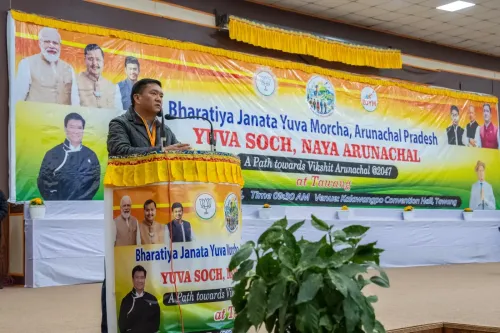
On Swachh Bharat Diwas 2026, Arunachal Pradesh Chief Minister Pema Khandu stood in Itanagar and delivered a pointed cultural declaration — invoking ancient sites from Bhismaknagar to Naksaparbat in Dissing-Paso to assert that the state's archaeological record is its own unanswerable argument.
From Bhismaknagar to Naksaparbat: the sites behind the statement
Bhismaknagar, located in the Roing area of Lower Dibang Valley district, is one of the most significant archaeological sites in the northeastern region — a fort complex tied to Puranic legend and considered evidence of early settled civilisation in the Brahmaputra valley. Naksaparbat, in the Dissing-Paso area, represents the state's lesser-known but equally rich heritage trail in its western reaches. Together, Khandu invoked them as bookmarks of a civilisational continuum that runs deep into recorded Indian history.
His message was deliberate and layered: 'Our history speaks for itself. We need not explain it to anyone.' In a border state whose territorial identity has repeatedly been questioned — most vocally by China — the framing of archaeological heritage as sovereign proof carries unmistakable weight. The stones, he implied, have already made the argument.
Swachh Bharat Diwas as a stage for civilisational assertion
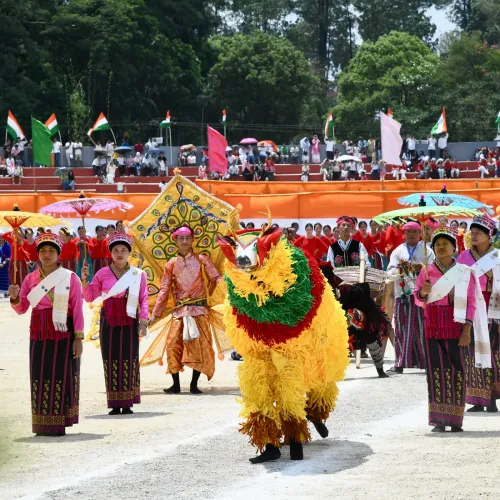
October 2, observed nationally as Swachh Bharat Diwas on the birth anniversary of Mahatma Gandhi, is typically associated with cleanliness drives and sanitation pledges. Khandu's choice to anchor a statement about civilisational heritage to this occasion — at an event in Itanagar — signals that the day was used as a broader platform for cultural pride and identity politics in the northeast.
For a state like Arunachal Pradesh, whose approximately 84,000 square kilometres are claimed in large part by China as 'South Tibet', every assertion of deep Indian civilisational roots is both cultural and geopolitical. The BJP government in the state has consistently pursued a dual strategy: accelerating physical infrastructure to integrate the region and amplifying historical and cultural narratives to consolidate its Indian identity.
A message without an addressee — and that is precisely the point
Khandu did not name China, did not reference any diplomatic episode, and did not address any specific provocation. That restraint is itself the rhetoric. By saying 'we need not explain it to anyone', he positioned Arunachal Pradesh's civilisational credentials as self-evident — above debate, above external adjudication. It is a confidence play, and it lands on home turf on a nationally significant date.
As India continues to invest heavily in border infrastructure across Arunachal — roads, tunnels, and connectivity projects that have transformed access to once-remote districts — the cultural narrative around heritage sites like Bhismaknagar gains new strategic resonance. The infrastructure binds the land to the nation's body; the heritage narrative binds it to the nation's memory. Pema Khandu, on the banks of the Itanagar ceremonial circuit, was doing both at once.
Point of View
A nationally resonant occasion, he amplified reach without making a purely confrontational statement. The 'we need not explain' framing is classic sovereignty assertion through silence — denying the premise that any explanation is owed. It fits a broader BJP pattern of using cultural depth as territorial argument in the northeast, where infrastructure and identity are treated as co-equal instruments of integration.
NationPress
2 Oct 2026
Frequently Asked Questions
What is Bhismaknagar and why is it significant for Arunachal Pradesh?
Bhismaknagar is an ancient fort complex in the Lower Dibang Valley district of Arunachal Pradesh, linked to Puranic legend and considered one of the most important archaeological sites in northeastern India. CM Khandu cited it as evidence of the state's deep civilisational ties with India.
Why did Pema Khandu talk about heritage on Swachh Bharat Diwas 2026?
Swachh Bharat Diwas , observed on October 2 to mark Mahatma Gandhi's birth anniversary, served as a public platform for CM Pema Khandu to make a broader statement about Arunachal Pradesh's civilisational and cultural identity, connecting national pride with the state's archaeological legacy.
Is Naksaparbat in Dissing-Paso an archaeological site in Arunachal Pradesh?
Naksaparbat , located in the Dissing-Paso area of Arunachal Pradesh, is one of the state's heritage sites cited by CM Khandu as part of the region's enduring archaeological record that reflects its connection to India's civilisational history.
What is the geopolitical context of CM Pema Khandu's heritage statement?
China lays claim to large parts of Arunachal Pradesh , calling it 'South Tibet.' CM Pema Khandu's assertion that the state's archaeological heritage reflects its Indian civilisational roots — and 'need not be explained to anyone' — carries implicit weight as a sovereignty argument in that context.
What sites did Pema Khandu mention in his Swachh Bharat Diwas 2026 speech?
CM Pema Khandu specifically mentioned Bhismaknagar and Naksaparbat in Dissing-Paso as representative archaeological sites that demonstrate Arunachal Pradesh's deep and enduring connection with India's shared civilisational heritage.