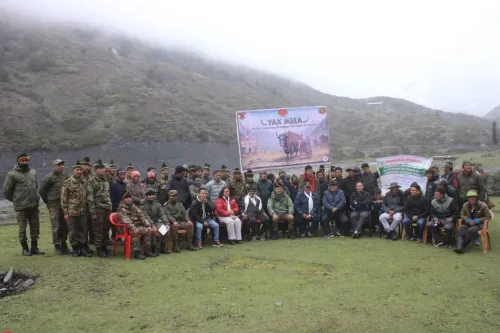
CM Pema Khandu backs yak herders' welfare at ICAR-NRC Dirang event

Synopsis
Arunachal Pradesh CM Pema Khandu virtually attended a highland livestock programme by ICAR-NRC Dirang, the Yak Federation of India and Ladakh's animal husbandry department on 27 July 2026, calling yak herders integral to Himalayan livelihoods and border security.
Key Takeaways
CM Pema Khandu virtually attended the Highland Livestock Production and Healthcare programme on 27 July 2026 .
The event was jointly organised by ICAR-NRC Dirang , the Department of AH and Veterinary Services, Ladakh , and the Yak Federation of India .
Khandu described yak herders as integral to livelihoods, traditional knowledge and community sustenance in remote Himalayan frontier areas.
He explicitly linked the presence of yak herders along India's borders to national security and border-community resilience.
The ICAR-National Research Centre on Yak, Dirang was established in 1989 to support scientific yak husbandry in the eastern Himalayas.
The Chief Minister reaffirmed government commitment to scientific yak management, improved veterinary care and sustainable herder livelihoods.
Arunachal Pradesh Chief Minister Pema Khandu virtually attended a programme on Highland Livestock Production and Healthcare on Monday, 27 July 2026, organised by ICAR-National Research Centre on Yak, Dirang, in collaboration with the Department of Animal Husbandry and Veterinary Services, Ladakh, and the Yak Federation of India. The Chief Minister used the occasion to underline the strategic and cultural significance of yaks and their herders across India's high-altitude Himalayan frontier.
Context
Attending the event virtually, CM Khandu described yaks and their herders as 'an integral part of life in our high-altitude Himalayan regions,' noting their role in 'supporting livelihoods, preserving traditional knowledge and sustaining communities in some of the most remote frontier areas.' He added that the presence of yak herders along India's borders 'carries strategic significance, contributing in their own unique way to national security and the resilience of our border communities.'
The programme brought together three key institutions — a premier national research centre, a union territory's livestock department and a national herders' federation — signalling a cross-institutional push to address the intertwined challenges of animal health, pastoral livelihoods and border-area development.
Policy Backdrop
The ICAR-National Research Centre on Yak was established at Dirang, Arunachal Pradesh, in 1989 to provide scientific backing for yak husbandry across the eastern Himalayas. Over the decades, its mandate has expanded to cover breeding improvement, disease management and nutrition research suited to high-altitude agro-pastoral systems.
Central and state governments have increasingly framed high-altitude livestock programmes within a dual lens: livelihood security for transhumant pastoralists and strategic resilience in border zones. Arunachal Pradesh and Ladakh — both sharing sensitive international boundaries — have been at the centre of this policy convergence, with scientific interventions positioned alongside traditional knowledge systems to counter threats from climate variability, disease outbreaks and market exclusion.
The Yak Federation of India plays a critical advocacy role, linking herding communities to policy corridors and market networks, while pressing for conservation of the yak gene pool that underpins high-altitude pastoral economies.
Stakeholders and Impact
Yak herders — many belonging to tribal and transhumant communities in Arunachal Pradesh, Ladakh, Himachal Pradesh and Sikkim — are the primary beneficiaries of improved veterinary care and scientific management practices. Better animal health directly translates to higher productivity in meat, milk, fibre and draught work, improving household incomes in regions with limited economic alternatives.
The strategic dimension highlighted by CM Khandu reflects a growing recognition that pastoral communities in frontier zones serve as a human presence that reinforces India's border management. Healthy, economically viable herding communities are less likely to abandon high-altitude grazing grounds, maintaining a civilian footprint in areas of geopolitical sensitivity.
What's Next
CM Khandu reaffirmed the government's commitment to 'promoting scientific yak management, better veterinary care and sustainable livelihoods for our yak herders,' signalling continued state-level support for programmes of this nature. Future indicators to watch include state and central budget allocations for yak veterinary infrastructure and any new collaborative projects between ICAR centres and Himalayan union territories or states.
As climate pressures on high-altitude ecosystems intensify and border-area development gains renewed policy attention, the convergence of livestock welfare, traditional knowledge and national security in India's Himalayan regions is likely to attract greater institutional investment in the months ahead.
Point of View
Khandu is doing more than endorsing a livestock welfare scheme; he is positioning pastoral communities as active contributors to India's border management architecture. The three-way collaboration between a central research body, a union territory administration and a herders' federation also reflects the Centre's push for convergent institutional models in remote regions. If budget allocations follow the rhetoric, this event could mark a step-up in state-backed investment in Himalayan agro-pastoral systems.
NationPress
27 Jul 2026
Frequently Asked Questions
What is ICAR-NRC Dirang and what does it do?
The ICAR-National Research Centre on Yak, located at Dirang in Arunachal Pradesh, was established in 1989 to conduct scientific research on yak breeding, health and production systems for high-altitude regions of India.
Why did CM Pema Khandu attend the yak livestock programme?
CM Pema Khandu attended virtually to express government support for highland livestock welfare, highlighting the role of yak herders in sustaining livelihoods, preserving traditional knowledge and contributing to national security along India's Himalayan borders.
What is the Yak Federation of India?
The Yak Federation of India is a national body that represents yak herding communities, working on conservation of the yak gene pool, market linkages and policy advocacy for transhumant pastoralists across Himalayan states and union territories.
How are yak herders connected to India's border security?
Yak herders maintain a civilian presence in some of India's most remote high-altitude frontier zones, which contributes to the human footprint and community resilience along sensitive international boundaries, as noted by CM Khandu.
Which states and UTs are involved in yak husbandry programmes?
Arunachal Pradesh and Ladakh are the primary focus areas for collaborative yak husbandry programmes, though yak herding communities also exist in Himachal Pradesh and Sikkim across the Indian Himalayas.