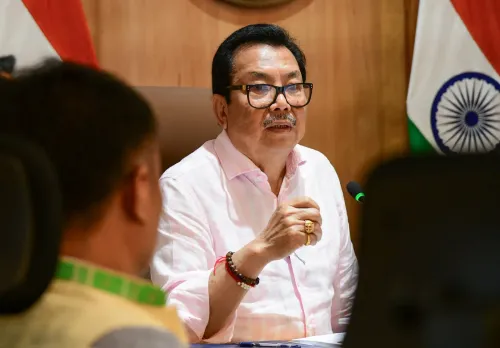
CM Pema Khandu Marks a Decade of Progress in Arunachal

Synopsis
The Chief Minister's Office of Arunachal Pradesh marked a decade of development under CM Pema Khandu on July 17, 2026, highlighting inclusive growth and sustainable progress across sectors in India's northeasternmost frontier state.
Key Takeaways
The Chief Minister's Office of Arunachal Pradesh posted on July 17, 2026 , marking a decade of development under CM Pema Khandu .
Pema Khandu has served as Chief Minister since July 2016 , making this nearly a full decade of continuous leadership.
The state's development is anchored in the central government's Act East Policy , active since 2014 , focusing on border connectivity and infrastructure.
Arunachal Pradesh borders China , Myanmar , and Bhutan , giving its development both welfare and strategic national significance.
Key areas of focus include road networks, hydropower projects, digital connectivity, and inclusive outreach to indigenous tribal communities.
State budget allocations for 2026-27 and flagship project updates will be the next key indicators of progress.
The Chief Minister's Office of Arunachal Pradesh on Friday, July 17, 2026, highlighted a decade of multi-sector development under Chief Minister Pema Khandu, citing inclusive growth and sustainable progress as the defining themes of the state's governance trajectory.
The official post stated that 'Arunachal Pradesh has witnessed significant progress across sectors over the past decade,' crediting Khandu's leadership and a commitment to 'inclusive development and sustainable growth' as the guiding principles behind the state's forward momentum.
Context
Pema Khandu has led Arunachal Pradesh since July 2016, when he assumed office following the death of his predecessor. Over nearly a decade in power, his administration has overseen the state's engagement with centrally sponsored schemes and the national Act East Policy, which prioritises border connectivity and infrastructure in India's northeastern frontier.
Arunachal Pradesh is India's northeasternmost state, sharing borders with China, Myanmar, and Bhutan. Its strategic location, diverse indigenous tribal communities, and rich biodiversity make governance both complex and consequential for national security and regional equity.
Policy Backdrop
The state's development narrative is closely tied to the central government's sustained push to reduce regional disparities in the northeast. Successive plans have channelled investment into road networks, hydropower projects, and digital connectivity across the region, with Arunachal among the primary beneficiaries given its frontier geography.
Political stability under the current leadership has coincided with accelerated execution of centrally sponsored schemes in the state. The Act East Policy, active since 2014, has provided the overarching framework for much of this infrastructure push, linking Arunachal's development to India's broader strategic engagement with Southeast Asia.
Stakeholders and Impact
The primary beneficiaries of this decade-long development push are Arunachal Pradesh's state residents and its numerous indigenous tribal communities, who have historically faced challenges of geographic isolation and limited access to public services. Improved connectivity and infrastructure directly affect livelihoods, access to healthcare, and educational opportunities in remote districts.
The state's progress also carries national significance. As a frontier state, Arunachal's development is intertwined with India's border management strategy and its diplomatic posture toward neighbouring countries, making inclusive growth here a matter of both welfare and strategic interest.
What's Next
Attention will now turn to Arunachal Pradesh's budget allocations for 2026-27 and the status of flagship road and hydropower projects under the central Act East framework. These will serve as concrete benchmarks against which the broad claims of a decade's progress can be assessed.
The state's ability to translate political stability and central funding into measurable outcomes for its tribal communities will define whether this development narrative holds up to scrutiny in the years ahead.
Point of View
Framing ten years of BJP rule in Arunachal as a story of purposeful, inclusive governance. The emphasis on 'sustainable growth' and 'confidence' signals an attempt to align the state's narrative with the broader national development vocabulary. For a frontier state long defined by its strategic vulnerabilities, projecting administrative momentum serves both domestic electoral purposes and a wider diplomatic signal about India's commitment to its northeastern periphery. Whether the rhetoric translates into verifiable outcomes for tribal communities remains the critical question that the 2026-27 budget cycle will begin to answer.
NationPress
17 Jul 2026
Frequently Asked Questions
How long has Pema Khandu been Chief Minister of Arunachal Pradesh?
Pema Khandu has served as Chief Minister of Arunachal Pradesh since July 2016 , making it nearly a decade of continuous leadership as of 2026.
What is the Act East Policy and how does it affect Arunachal Pradesh?
The Act East Policy , active since 2014 , is India's strategic framework for deepening ties with Southeast Asia, with Arunachal Pradesh as a key beneficiary through investments in border road networks, hydropower, and digital infrastructure.
Which countries share a border with Arunachal Pradesh?
Arunachal Pradesh shares international borders with China , Myanmar , and Bhutan , making it India's most strategically sensitive northeastern frontier state.
What sectors have seen development in Arunachal Pradesh under Pema Khandu?
Under CM Pema Khandu , Arunachal Pradesh has focused on road connectivity, hydropower projects, digital infrastructure, and inclusive outreach to its diverse indigenous tribal communities, largely through centrally sponsored schemes.
What should we watch for next in Arunachal Pradesh's development story?
The 2026-27 state budget allocations and progress updates on flagship road and hydropower projects under the Act East Policy framework are the key near-term indicators to watch.