CM Pema Khandu: New Plant Species Named After Him in Arunachal
Synopsis
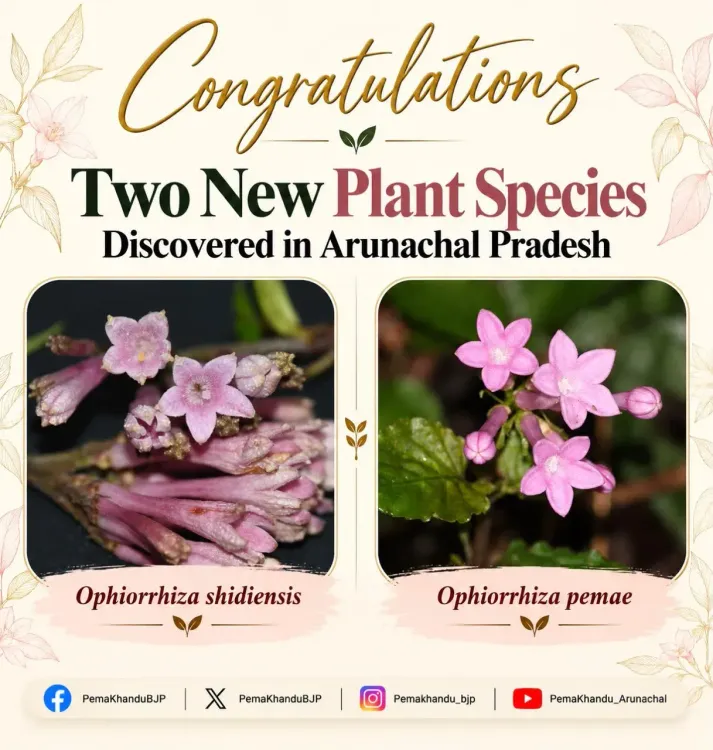
Botanists have discovered two new plant species — Ophiorrhiza shidiensis and Ophiorrhiza pemae — in the remote Vijoynagar area of Changlang district, Arunachal Pradesh. CM Pema Khandu congratulated the research team and acknowledged the honour of having Ophiorrhiza pemae named after him.
Key Takeaways
Two new plant species — Ophiorrhiza shidiensis and Ophiorrhiza pemae — have been discovered in Vijoynagar, Changlang district, Arunachal Pradesh .
The discovery is credited to researchers Krishna Chowlu , Renthlei Lalnunfeli , and Dr.
Vinay Kumar Sahani .
Ophiorrhiza pemae is named after Arunachal Pradesh Chief Minister Pema Khandu , permanently linking his name to the state's biodiversity record.
Vijoynagar lies in Changlang district on the Myanmar border, within the Eastern Himalayas biodiversity hotspot .
Arunachal Pradesh has been a consistent source of new-to-science species owing to its intact forests and difficult-to-survey terrain.
Formal peer-reviewed publication of the species descriptions and potential follow-up surveys by the Botanical Survey of India are the next steps to watch.
Deep inside Vijoynagar — one of India's most remote corners, tucked into the forested frontier of Changlang district, Arunachal Pradesh — botanists have documented two plant species that science had never seen before. On Friday, 23 October 2026, Arunachal Pradesh Chief Minister Pema Khandu congratulated the research team and acknowledged a rare personal honour: one of those species bears his name.
The two newly discovered species belong to the genus Ophiorrhiza — a group of flowering plants in the coffee family found across tropical Asia — and have been named Ophiorrhiza shidiensis and Ophiorrhiza pemae. The discovery is credited to Krishna Chowlu, Renthlei Lalnunfeli, and Dr. Vinay Kumar Sahani. CM Khandu wrote: 'I sincerely thank the research team for naming one of these newly discovered plant species, Ophiorrhiza pemae, in my name.'
Why Vijoynagar matters to global biodiversity science
Vijoynagar is not just remote — it is almost mythically isolated, accessible for years only by air or multi-day trek through dense forest. It sits at the southeastern tip of Changlang district, sharing a long border with Myanmar, within the Eastern Himalayas biodiversity hotspot — one of only 36 such hotspots on Earth, and among the richest for flowering plant diversity anywhere in the Indo-Pacific. The combination of altitude gradients, intact forest cover, and minimal human disturbance makes it a prime target for taxonomic surveys.
Arunachal Pradesh has delivered a steady stream of new-to-science plant and animal species over the past two decades, driven by field expeditions from Indian research institutions. The Ophiorrhiza genus alone has seen multiple new species described from northeastern India in recent years, reflecting how much of the region's biodiversity remains formally undocumented.
The tradition of naming species after people and places
Taxonomists routinely name newly described taxa after local leaders, conservation advocates, or geographic sites — a practice that carries strategic intent beyond sentiment. A species named after a sitting chief minister draws political and public attention to a specific ecosystem, subtly amplifying the case for its protection. Ophiorrhiza pemae now places Pema Khandu's name permanently in the scientific record, linking his tenure to the biodiversity heritage of the state he governs.
Khandu acknowledged both the recognition and the larger mission behind it, expressing 'sincere gratitude to the entire research team for their valuable work in documenting Arunachal Pradesh's rich natural heritage.' The next milestone for this discovery is peer-reviewed publication of the formal species descriptions — and potentially, follow-up surveys by the Botanical Survey of India in Changlang that could yield further finds from the same terrain.
Two new species. One forgotten frontier. Science just drew a sharper map of India's wild northeast.
Point of View
Which has emphasised the state's strategic and ecological significance, the discovery offers a rare soft-power moment: an internationally documented contribution to global biodiversity science from India's far northeast. More broadly, the steady flow of new species from the Eastern Himalayas hotspot makes a quiet but powerful argument for sustained taxonomic investment in India's understudied tribal territories — an argument that a chief minister's name in the scientific record can only amplify.
NationPress
24 Oct 2026
Frequently Asked Questions
What are Ophiorrhiza shidiensis and Ophiorrhiza pemae?
They are two newly discovered plant species belonging to the genus Ophiorrhiza (coffee family) found in Vijoynagar, Changlang district, Arunachal Pradesh. Ophiorrhiza shidiensis is named after the locality, while Ophiorrhiza pemae is named after Chief Minister Pema Khandu .
Who discovered the new plant species in Arunachal Pradesh?
The species were discovered by botanists Krishna Chowlu , Renthlei Lalnunfeli , and Dr. Vinay Kumar Sahani during field research in the Vijoynagar area of Changlang district.
Where is Vijoynagar in Arunachal Pradesh?
Vijoynagar is an extremely remote circle in Changlang district , eastern Arunachal Pradesh, bordering Myanmar . It lies within the Eastern Himalayas biodiversity hotspot and is known for dense, largely undisturbed forest.
Why was a plant species named after Pema Khandu?
Taxonomists frequently name newly described species after prominent local figures, leaders, or geographic sites to highlight conservation priorities and draw public attention to specific ecosystems. The research team chose to honour Arunachal Pradesh Chief Minister Pema Khandu with the name Ophiorrhiza pemae .
Is Arunachal Pradesh a biodiversity hotspot?
Yes. Arunachal Pradesh falls within the Eastern Himalayas biodiversity hotspot , one of only 36 globally recognised hotspots and one of the richest in flowering plant diversity. The state has recorded multiple new plant and animal species in the past two decades.