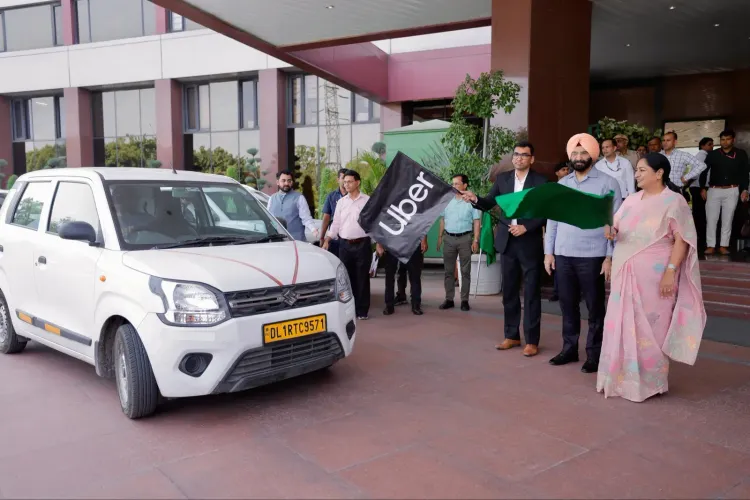
CM Rekha Gupta Flags Off Uber Airport Share from IGI T3
Synopsis
Delhi Chief Minister Rekha Gupta flagged off Uber's Airport Share car-pooling service from IGI Terminal-3 on 22 May 2026, linking the launch to the state's 'Mera Bharat, Mera Yogdaan' campaign and PM Modi's call for public participation amid global fuel pressures.
Key Takeaways
Delhi CM Rekha Gupta flagged off the Uber Airport Share service from IGI Terminal-3 on 22 May 2026 .
The launch was formally conducted from Delhi Secretariat , with cabinet minister Manjinder Singh Sirsa in attendance.
The initiative is part of the Delhi government's 'Mera Bharat, Mera Yogdaan' ('My India, My Contribution') campaign promoting fuel conservation.
The move is framed as a response to PM Narendra Modi's call for jan bhagidari (public participation) amid global fuel conditions.
The service targets air passengers at one of India's busiest international airport terminals, aiming to reduce single-occupancy vehicle trips.
Possible future extensions include similar pooled-ride schemes at other Indian airports and integration with Delhi Metro feeder services.
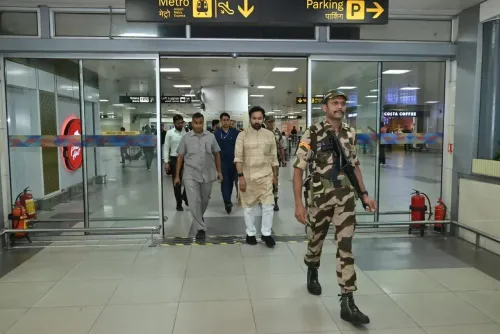
Delhi Chief Minister Rekha Gupta on Friday, 22 May 2026 flagged off the Uber Airport Share service from Indira Gandhi International Airport Terminal-3, launching the car-pooling initiative from Delhi Secretariat to promote shared mobility and fuel conservation in the capital.
Context
Posting on X, Chief Minister Gupta announced that the service was formally launched with a green flag from Delhi Secretariat. Her post, written in Hindi, stated: 'IGI टर्मिनल-3 से Uber Airport Share सेवा को दिल्ली सचिवालय से हरी झंडी दिखाकर रवाना किया' — ('flagged off the Uber Airport Share service from IGI Terminal-3 from Delhi Secretariat'). Cabinet colleague Manjinder Singh Sirsa was present at the occasion.
The launch is positioned under the Delhi government's 'Mera Bharat, Mera Yogdaan' campaign, which translates to 'My India, My Contribution.' The Chief Minister credited Prime Minister Narendra Modi's call for public participation amid global fuel conditions as the driving inspiration behind the initiative.
Policy Backdrop
The 'Mera Bharat, Mera Yogdaan' campaign frames citizen-led fuel conservation as a national contribution during a period of global oil price volatility. The Delhi government's partnership with Uber to operationalise Airport Share at IGI Terminal-3 follows a broader pattern of Indian administrations leveraging public-private partnerships with ride-hailing aggregators to advance sustainable urban transport goals.
Indian governments have historically promoted car-pooling and fuel conservation drives through bodies such as the Petroleum Conservation Research Association. Linking the Uber Airport Share launch to jan bhagidari ('public participation') aligns it with wider national messaging around citizen responsibility during external economic pressures.
Stakeholders and Impact
The primary beneficiaries of the service are air passengers arriving at or departing from IGI Terminal-3, who can now opt for a pooled ride at a lower cost compared to a private cab. Delhi commuters and ride-hailing drivers also stand to benefit from reduced congestion on airport approach roads and more predictable ride demand.
By routing shared rides through an established aggregator, the initiative reduces the number of single-occupancy vehicles on some of Delhi's busiest corridors. The move is also consistent with efforts to integrate private mobility services with the capital's wider public transport network.
What's Next
Authorities and urban transport planners will watch whether the Uber Airport Share model at IGI Terminal-3 can be extended to other major Indian airports or linked to Delhi Metro feeder services, deepening last-mile connectivity. The success of the 'Mera Bharat, Mera Yogdaan' campaign's mobility component may also determine the pace of similar shared-ride rollouts at other high-traffic transit nodes across the country.
Point of View
Mera Yogdaan' and invoking PM Modi's jan bhagidari call, the state administration signals ideological continuity with the BJP's national narrative on shared sacrifice during global economic stress. The public-private partnership model with Uber also allows the government to deliver a tangible urban service without significant state expenditure. Whether the initiative translates into measurable reductions in airport traffic congestion or fuel use will ultimately determine its policy legacy beyond the optics of the launch.
NationPress
19 Sept 2026
Frequently Asked Questions
What is Uber Airport Share in Delhi?
Uber Airport Share is a car-pooling service launched from IGI Terminal-3 in Delhi that allows multiple passengers travelling in the same direction to share a ride, reducing travel costs and the number of vehicles on the road.
Who launched the Uber Airport Share service in Delhi?
Delhi Chief Minister Rekha Gupta flagged off the service from Delhi Secretariat on 22 May 2026 , with cabinet minister Manjinder Singh Sirsa also present at the launch.
What is the 'Mera Bharat, Mera Yogdaan' campaign?
'Mera Bharat, Mera Yogdaan' ('My India, My Contribution') is a Delhi government campaign that encourages citizens to contribute to national goals, including fuel conservation, in line with PM Narendra Modi's call for public participation amid global fuel pressures.
Why is car-pooling being promoted at IGI Airport Delhi?
Car-pooling at IGI Terminal-3 is being promoted to reduce single-occupancy vehicle trips, ease traffic congestion on airport corridors, and cut fuel consumption during a period of global oil price volatility.
Will Uber Airport Share be extended to other Indian airports?
No official announcement has been made, but urban transport planners are watching whether the IGI Terminal-3 model can be replicated at other major Indian airports and integrated with metro feeder services.