CM Rekha Gupta Pays Tribute to Dr. M.S. Swaminathan on Birth Anniversary
Synopsis
Delhi Chief Minister Rekha Gupta paid tribute to Bharat Ratna Dr. M.S. Swaminathan on his birth anniversary, honouring the agricultural scientist credited with powering India's Green Revolution and achieving national food self-sufficiency through high-yielding crop varieties in the 1960s.
Key Takeaways
Delhi CM Rekha Gupta posted a tribute to Dr.
Swaminathan on his birth anniversary, August 7, 2026 .
Swaminathan is credited as the father of India's Green Revolution , pioneering high-yielding wheat and rice varieties in the mid-1960s .
His research helped India achieve food grain self-sufficiency by the 1970s , ending dependence on food imports.
He was awarded the Bharat Ratna — India's highest civilian honour — in 2024 .
Political leaders across parties use the August 7 anniversary to reaffirm commitment to agricultural productivity and farmer welfare.
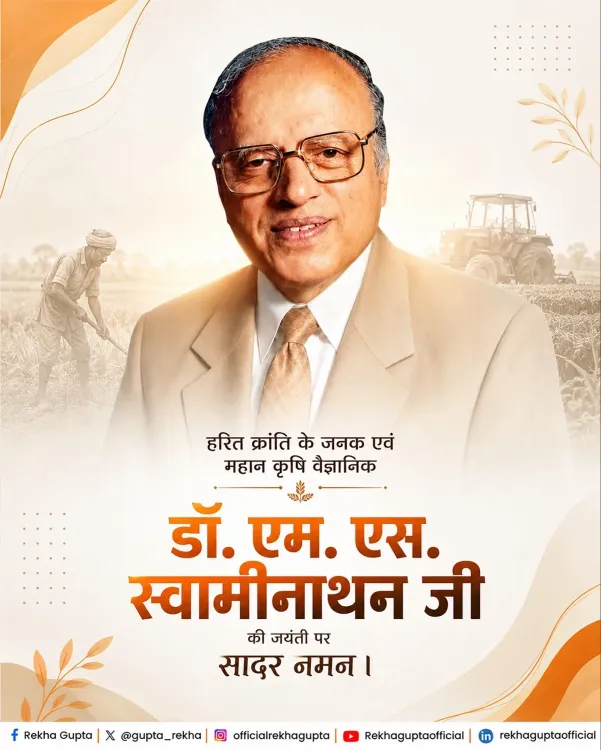
On the birth anniversary of the man who helped a hungry nation feed itself, Delhi Chief Minister Rekha Gupta on Friday, August 7, 2026 offered her homage to Bharat Ratna Dr. M.S. Swaminathan, saluting the architect of India's Green Revolution.
In her post, CM Gupta wrote: 'हरित क्रांति के जनक, भारत रत्न डॉ. एम. एस. स्वामीनाथन जी की जयंती पर उन्हें कोटिशः नमन' — 'On the birth anniversary of the father of the Green Revolution, Bharat Ratna Dr. M.S. Swaminathan, I bow to him a millionfold.' She added that his contributions to Indian agriculture, farmer welfare, and food security 'will always be remembered and remain a source of inspiration.'
The man who changed what India ate
Dr. Mankombu Sambasivan Swaminathan reshaped the fate of a nation on the edge of famine. Working through the Indian Agricultural Research Institute in the mid-1960s, he championed the introduction of high-yielding varieties of wheat and rice — a scientific leap that powered India's Green Revolution and delivered self-sufficiency in food grains by the 1970s. Before that breakthrough, India depended on food imports to survive. After it, the country fed itself.
For that singular transformation, the Government of India awarded him the Bharat Ratna — the nation's highest civilian honour — in 2024. It was a recognition long considered overdue by the scientific and agricultural communities.
A tribute that echoes across party lines
August 7 has become a moment of cross-party consensus in Indian politics. Leaders from across the spectrum use Swaminathan's birth anniversary to reaffirm their commitment to agricultural productivity and rural welfare — a reminder that food security remains one of the few issues capable of uniting a fractured political landscape. CM Gupta's tribute fits squarely within that tradition, placing the BJP-led Delhi government on record in honouring the legacy of a scientist whose work belongs to every Indian, regardless of affiliation.
Swaminathan's legacy also carries a living urgency: with climate stress, groundwater depletion, and farmer distress continuing to challenge Indian agriculture, his model of science-driven, farmer-first policymaking is routinely invoked in debates over the next generation of agricultural reform. The anniversary is not merely ceremonial — it is a prompt.
Point of View
But the ritual itself signals something real: agriculture remains the one policy domain where Indian leaders feel compelled to demonstrate reverence, not merely competence. For a BJP government in Delhi — a city-state with no farmland but enormous symbolic weight — invoking Swaminathan is a gesture toward the broader national conversation on farmer welfare that has defined Indian politics since the 2020-21 farm law protests. The Bharat Ratna conferred in 2024 has given that invocation fresh currency, making tributes this year carry more resonance than in previous cycles.
NationPress
7 Aug 2026
Frequently Asked Questions
Who is Dr. M.S. Swaminathan and why is he famous?
Dr. M.S. Swaminathan was an Indian agricultural scientist widely regarded as the father of India's Green Revolution. He championed high-yielding varieties of wheat and rice in the 1960s that helped India achieve food grain self-sufficiency by the 1970s, and was awarded the Bharat Ratna in 2024.
When is Dr. M.S. Swaminathan's birth anniversary?
Dr. M.S. Swaminathan's birth anniversary falls on August 7. In 2026, Delhi CM Rekha Gupta and other political leaders marked the occasion with public tributes.
What was India's Green Revolution?
India's Green Revolution was a mid-1960s agricultural transformation driven by the introduction of high-yielding crop varieties, particularly wheat and rice. It was spearheaded by scientists including Dr. M.S. Swaminathan and enabled India to move from food import dependence to self-sufficiency by the 1970s.
When did Dr. M.S. Swaminathan receive the Bharat Ratna?
Dr. M.S. Swaminathan was awarded the Bharat Ratna, India's highest civilian honour, in 2024, in recognition of his transformative contributions to Indian agriculture and food security.
What did Delhi CM Rekha Gupta say about Dr. Swaminathan?
CM Rekha Gupta said his contributions to Indian agriculture, farmer welfare, and food security 'will always be remembered and remain a source of inspiration,' offering what she described as a millionfold salute on his birth anniversary.