CM Rekha Gupta to Launch Child Beggar-Free Delhi Campaign
Synopsis
Delhi Chief Minister Rekha Gupta has announced the Child Beggar-Free Delhi Campaign across all 13 districts, emphasising non-coercive family counselling through DCPCR and NGOs while also targeting organised gangs that exploit children — a rights-based pivot in the capital's approach to child begging.
Key Takeaways
Delhi CM Rekha Gupta announced the Child Beggar-Free Delhi Campaign covering all 13 districts of the capital.
Children will not be removed by force — the campaign centres on counselling families and providing economic alternatives.
The Delhi Commission for Protection of Child Rights (DCPCR) and partner NGOs will lead outreach and rehabilitation efforts.
The drive will also work to identify and expose organised gangs that force children into begging.
The campaign draws on the legal framework of the Juvenile Justice (Care and Protection of Children) Act, 2015 .
Citizens and civil society have been invited to contribute suggestions directly to the Chief Minister.
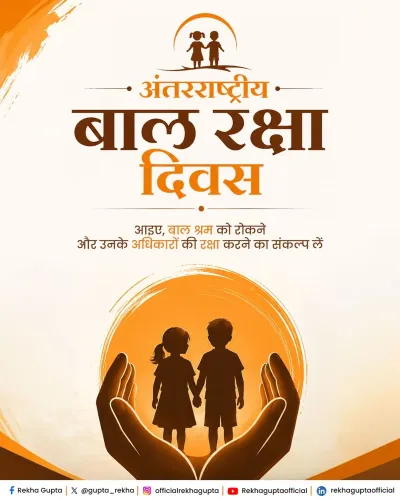
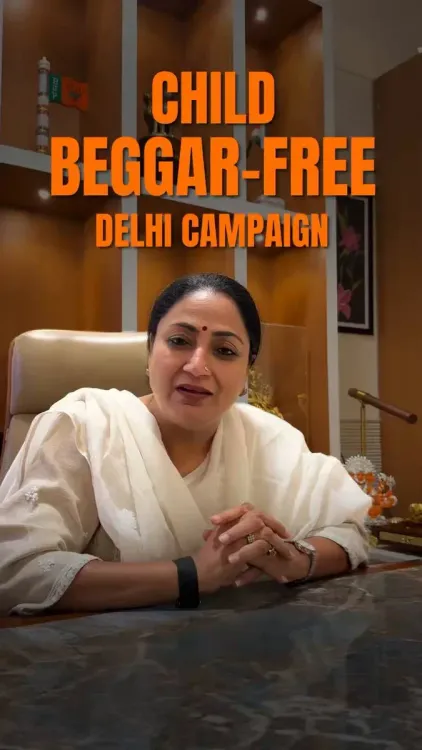
A city-wide campaign to pull children off Delhi's streets — without force, without fear — is coming. Delhi Chief Minister Rekha Gupta announced on Saturday, 8 August 2026 that the Child Beggar-Free Delhi Campaign will roll out across all 13 districts of the capital, promising a rights-based approach that puts rehabilitation before enforcement.
Counselling over coercion: how the campaign will work
The campaign's defining promise is what it will not do. 'Children will not be moved by force,' Gupta stated plainly. Instead, the drive will deploy the Delhi Commission for Protection of Child Rights (DCPCR) alongside partner NGOs to counsel families, understand the economic pressures pushing children onto the streets, and offer 'better alternatives' — though specific rehabilitation packages are yet to be publicly detailed.
The non-coercive framing is significant. Delhi administrations have run anti-begging drives before, often drawing criticism from child-rights groups for prioritising removal over root-cause intervention. This campaign's stated architecture — family counselling, district-level outreach, civil-society partnerships — signals a deliberate pivot toward the rehabilitation model enshrined in the Juvenile Justice (Care and Protection of Children) Act, 2015.
Targeting the gangs behind the children
Beyond the families, the campaign has a harder edge. Gupta said authorities will 'identify and expose organised gangs forcing children into begging' — a direct acknowledgement that many children on Delhi's streets are not there by family choice but by criminal compulsion. This strand of the drive aligns with national strategies under the Ministry of Women and Child Development targeting child trafficking and bonded-labour networks.
The Bombay Prevention of Begging Act, 1959, extended to Delhi, has long provided the legal scaffolding for enforcement action against such operations. Applying it against syndicate operators rather than the children themselves would mark a meaningful shift in how the law is used on the ground.
What Delhi is watching for next
The Chief Minister closed her post with an unusual public invitation: 'Have a suggestion? Comment or DM us.' It is a small but telling detail — the campaign is being positioned as participatory, with citizens and civil society explicitly brought into its design. The real test, however, will come at the district level: which NGOs sign on, what the rehabilitation packages actually look like, and whether action against identified begging syndicates follows through.
Thirteen districts. One mandate. The children are waiting to see if the promise holds.
Point of View
Rekha Gupta's BJP administration is pre-empting the criticism that has historically dogged anti-begging drives: that they criminalise poverty rather than address it. Anchoring the campaign through DCPCR and NGOs gives it institutional credibility, but the harder test is the anti-syndicate strand, which requires sustained law-enforcement follow-through beyond the launch moment. The public invitation for suggestions is an interesting participatory gesture that, if genuine, could build civil-society buy-in — or serve as optics cover if implementation stalls at the district level.
NationPress
8 Aug 2026
Frequently Asked Questions
What is the Child Beggar-Free Delhi Campaign?
It is a city-wide initiative announced by Delhi Chief Minister Rekha Gupta to protect children found begging across all 13 districts of Delhi. The campaign focuses on counselling families and offering rehabilitation alternatives rather than forcibly removing children from the streets.
Will children be arrested or detained under this campaign?
No. CM Rekha Gupta has explicitly stated that children will not be moved by force. The emphasis is on non-coercive counselling of families through DCPCR and NGO partners.
What is DCPCR and what role will it play?
DCPCR stands for the Delhi Commission for Protection of Child Rights. It is the statutory body mandated to safeguard child rights in Delhi, and will partner with NGOs to counsel families and facilitate rehabilitation under this campaign.
Will the campaign take action against begging gangs?
Yes. Alongside family rehabilitation, the campaign aims to identify and expose organised gangs that force children into begging — aligning with broader national strategies against child trafficking and bonded labour.
Which law governs child protection in begging cases in Delhi?
The primary framework is the Juvenile Justice (Care and Protection of Children) Act, 2015, which provides for identifying, rescuing, and rehabilitating children in exploitative situations. The Bombay Prevention of Begging Act, 1959, extended to Delhi, also applies to enforcement action.