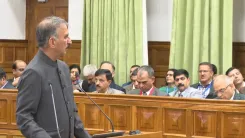
CM Rekha Gupta to Launch Delhi's First School Mental Health Policy
Synopsis
Delhi Chief Minister Rekha Gupta announced the launch of EHSAAS 2026 on November 19 — the capital's first Mental Health and Well-being Policy for schools — promising one counsellor per 500 students and a 24x7 helpline to support over 45 lakh children.
Key Takeaways
Delhi CM Rekha Gupta will launch EHSAAS 2026 — the city's first school Mental Health and Well-being Policy — on 19 November 2026 .
The policy targets over 45 lakh students across Delhi's schools.
It mandates one counsellor for every 500 students , requiring an estimated 9,000 counsellors at full scale.
A 24×7 mental health helpline will be operationalised as part of the rollout.
The initiative follows a national pattern of increased focus on student mental health post the COVID-19 pandemic .
Key details — coverage of private schools and counsellor recruitment timelines — are expected at the formal launch.
Behind every schoolbag, says Delhi Chief Minister Rekha Gupta, is a child carrying dreams, hopes — and sometimes worries they cannot put into words. On Wednesday, November 18, 2026, Gupta announced that Delhi will launch its first-ever Mental Health and Well-being Policy for school students on Thursday, November 19, under the banner 'EHSAAS 2026' — a move she described as a landmark step for over 45 lakh students across the capital.
What EHSAAS 2026 promises Delhi's schoolchildren
The policy comes with three headline commitments: one trained counsellor for every 500 students, a 24×7 mental health helpline, and a wider basket of support measures aimed at ensuring timely emotional care. The counsellor-to-student ratio, if implemented at scale, would mark a significant structural shift — most Delhi government schools currently operate without a dedicated mental health professional on campus.
Gupta framed the initiative in deeply personal terms, posting: 'I want every child in Delhi to know that they are never alone. Their feelings matter, their happiness matters, and we are here to listen, understand and care.' The language signals a deliberate departure from purely academic performance metrics, centering emotional well-being as a governance priority under the #ViksitDelhi umbrella.
India's rising tide of student distress — and the policy gap
Delhi's move arrives against a well-documented national backdrop. India's National Mental Health Policy, adopted in 2014, called for universal access to mental health services but left implementation largely to states, with uneven results. The Rashtriya Kishor Swasthya Karyakram, also launched in 2014, embedded adolescent mental health components into the broader health system — yet school-specific, structured counselling frameworks have remained the exception rather than the rule.
The COVID-19 pandemic accelerated the crisis: prolonged school closures, social isolation, and academic disruption produced a measurable surge in student anxiety and depression reports across Indian cities. Several states subsequently piloted helplines and in-school counselling, but a comprehensive, policy-backed framework at the scale Delhi is now proposing has been rare.
The delivery challenge ahead
The critical test will be execution. 45 lakh students across Delhi's government and aided schools translates into a requirement for 9,000 counsellors at the promised ratio — a recruitment and training pipeline that will take sustained institutional effort to build. Operationalising a true 24×7 helpline with trained responders, not just a call-forwarding number, adds another layer of complexity.
What to watch: whether the policy covers only government schools or extends to private unaided schools, how quickly counsellor positions are sanctioned and filled, and whether the helpline is staffed by licensed mental health professionals. The launch on November 19 is expected to provide those details.
If the architecture holds, Delhi could hand the rest of India a replicable blueprint for student mental health — one that moves the conversation from crisis response to everyday care.
Point of View
Allowing CM Rekha Gupta to stake out a welfare and education narrative that rivals the social-sector branding her predecessors built. By committing to a structural ratio — one counsellor per 500 students — rather than a vague aspiration, the policy sets a measurable accountability benchmark, which is both its strength and its political risk. It also reflects a broader national shift: mental health is moving from a niche health-ministry concern to a mainstream education-governance issue, accelerated by pandemic-era data on adolescent distress. How rigorously Delhi funds and staffs the rollout will determine whether EHSAAS 2026 becomes a replicable state model or remains a well-intentioned headline.
NationPress
18 Nov 2026
Frequently Asked Questions
What is EHSAAS 2026 Delhi mental health policy?
EHSAAS 2026 is Delhi's first Mental Health and Well-being Policy for school students, announced by Chief Minister Rekha Gupta. It promises one counsellor for every 500 students, a 24x7 mental health helpline, and other support measures for over 45 lakh children across the capital.
When will Delhi's EHSAAS 2026 mental health policy be launched?
The policy is set to be formally launched on 19 November 2026, as announced by Delhi CM Rekha Gupta on the evening of 18 November 2026.
How many counsellors will Delhi schools get under EHSAAS 2026?
Under EHSAAS 2026, Delhi aims to provide one trained counsellor for every 500 students. With over 45 lakh students targeted by the policy, full implementation would require approximately 9,000 counsellors.
Is there a mental health helpline for Delhi students?
Yes, EHSAAS 2026 includes a 24x7 mental health helpline for students in Delhi. Details of the helpline number and staffing are expected to be announced at the formal policy launch on 19 November 2026.
Which schools in Delhi will be covered under the mental health policy?
CM Rekha Gupta's announcement references over 45 lakh students in Delhi, but the specific breakdown of government versus private school coverage under EHSAAS 2026 is expected to be clarified at the official launch on 19 November 2026.