CM Rio backs Khelo India vision on sports as employment driver

Synopsis
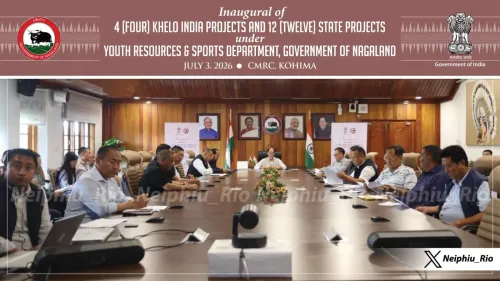
Nagaland Chief Minister Neiphiu Rio backed the Khelo India vision on 3 July 2026, calling sports a vibrant employment-generating industry and urging stronger coaching capacity and athlete exposure to build a brighter future for youth.
Key Takeaways
CM Neiphiu Rio replied to @kheloindia on 3 July 2026 , framing sports as a 'vibrant industry' beyond recreation.
He stressed three pillars: building a strong sporting culture, strengthening coaches and trainers, and providing exposure to athletes.
The Khelo India scheme, launched in 2017 , underpins national grassroots sports development and talent identification.
Nagaland has been included in national talent searches as part of efforts to address regional under-representation in Indian sports.
The statement signals political alignment between the Nagaland state government and the central sports development agenda.
Nagaland Chief Minister Neiphiu Rio on Friday, 3 July 2026, responded to the official Khelo India handle on X, asserting that sports has evolved into a 'vibrant industry' capable of generating employment and opportunities for youth across India.
Context
Replying to @kheloindia, CM Rio wrote that sports today have 'moved beyond recreation' and emerged as a sector with real economic potential. He called for building a 'strong sporting culture,' strengthening the capacity of coaches and trainers, and providing greater exposure to athletes as pathways to nurturing talent.
The Chief Minister's framing positions sports not merely as a leisure activity but as a structured industry — a view increasingly shared by policymakers at both the central and state levels.
Policy Backdrop
The Khelo India programme, launched in 2017 under the Ministry of Youth Affairs and Sports, was designed precisely to revive grassroots sports culture and create talent pipelines from school level through to elite competition. It funds academies, scholarships, and infrastructure across states, including in the Northeast.
India's National Sports Policy of 2001 had earlier set broad goals for sports development, but targeted schemes like Khelo India operationalised those ambitions at scale. The programme has expanded to include university games, annual talent searches, and dedicated infrastructure grants for states that have historically been under-represented in mainstream Indian sports.
Nagaland, a northeastern state with a significant tribal population, has in recent years been included in national talent identification drives. The state government under Rio has emphasised youth empowerment and economic diversification as pillars of development.
Stakeholders and Impact
The primary beneficiaries of the vision CM Rio articulated are young athletes, coaches, and trainers — particularly those in states like Nagaland that have historically had limited access to high-performance infrastructure. When sports is treated as an industry, it creates ancillary roles in coaching, sports science, event management, and administration.
For Nagaland specifically, where conventional employment avenues can be limited, a sports-led economic model offers a credible alternative. The state has produced athletes in disciplines such as boxing and football, and a stronger institutional framework could channel that raw talent more effectively.
What's Next
Attention will now turn to whether Nagaland accelerates the rollout of Khelo India academies at the state level and whether more athletes from the state feature in national competitions and university games. CM Rio's public alignment with the programme's goals signals political will, but concrete steps — infrastructure investment, coach recruitment, and athlete stipends — will determine the on-ground impact.
As India continues to build toward larger sporting ambitions on the global stage, statements like Rio's underscore a growing consensus: sports development is inseparable from economic development, and the two must be pursued together.
Point of View
Framing sports as an industry is more than rhetorical; it opens doors to central funding and infrastructure grants. Rio's emphasis on coaches and trainers, not just athletes, suggests awareness that talent pipelines require institutional scaffolding, not just raw ability. The statement fits a broader pattern of northeastern chief ministers using sports diplomacy to assert developmental credibility and attract central attention.
NationPress
3 Jul 2026
Frequently Asked Questions
What did Nagaland CM Neiphiu Rio say about Khelo India?
CM Rio replied to the Khelo India handle on X on 3 July 2026, saying sports has moved beyond recreation and become a vibrant industry capable of providing employment and opportunities, and called for stronger coaching capacity and athlete exposure.
What is the Khelo India scheme?
Khelo India is a national programme launched in 2017 under the Ministry of Youth Affairs and Sports to promote grassroots sports, identify talent, and build infrastructure across India, including in northeastern states like Nagaland.
How does Nagaland benefit from Khelo India?
Nagaland has been included in national talent identification drives under Khelo India, giving athletes from the state access to scholarships, coaching, and competition pathways that were previously limited.
Why is sports being called an industry in India?
Policymakers increasingly recognise that sports generates employment in coaching, sports science, event management, and administration — not just for athletes — making it a legitimate economic sector, especially in states with limited conventional employment options.
What is Neiphiu Rio's party and role?
Neiphiu Rio is the Chief Minister of Nagaland and leader of the Nationalist Democratic Progressive Party, focused on state development including youth empowerment and economic diversification.