CM Rio Marks World MSME Day, Highlights RAMP in Nagaland
Synopsis
On World MSME Day, Nagaland Chief Minister Neiphiu Rio highlighted the RAMP scheme as a pillar of the state's effort to build a stronger small-enterprise ecosystem, citing support, capacity building and expanded opportunities for local businesses.
Key Takeaways
Nagaland CM Neiphiu Rio posted on 27 June 2026 to mark World MSME Day , celebrating the resilience and contribution of MSMEs to the state.
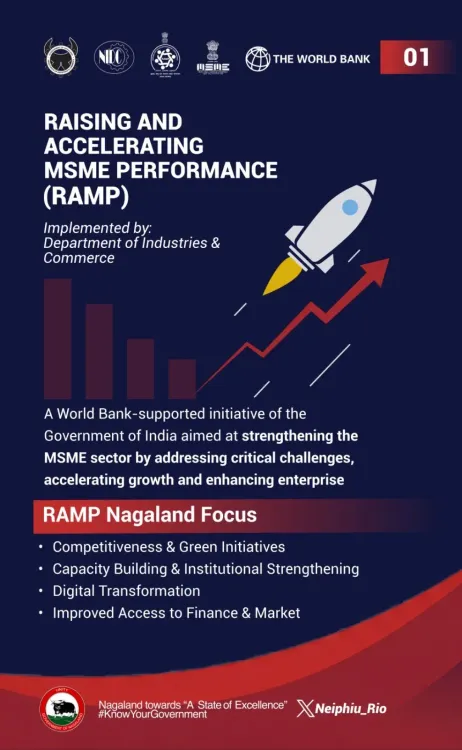
He specifically cited the RAMP (Raising and Accelerating MSME Performance) scheme as a key vehicle for strengthening Nagaland 's MSME ecosystem.
RAMP is a World Bank -supported central scheme approved in 2022 , running from 2022-23 to 2026-27 , targeting credit access, market linkages and formalisation.
Northeastern states including Nagaland have dedicated components under RAMP to address regional economic disparities.
The scheme aligns with the Atmanirbhar Bharat push to strengthen domestic manufacturing and services through small enterprises.
State-level progress reports on RAMP disbursement and district-level workshops in Nagaland are expected in the current financial year.
Nagaland Chief Minister Neiphiu Rio on Saturday, 27 June 2026, marked World MSME Day by acknowledging the contribution of micro, small and medium enterprises to the state's growth and highlighting the role of the Raising and Accelerating MSME Performance (RAMP) scheme in strengthening Nagaland's small-business ecosystem.
Context
World MSME Day, observed annually on 27 June, is a United Nations-recognised day that spotlights the role of small enterprises in driving employment and economic development. Chief Minister Rio used the occasion to affirm the state government's commitment to local entrepreneurs, stating that Nagaland is 'strengthening the MSME ecosystem by enhancing support, capacity building, and opportunities for local enterprises.'
The post, shared on Rio's official X account, cited the RAMP scheme by name as a key instrument in this effort, signalling the state's active engagement with the centrally-sponsored programme.
Policy Backdrop
The RAMP scheme — Raising and Accelerating MSME Performance — was approved by the Union Cabinet in 2022 for a five-year run from 2022-23 to 2026-27, backed by World Bank financing. It targets persistent gaps in credit access, market linkages, formalisation, and technology adoption that constrain small businesses across India.
Northeastern states, including Nagaland, received dedicated components under RAMP to leverage local resources and reduce regional economic disparities. The scheme fits within the broader Atmanirbhar Bharat framework, which emphasises domestic manufacturing and services through small enterprise development. Nagaland's economy has a growing MSME base in traditional crafts, agri-processing and services sectors.
Stakeholders and Impact
The primary beneficiaries of RAMP in Nagaland are entrepreneurs in micro and small enterprises — weavers, agri-processors, food producers, and service providers — who have historically faced limited access to formal credit and markets. Capacity-building components of the scheme are intended to improve business skills and connect local producers to wider supply chains.
The Ministry of MSME at the Union level provides policy, credit and technology support that state governments then translate into ground-level implementation. CM Rio's public acknowledgement of the scheme on a high-visibility day reinforces the state government's role as a partner in its delivery.
What's Next
With RAMP's implementation window closing at the end of 2026-27, attention will turn to state-level progress reports on disbursement and the outcomes of capacity-building workshops scheduled across Nagaland districts in the current financial year. The results will inform whether the programme has meaningfully shifted credit access and market participation for small businesses in the state.
Broader policy momentum around northeastern enterprise development suggests that successor schemes or extended frameworks may follow, making Nagaland's experience under RAMP a reference point for future regional MSME policy design.
Point of View
He is publicly aligning the state government's credibility with a centrally-sponsored scheme whose implementation window closes in 2026-27. For a small northeastern economy where informal enterprise dominates, visibility at the political level can accelerate bureaucratic follow-through on credit and capacity programmes. The post also reflects a broader pattern in which state governments in the northeast use national observance days to signal policy seriousness to both local constituents and Union-level stakeholders. As RAMP approaches its final year, Rio's framing sets up an implicit accountability marker for measurable outcomes in Nagaland.
NationPress
25 Sept 2026
Frequently Asked Questions
What is the RAMP scheme mentioned by Nagaland CM Neiphiu Rio?
RAMP stands for Raising and Accelerating MSME Performance. It is a World Bank-supported central government scheme approved in 2022 and running from 2022-23 to 2026-27, designed to improve credit access, market linkages, formalisation and technology adoption for micro, small and medium enterprises across India, including dedicated components for northeastern states like Nagaland.
Why did CM Rio post about MSMEs on 27 June 2026?
27 June is observed as World MSME Day, a United Nations-recognised annual occasion to highlight the contribution of small enterprises to economic development. CM Rio used the day to celebrate Nagaland's MSME sector and outline the state's efforts through the RAMP scheme.
How does Nagaland benefit from the RAMP scheme?
Nagaland has a dedicated component under RAMP aimed at leveraging local resources in sectors such as traditional crafts, agri-processing and services. The scheme provides support for capacity building, credit access and market linkages to help small businesses in the state become more competitive and formally integrated.
What is World MSME Day and when is it observed?
World MSME Day is observed every year on 27 June. It was designated by the United Nations to recognise the role of micro, small and medium enterprises in sustainable development and employment generation globally.
What sectors does Nagaland's MSME economy cover?
Nagaland's MSME base includes traditional handicrafts and weaving, agri-processing, food production and a growing services sector. These enterprises are the primary targets of schemes like RAMP, which aim to improve their access to finance and markets.