CM Rio calls for professional, community-centred Nagaland Police
Synopsis
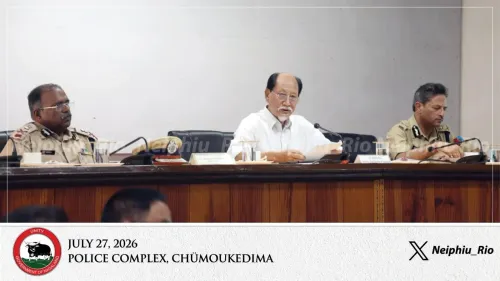
Nagaland Chief Minister Neiphiu Rio on 27 July 2026 called on the state police to press ahead with its transition to professional, investigation-oriented and community-centred policing, highlighting stronger District Executive Forces and police stations as the key levers of reform.
Key Takeaways
CM Neiphiu Rio publicly directed Nagaland Police to continue its transition toward professional, investigation-oriented and community-centred policing on 27 July 2026 .
He identified District Executive Forces and police stations as the primary vehicles for this reform.
Rio defined a modern police force by four qualities: integrity, professionalism, compassion and public trust.
The call aligns with national reform frameworks including the Model Police Act 2006 and the Prakash Singh v.
Union of India (2006) Supreme Court directives.
In Nagaland , police modernisation is complicated by ongoing peace processes and special constitutional arrangements unique to the Northeast.
Budget allocations and legislative action in the next assembly session will be key indicators of follow-through.
Nagaland Chief Minister Neiphiu Rio on Monday, 27 July 2026 called on Nagaland Police to accelerate its transformation into a professional, investigation-oriented and community-centred force, stressing that integrity and public trust are the defining markers of a modern police service.
Context
Responding to a post by AIR News Kohima, CM Rio stated that Nagaland Police 'must continue its transition to a professional, investigation-oriented, and community-centred policing through stronger District Executive Forces and police stations.' He added that 'a modern police force is defined by the integrity, professionalism, compassion and trust of the people.'
The remarks signal a clear policy direction from the state's top executive, placing the onus on district-level structures — the District Executive Forces and individual police stations — as the primary vehicles of reform.
Policy Backdrop
The push for professional, investigation-focused policing has a long national lineage. The Model Police Act of 2006 proposed a structural overhaul of Indian police forces to move away from a colonial-era law-and-order orientation toward community service and independent investigation. The landmark Prakash Singh v. Union of India (2006) Supreme Court ruling went further, directing states to functionally separate investigation from law-and-order duties and establish independent oversight mechanisms.
Many Indian states have implemented these directives only partially. In the Northeast, police modernisation carries additional complexity: forces operate alongside peace accord frameworks and special constitutional provisions that shape local security arrangements. Nagaland in particular has navigated a decades-long peace process with armed groups, making the shift toward community-centred policing both more urgent and more sensitive.
Stakeholders and Impact
For ordinary Nagaland residents, the transition holds tangible implications — faster and more transparent investigation of crimes, better access to police stations at the district level, and a force perceived as an ally rather than an instrument of coercion. Police personnel, too, stand to benefit from clearer professional mandates, structured training, and improved infrastructure at the station level.
Strengthening District Executive Forces is particularly significant in a state where district headquarters often serve as the primary interface between citizens and the state. A well-resourced, professionally oriented district force can meaningfully reduce the gap between policy intent and ground-level delivery.
What's Next
Observers will watch whether CM Rio's public directive translates into concrete allocations in the next Nagaland state budget — specifically for police training infrastructure, station upgrades and capacity building at the district level. Any legislative proposals in the forthcoming assembly session to formally strengthen the District Executive Forces would be a direct follow-through on today's statement. The Chief Minister's framing of integrity and public trust as the benchmarks of a modern force also sets a standard against which the administration's own record on police accountability will be measured.
Point of View
Professionalism, compassion and trust' as the yardstick, he has set a measurable standard his own administration will be judged against. The emphasis on District Executive Forces reflects a strategic choice to anchor reform at the sub-state level, where citizen contact is most direct and outcomes most visible. In the Northeast's complex security landscape, framing police reform as community-centred rather than enforcement-heavy is also a political signal about the state's approach to the ongoing peace process. Whether the statement is followed by budget commitments and legislative action will determine if it marks a genuine policy inflection or remains aspirational rhetoric.
NationPress
27 Jul 2026
Frequently Asked Questions
What did Nagaland CM Neiphiu Rio say about Nagaland Police?
CM Neiphiu Rio called on Nagaland Police to continue transitioning to professional, investigation-oriented and community-centred policing, with stronger District Executive Forces and police stations at the core of this effort.
What are District Executive Forces in Nagaland?
District Executive Forces are district-level police units in Nagaland that serve as the primary law-enforcement interface between citizens and the state government, handling both routine policing and investigation at the local level.
What is the Model Police Act 2006 and how does it relate to Nagaland?
The Model Police Act 2006 is a national framework that recommended shifting Indian police forces from a colonial law-and-order focus to professional investigation and community service — the same direction CM Rio is urging Nagaland Police to pursue.
Why is police reform in Nagaland more complex than in other states?
Nagaland's police reform efforts occur alongside a decades-long peace process with armed groups and special constitutional provisions, making the shift to community-centred policing both more urgent and more politically sensitive than in most other states.
What should we watch for after CM Rio's police reform statement?
Key indicators will be state budget allocations for police training and station infrastructure, and any legislative proposals in the next Nagaland assembly session to formally strengthen District Executive Forces.