CM Rio Hails First Naga Woman Gauhati HC Judge
Synopsis
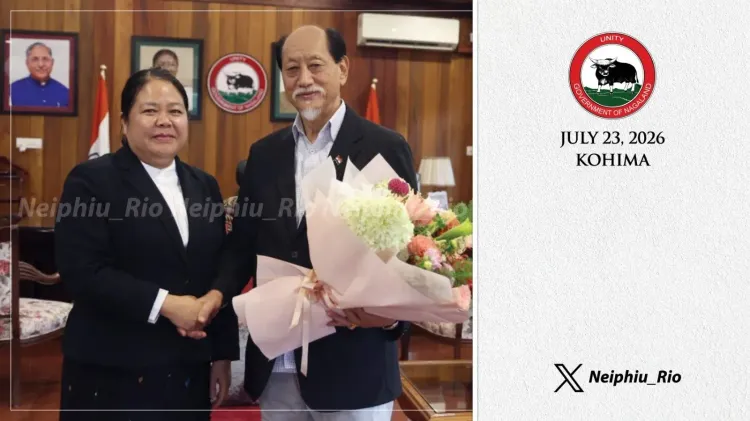
Nagaland Chief Minister Neiphiu Rio received Justice Yarenjungla Longkumer, the first Naga woman to be appointed Additional Judge of the Gauhati High Court, calling her elevation a proud milestone and an inspiration to young women across the state.
Key Takeaways
Justice Yarenjungla Longkumer is the first Naga woman to be appointed and sworn in as an Additional Judge of the Gauhati High Court .
Chief Minister Neiphiu Rio received her at a courtesy call on 23 July 2026 and publicly celebrated the appointment on X .
The Gauhati High Court , established in 1948 , has jurisdiction over Assam , Nagaland , Mizoram , and Arunachal Pradesh .
High court appointments in India follow the collegium system, which aims to balance merit with regional and demographic representation.
Women judges from Scheduled Tribe communities and northeastern states remain underrepresented across Indian high courts, making this appointment a notable precedent.
Nagaland Chief Minister Neiphiu Rio on Thursday, 23 July 2026 received Justice Yarenjungla Longkumer — the first Naga woman to be appointed and sworn in as an Additional Judge of the Gauhati High Court — at a courtesy call, describing the occasion as 'a proud milestone for Nagaland and an inspiration, especially to young women.'
Context
Justice Yarenjungla Longkumer's appointment marks a historic first for Nagaland: no Naga woman had previously reached the bench of the Gauhati High Court, which holds original and appellate jurisdiction over Assam, Nagaland, Mizoram, and Arunachal Pradesh. Chief Minister Rio took to X (formerly Twitter) to share the moment, calling her tenure one he wishes to be 'distinguished in the service of justice.'
The Gauhati High Court, established in 1948, is one of the older high courts in the northeastern region and has periodically expanded its bench to address access-to-justice gaps across the four states it covers.
Policy Backdrop
Appointments to high court benches in India follow the collegium system, whose primacy was affirmed by landmark Supreme Court judgments in 1993 and 1998. The system is intended to balance merit with regional and demographic representation — a principle that makes Justice Longkumer's elevation particularly significant for the northeastern tribal belt.
Across Indian high courts, the share of women judges has risen gradually since the early 2000s, yet representation from Scheduled Tribe communities and from northeastern states has remained limited. Nagaland carries special constitutional protections under Article 371A, and successive state governments have sought to expand professional pathways for women within both customary and statutory frameworks.
Stakeholders and Impact
The appointment resonates most immediately with Naga women in the legal profession, for whom Justice Longkumer becomes a visible precedent-setter at the highest tier of the state's judicial hierarchy. Legal educators and bar associations across Kohima and Dimapur are likely to cite the milestone in recruitment and mentorship efforts targeting women law students.
More broadly, the development signals incremental progress in the judiciary's effort to reflect the diversity of the Northeast. For the state government, the occasion also offers a moment to align its governance narrative with women's empowerment — a recurring theme in Chief Minister Rio's public communications.
What's Next
Attention will now turn to whether Nagaland and the wider northeastern region see further high court appointments that deepen representation of tribal communities and women. State-level initiatives in legal education and judicial training for women could accelerate that pipeline. Justice Longkumer's tenure at the Gauhati High Court will itself be watched as a test of how the bench addresses cases touching on customary law, land rights, and the rights of tribal citizens — areas of acute relevance to Nagaland's socio-legal landscape.
Point of View
Publicly marking the occasion serves a dual purpose: it reinforces the NDPP government's women's empowerment credentials and signals Nagaland's growing stake in mainstream constitutional institutions. The appointment also sits within a broader national conversation about collegium reforms and the need for tribal and northeastern voices on high court benches. Whether it translates into structural change — more appointments, stronger legal education pipelines — will be the real measure of its significance.
NationPress
23 Jul 2026
Frequently Asked Questions
Who is Justice Yarenjungla Longkumer?
Justice Yarenjungla Longkumer is the first Naga woman to be appointed and sworn in as an Additional Judge of the Gauhati High Court, a historic milestone for Nagaland's legal community.
Which states does the Gauhati High Court cover?
The Gauhati High Court, established in 1948, has jurisdiction over four northeastern states: Assam, Nagaland, Mizoram, and Arunachal Pradesh.
What did Nagaland CM Neiphiu Rio say about the appointment?
Chief Minister Rio called the appointment 'a proud milestone for Nagaland and an inspiration, especially to young women,' and wished Justice Longkumer a distinguished tenure in the service of justice.
How are High Court judges appointed in India?
High Court judges in India are appointed through the collegium system, whose primacy was established by Supreme Court judgments in 1993 and 1998, balancing merit with regional and demographic representation.
Why is this appointment significant for Nagaland?
No Naga woman had previously served as a judge of the Gauhati High Court, making Justice Longkumer a precedent-setter for tribal women's representation in India's higher judiciary.