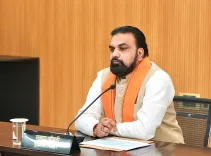
Giriraj Singh highlights Tamil Nadu weaver Poongodi's skill journey
Synopsis
Union Textiles Minister Giriraj Singh on 23 July 2026 spotlighted Tamil Nadu weaver Poongodi, who trained in modern textile design and card-punching and now runs her own enterprise while serving local weavers — illustrating the government's push for women-led micro-enterprises in handloom clusters under schemes like SAMARTH and the Viksit Bharat 2047 vision.
Key Takeaways
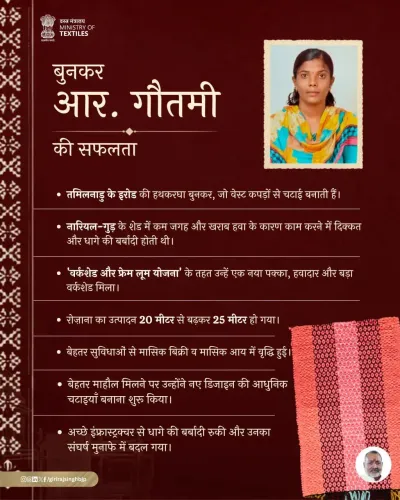
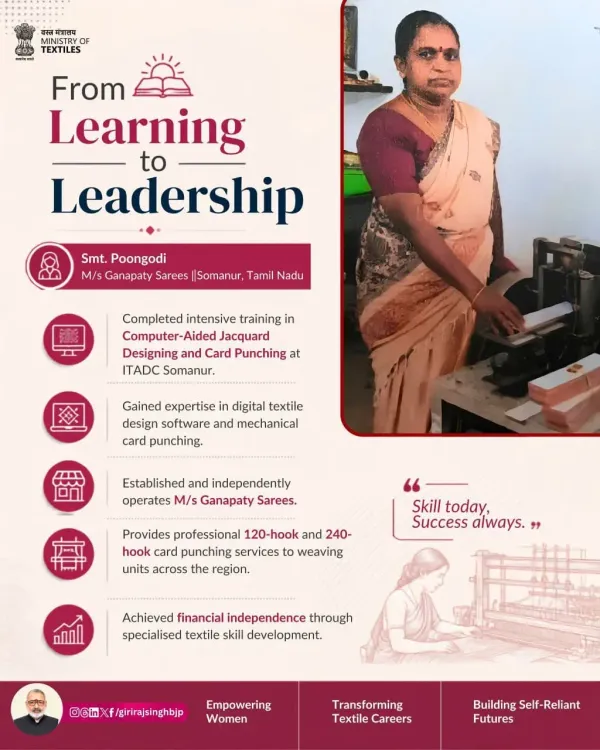
Union Textiles Minister Giriraj Singh shared the story of Poongodi , a woman from Tamil Nadu , who acquired modern textile design and card-punching skills through formal training.
Poongodi now runs her own enterprise and provides professional services to weavers in her region, exemplifying a women-led micro-enterprise model.
The SAMARTH scheme, launched in 2018 by the Ministry of Textiles, is the central government's primary vehicle for skill training in the handloom and textile sector.
The Skill India Mission (launched 2015 ) provides the broader vocational training infrastructure within which such textile-sector programmes operate.
The post is linked to the Viksit Bharat 2047 vision, which includes targets for women's economic participation and textile sector growth.
Tamil Nadu is a key handloom state, with clusters in Kanchipuram, Salem, and Erode employing large numbers of women weavers.
Union Textiles Minister Giriraj Singh on Thursday, 23 July 2026, shared the story of Poongodi, a woman weaver from Tamil Nadu, to highlight how government-backed skill training is enabling women artisans to build independent enterprises and serve their wider weaving communities.
In his post, the Minister wrote — translated from Hindi — that 'Shrimati Poongodi ji ne prashikshan ke madhyam se aadhunik vastra design aur card punching ki taknik seekhi' (Mrs Poongodi learned modern textile design and card-punching techniques through training). He noted that she is today successfully running her own enterprise and providing professional services to weavers in her region, adding: 'When women receive the right training and opportunities, they become self-reliant and open new pathways of opportunity for others as well.'
Context
Tamil Nadu is one of India's most significant handloom states, with a large workforce of women weavers engaged in producing silk and cotton fabrics across clusters such as Kanchipuram, Salem, and Erode. Card punching — the process of encoding weave patterns onto jacquard cards for power looms — is a specialised technical skill that has historically been dominated by men, making Poongodi's transition into this domain particularly notable.
The Minister's post, tagged with #WomenEmpowerment, #SkillDevelopment, #Textiles, and #ViksitBharat2047, positions individual success stories as evidence of the broader policy push toward women-led micro-enterprises in traditional textile clusters.
Policy Backdrop
The SAMARTH (Scheme for Capacity Building in Textile Sector) scheme, launched in 2018 by the Ministry of Textiles, is the primary central government vehicle for providing skill training to handloom weavers, including women artisans. It funds placement-linked training programmes across the textile value chain — from weaving and design to finishing and entrepreneurship.
SAMARTH operates alongside the Skill India Mission, initiated in 2015, which expanded vocational training infrastructure in labour-intensive traditional industries. Together, these frameworks aim to modernise production techniques in handloom clusters while simultaneously creating a pipeline of women entrepreneurs who can offer services — such as design and card punching — to other weavers on a commercial basis.
Both schemes feed into the government's overarching Viksit Bharat 2047 vision, which sets targets for skill development, women's economic participation, and growth in the textile sector as part of India's goal of becoming a developed nation by the centenary of its independence.
Stakeholders and Impact
Women weavers and handloom artisans are the primary beneficiaries of such training interventions. When a trained artisan like Poongodi begins offering professional card-punching and design services commercially, the downstream effect extends to other weavers in the cluster who gain access to affordable, locally available technical expertise — reducing dependence on outside intermediaries.
For the Ministry of Textiles, individual success stories serve a dual purpose: they validate scheme outcomes and build public awareness of available training pathways. The Minister's use of social media to amplify such stories is consistent with a broader government communications strategy of showcasing grassroots beneficiaries to demonstrate policy impact.
What's Next
Attention will now turn to whether the Ministry of Textiles expands the reach of SAMARTH and allied programmes in Tamil Nadu's handloom clusters, and whether upcoming budget cycles include enhanced allocations for women-focused skill modules. Impact assessments of training outcomes — particularly for women who have transitioned from weaving to enterprise ownership — are likely to shape the next phase of scheme design.
As the Viksit Bharat 2047 roadmap matures, the textile sector's ability to produce a new generation of women-led micro-enterprises will be a key metric of success for both skill development and women's economic empowerment goals.
Point of View
The Ministry of Textiles is consciously threading grassroots success into a long-horizon national narrative. The emphasis on card punching — a technical, male-dominated skill — signals that women's empowerment messaging is being extended beyond conventional craft roles into higher-value production services. This pattern suggests the Ministry intends to position women artisan-entrepreneurs, not just weavers, as the face of India's handloom modernisation story ahead of future scheme reviews and budget cycles.
NationPress
23 Jul 2026
Frequently Asked Questions
Who is Poongodi and why is she in the news?
Poongodi is a woman from Tamil Nadu who received skill training in modern textile design and card-punching techniques and now runs her own enterprise serving local weavers. She came into the news after Union Textiles Minister Giriraj Singh shared her story on social media on 23 July 2026 as an example of women's empowerment through skill development.
What is the SAMARTH scheme for textile workers?
SAMARTH — Scheme for Capacity Building in Textile Sector — was launched in 2018 by the Ministry of Textiles to provide placement-linked skill training to workers across the textile value chain, including handloom weavers and artisans, with a focus on women and marginalised communities.
What is card punching in the textile industry?
Card punching is a specialised technique used to encode weave patterns onto jacquard cards that guide power looms in producing complex fabric designs. It is a technical skill that enables weavers to create intricate patterns and is increasingly important in modernising handloom production.
What is Viksit Bharat 2047 and how does it relate to textiles?
Viksit Bharat 2047 is the Indian government's vision for transforming India into a fully developed nation by the centenary of independence in 2047. For the textile sector, it includes targets for skill development, women's economic participation, and growth of handloom and handicraft industries as part of a broader self-reliance agenda.
What is the government doing for women weavers in Tamil Nadu?
The central government runs the SAMARTH scheme and Skill India Mission to provide vocational training to women weavers in Tamil Nadu's handloom clusters. These programmes aim to upgrade technical skills, promote women-led micro-enterprises, and increase productivity in traditional textile clusters across states like Tamil Nadu.