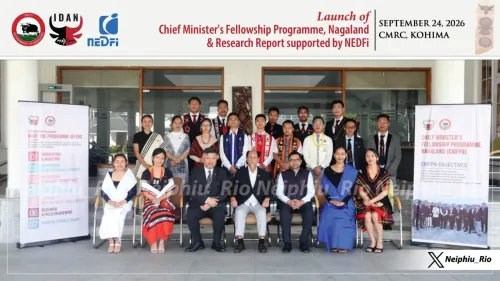
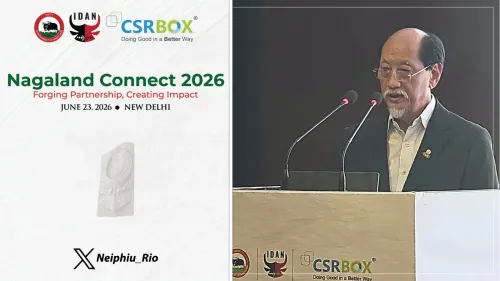
CM Rio launches fellowship to groom Nagaland's next policy minds
Synopsis
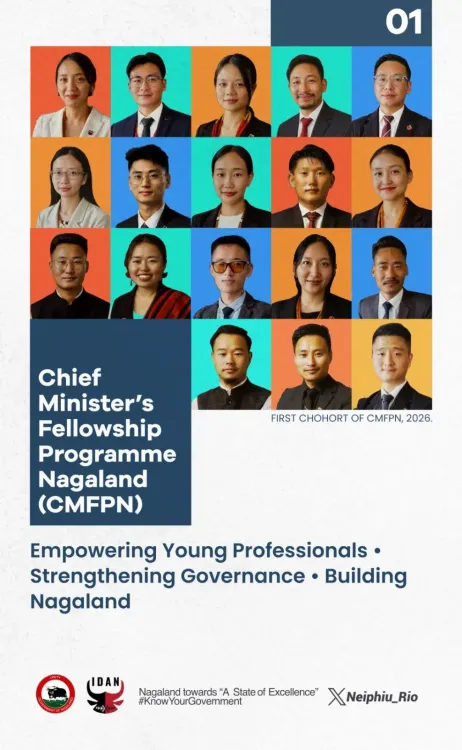
Chief Minister Neiphiu Rio has announced the CM Fellowship Programme Nagaland, implemented by IDAN, to embed young professionals in state governance and public policy — positioning it as a long-term investment in Nagaland's development capacity.
Key Takeaways
CM Neiphiu Rio announced the CM Fellowship Programme, Nagaland on 29 September 2026 .
The programme is implemented by IDAN (Investment and Development Authority of Nagaland) .
Fellows will gain hands-on experience in governance, public policy, research, and development work.
The fellowship operates within Nagaland's unique Article 371A constitutional framework, adding a distinctive institutional dimension.
Details including cohort size, eligibility, stipend, and placement departments are yet to be officially released.
The programme is part of a wider Indian trend of state-level CM fellowships aimed at building administrative capacity from outside the traditional civil-service pipeline.
Nagaland is betting on its own youth to write the next chapter of its governance story. Chief Minister Neiphiu Rio announced on Tuesday, 29 September 2026 that the CM Fellowship Programme, Nagaland — implemented by the Investment and Development Authority of Nagaland (IDAN) — will place young professionals inside the machinery of state government, giving them hands-on exposure to governance, public policy, research, and development work.
What the CM Fellowship actually promises
Rio framed the programme in direct terms: 'It is an investment in people, enabling them to learn, engage, and contribute to Nagaland's development journey.' The fellowship is designed not as a ceremonial attachment but as a structured immersion — fellows are expected to engage with live policy processes and contribute to real departmental work, not shadow officials from a distance.
IDAN, the state agency behind investment promotion and select development programmes in Nagaland, takes the implementation lead. The choice of IDAN signals that the fellowship sits at the intersection of governance capacity-building and the state's broader development agenda, rather than being housed in a purely academic or administrative silo.
Nagaland joins a pattern — but with its own constitutional texture
Several Indian states launched comparable CM-level fellowships from the mid-2010s onward, driven by a recognition that modern governance demands skills — data analysis, policy design, field research — that routine civil-service pipelines are slow to deliver. Nagaland's version arrives within a distinctly different constitutional context: the state operates under Article 371A of the Constitution, which protects Naga customary law and tribal administrative structures. Any fellowship cohort working inside government here will inevitably engage with that layered institutional reality — a learning environment few other state programmes can replicate.
Rio's hashtag #KnowYourGovernment points to a secondary ambition: demystifying state institutions for a generation of educated Nagaland youth who are often more familiar with central government schemes than with the workings of their own state machinery.
What the programme still needs to show
The announcement establishes intent; the details that will define impact — cohort size, placement departments, eligibility criteria, stipend structure, and a mid-term review mechanism — are yet to be made public. Those specifics will determine whether the fellowship builds genuine institutional memory or remains a well-intentioned one-cycle pilot. The Nagaland government's track record on programme continuity will be watched closely once the first cohort completes its tenure.
For now, IDAN Nagaland carries the implementation mandate, and the clock on turning this announcement into applications has started.
Point of View
Injected early, can accelerate policy quality. For Nagaland, the stakes are higher than optics: the state's distinctive Article 371A framework and tribal administrative structures mean fellows will encounter governance complexity that is genuinely rare, potentially producing a cohort with unusually deep institutional knowledge. The routing of implementation through IDAN rather than a line department suggests Rio's administration wants the fellowship tied to economic development outcomes, not just administrative exposure. Whether the programme achieves scale and continuity — the perennial weakness of state fellowships across India — will be the real test.
NationPress
29 Sept 2026
Frequently Asked Questions
What is the CM Fellowship Programme Nagaland?
It is a state government initiative announced by Chief Minister Neiphiu Rio that places young professionals inside Nagaland's governance machinery to give them experience in public policy, research, and development work. It is implemented by IDAN Nagaland.
Who implements the CM Fellowship Programme in Nagaland?
The programme is implemented by IDAN — the Investment and Development Authority of Nagaland — the state agency that handles investment promotion and select development programmes.
Who can apply for the CM Fellowship Nagaland?
The fellowship targets young professionals, but specific eligibility criteria, educational qualifications, and application details have not yet been officially released by the Nagaland government.
How is the Nagaland CM Fellowship different from other state fellowships in India?
Nagaland operates under Article 371A of the Constitution, which protects Naga customary law and tribal administrative structures. Fellows here will engage with a layered institutional environment that is largely unique among Indian states.
What is the significance of the #KnowYourGovernment hashtag used by CM Rio?
The hashtag signals a secondary goal of the programme: familiarising educated Nagaland youth with the workings of their own state government, which they are often less aware of than central government schemes.