CM Sai Hails Rail Line Approval for Jashpur District
Synopsis
Chhattisgarh Chief Minister Vishnu Deo Sai announced on 20 June 2026 that the Dharamjaigarh–Patthalgaon–Lohardaga rail line has been approved, ending decades of wait and connecting the tribal-majority Jashpur district to India's national rail network for the first time.
Key Takeaways
The Dharamjaigarh–Patthalgaon–Lohardaga rail line project has received formal approval, as announced by CM Vishnu Deo Sai on 20 June 2026 .
Jashpur district in northern Chhattisgarh will be connected to the national rail network for the first time once the project is built.
The inter-state line will link Chhattisgarh's interior to the existing rail junction at Lohardaga, Jharkhand .
Key beneficiaries include tribal communities, traders, students, and tourists in the Jashpur region.
Next steps include land acquisition, engineering surveys, and budget allocation before construction can begin.
The project aligns with the BJP's 'double engine government' infrastructure push in remote tribal districts.
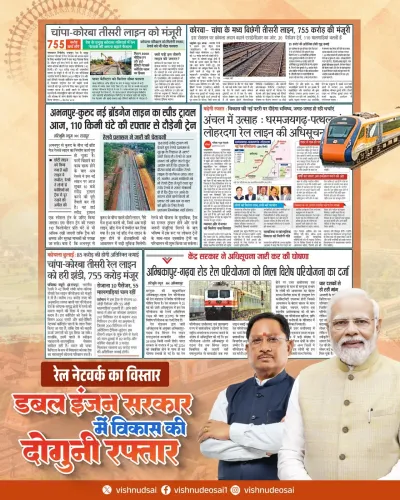
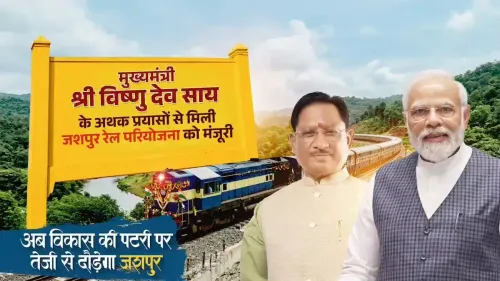
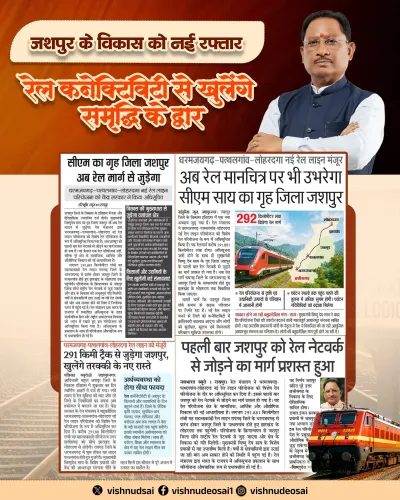
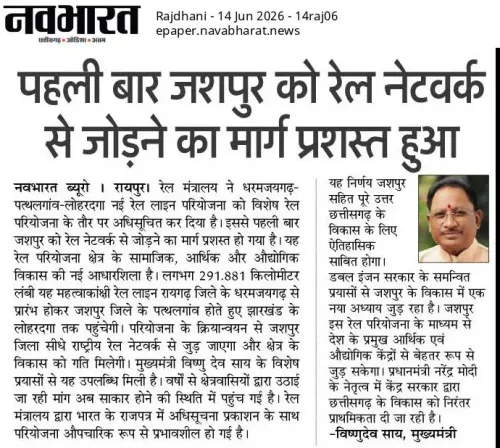
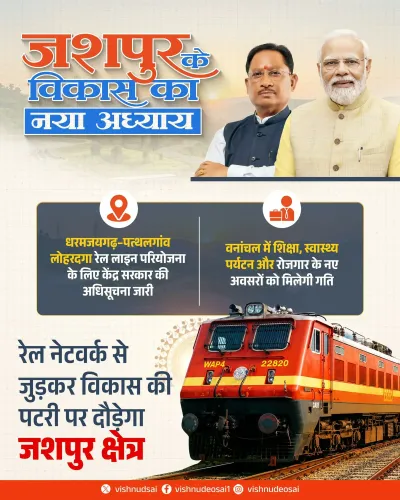
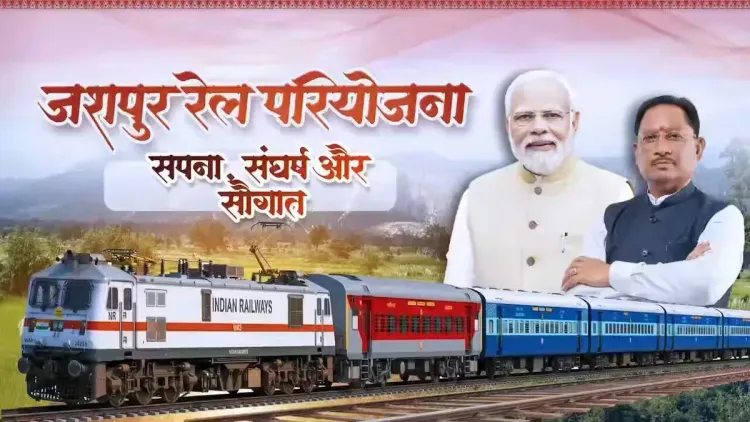
Chhattisgarh Chief Minister Vishnu Deo Sai on Saturday, 20 June 2026, announced that the long-pending Dharamjaigarh–Patthalgaon–Lohardaga rail line project has received formal approval, marking the first time Jashpur district will be connected to India's national rail network after decades of isolation.
Posting on X in Hindi, the Chief Minister wrote: 'जशपुर में रेल कनेक्टिविटी का सपना हुआ साकार, डबल इंजन सरकार में खत्म हुआ दशकों का इंतज़ार' — 'The dream of rail connectivity in Jashpur has come true; decades of waiting have ended under the double-engine government.' He added that the project would open new avenues for education, employment, trade, tourism, and development by linking Jashpur to the national network for the first time.
Context
Jashpur is a tribal-majority district in northern Chhattisgarh, bordering Jharkhand, and has historically remained cut off from the country's rail grid. The district's terrain and sparse population density made it a low priority for successive railway planning cycles, leaving residents dependent on road transport for inter-district and inter-state movement.
The proposed Dharamjaigarh–Patthalgaon–Lohardaga rail line is an inter-state project that would link Chhattisgarh's interior districts to the existing rail junction at Lohardaga in Jharkhand, effectively plugging Jashpur into the broader national network. CM Sai described the approval as 'historic,' signalling the political weight his administration attaches to the announcement.
Policy Backdrop
Rail expansion into remote tribal and forested districts has been a recurring infrastructure priority for the central government since 2014, with comparable projects advanced in Jharkhand, Odisha, and other parts of Chhattisgarh. The BJP's 'double engine' framing — simultaneous BJP rule at the Centre and in the state — is routinely invoked to explain the acceleration of such long-pending clearances.
Chhattisgarh's BJP government, which took office in December 2023 with Vishnu Deo Sai as Chief Minister, has aligned state infrastructure demands closely with central railway priorities. The current approval fits that pattern, arriving roughly two and a half years into the state administration's tenure.
Stakeholders and Impact
The primary beneficiaries of the project would be Jashpur's tribal communities, who have long faced limited access to markets, hospitals, and educational institutions beyond the district. Improved rail connectivity is expected to reduce travel time and logistics costs for local traders and agricultural producers.
Students and youth seeking employment in larger urban centres stand to gain directly, as rail access typically lowers the cost and time burden of commuting or relocating for work and higher education. Tourism to the district's forested and hilly terrain could also see a boost once the line becomes operational.
What's Next
While the approval marks a significant milestone, the project's realisation will depend on several subsequent steps: land acquisition along the proposed corridor, completion of detailed engineering surveys, and funding allocation in an upcoming Union Railway Budget. These processes have historically been the primary bottlenecks for rail projects in forested and tribal regions.
Observers will watch closely whether the project receives a dedicated budget line and a defined construction timeline, which would signal the transition from policy approval to active implementation. The pace of land acquisition in particular — given the tribal land rights framework applicable in parts of Chhattisgarh and Jharkhand — will be a key indicator of how quickly the project can move on the ground.
Point of View
Whose own political base includes tribal communities in northern Chhattisgarh, the announcement reinforces a governance identity built around closing the infrastructure gap with more developed states. The project also fits a broader central government pattern of using rail connectivity in eastern and central India as a tool for economic integration of forest-fringe districts. The real test, however, will come at the land acquisition and budget stages, where comparable projects have stalled for years despite initial approvals.
NationPress
20 Jun 2026
Frequently Asked Questions
What is the Dharamjaigarh–Patthalgaon–Lohardaga rail line?
It is a proposed inter-state railway project that will connect Chhattisgarh's interior districts of Dharamjaigarh and Patthalgaon to the existing rail junction at Lohardaga in Jharkhand, bringing Jashpur district onto the national rail network for the first time.
Why is Jashpur getting a railway line only now?
Jashpur is a tribal-majority, forested district in northern Chhattisgarh that was historically deprioritised in railway planning due to difficult terrain and low population density. The project has been pending for decades and has now received formal approval.
Who announced the Jashpur rail project approval?
Chhattisgarh Chief Minister Vishnu Deo Sai announced the approval on 20 June 2026 via a post on X, calling it a historic achievement for the district.
What does 'double engine government' mean in this context?
'Double engine government' is a BJP phrase referring to the same party being in power both at the Centre and in the state, which the party argues enables faster clearance and implementation of infrastructure projects.
When will the Jashpur rail line be built?
No construction timeline has been announced yet. The project must still go through land acquisition, detailed engineering surveys, and allocation of funds in a Union Railway Budget before work can begin.