CM Sai Hails Rail Line Nod for Jashpur's Tribal Belt
Synopsis
Chhattisgarh CM Vishnu Deo Sai announced on 14 June 2026 that the Centre has issued a notification for the Dharamjaygarh-Patthalgaon-Lohardaga rail line, promising new connectivity for the tribal-majority Jashpur region in education, health, trade, and employment.
Key Takeaways
The central government has issued a formal notification for the Dharamjaygarh-Patthalgaon-Lohardaga rail line project .
CM Vishnu Deo Sai announced the development on 14 June 2026 , calling it a new chapter for the Jashpur region.
The proposed line will connect remote northern Chhattisgarh with Lohardaga in Jharkhand , bridging a cross-state connectivity gap.
Jashpur district is a tribal-majority, forested area historically underserved by rail infrastructure.
The project is expected to expand opportunities in education, health, tourism, trade, and employment across the vananchal zone.
Next steps include a detailed project report, forest and environmental clearances, and land acquisition proceedings.
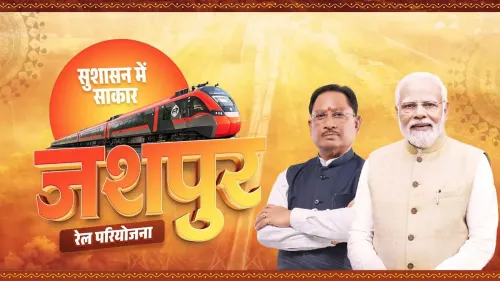
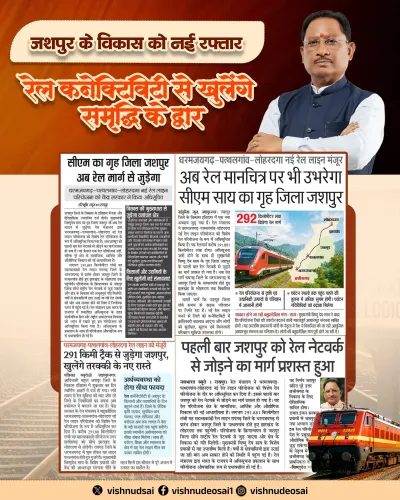
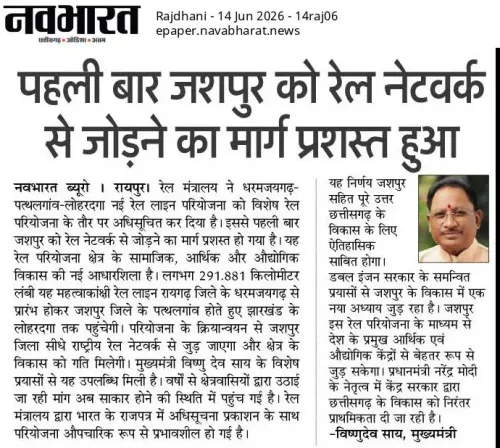
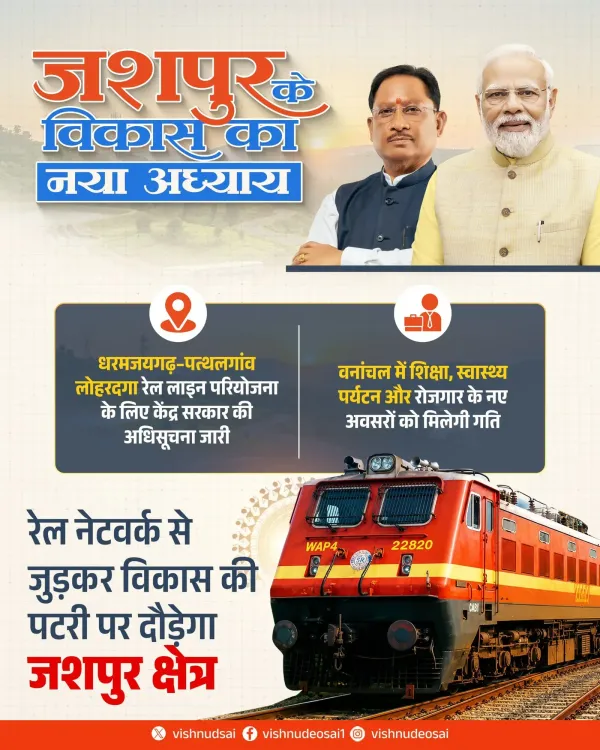
Chhattisgarh Chief Minister Vishnu Deo Sai announced on Sunday, 14 June 2026 that the central government has issued a formal notification for the Dharamjaygarh-Patthalgaon-Lohardaga rail line project, marking what he called a new chapter in the development of the Jashpur region. The announcement was made via a post on X, in which the Chief Minister said the project would open new doors of progress and prosperity for the forested tribal belt.
Context
Jashpur district, situated in the forested northern reaches of Chhattisgarh, is a tribal-majority area that has historically remained underserved by rail infrastructure. The proposed line would connect Dharamjaygarh and Patthalgaon in northern Chhattisgarh with Lohardaga in the neighbouring state of Jharkhand, bridging a long-standing connectivity gap between the two states' interior regions.
CM Sai's post, written in Hindi, declared: 'जशपुर क्षेत्र के विकास का नया अध्याय' ('A new chapter in the development of the Jashpur region'), adding that the rail link would expand opportunities in education, health, tourism, trade, and employment across the vananchal (forested) zone.
Policy Backdrop
The notification continues a pattern established since 2014, when successive central railway budgets began prioritising new lines and track-doubling projects in Chhattisgarh's and Jharkhand's tribal belts to address deep-rooted connectivity deficits. The framing of such projects as instruments for integrating remote forested communities with markets, schools, and hospitals has been consistent across multiple administrations.
The Ministry of Railways is the nodal authority responsible for issuing project notifications, commissioning detailed project reports, and overseeing survey and funding approvals for new lines of this nature. A central notification is typically an early but significant step in the project pipeline.
Stakeholders and Impact
The primary beneficiaries of the proposed corridor are the tribal communities, forest dwellers, and local traders of the Jashpur belt, who currently depend on road transport for access to district headquarters, hospitals, and markets. A rail link is expected to reduce travel time and logistics costs substantially for goods and passengers alike.
The line's cross-state alignment — connecting Chhattisgarh with Jharkhand at Lohardaga — also holds significance for regional economic integration, potentially easing the movement of mineral produce, agricultural goods, and daily commuters across the two states' shared tribal corridor.
What's Next
Following the central notification, the project's progress will hinge on the preparation of a detailed project report, forest and environmental clearances under relevant central laws, and land acquisition proceedings coordinated between the state government and the Ministry of Railways. These stages have historically been the most time-intensive elements of rail expansion in forested regions.
With the notification now in place, the Sai government is expected to accelerate state-level coordination to ensure the project moves swiftly through regulatory approvals — a test of its ability to translate central clearances into ground-level implementation in one of Chhattisgarh's most remote districts.
Point of View
But the real political and developmental test lies ahead in navigating forest clearances and land acquisition in one of India's most ecologically sensitive tribal zones. For CM Sai, amplifying this announcement serves a dual purpose: reinforcing the BJP's 'development for tribals' narrative ahead of future electoral cycles and demonstrating that Chhattisgarh's new government can leverage its alignment with the Centre into tangible infrastructure wins. The cross-state dimension — linking Chhattisgarh with Jharkhand — also fits into a broader Union government pattern of knitting together the central Indian tribal belt through rail, a strategy with both economic and strategic underpinnings.
NationPress
19 Sept 2026
Frequently Asked Questions
What is the Dharamjaygarh-Patthalgaon-Lohardaga rail line project?
It is a proposed new railway line that will connect Dharamjaygarh and Patthalgaon in northern Chhattisgarh with Lohardaga in Jharkhand, aimed at improving connectivity in the tribal-majority Jashpur region.
Why is the Jashpur rail line significant for tribal communities?
Jashpur district is a forested, tribal-majority area historically lacking rail connectivity. The new line is expected to improve access to education, healthcare, markets, and employment for local tribal communities and forest dwellers.
What does a central government notification for a rail project mean?
A central notification from the Ministry of Railways is an early but important step that formally recognises the project, enabling subsequent stages such as detailed project reports, surveys, environmental clearances, and land acquisition.
Who announced the Jashpur rail line notification?
Chhattisgarh Chief Minister Vishnu Deo Sai announced the central government's notification on 14 June 2026 via a post on X.
What are the next steps for the Dharamjaygarh-Lohardaga rail project?
The project must now go through preparation of a detailed project report, forest and environmental clearances under central laws, and land acquisition coordinated between the Chhattisgarh state government and the Ministry of Railways.