CM Sai marks 7 years of Article 370 abrogation
Synopsis
Chhattisgarh CM Vishnu Deo Sai marked the seventh anniversary of Article 370's abrogation on 5 August 2026, calling the 2019 decision an epoch-making step that fulfilled Dr. Shyama Prasad Mukherjee's lifelong demand for one constitution across all of India.
Key Takeaways
5 August 2026 marks seven years since the abrogation of Articles 370 and 35A through a presidential order and parliamentary resolution.
Chhattisgarh CM Vishnu Deo Sai credited PM Narendra Modi and Home Minister Amit Shah for the constitutional change.
The 2019 decision bifurcated the former state of Jammu and Kashmir into two Union Territories: Jammu and Kashmir and Ladakh .
Shyama Prasad Mukherjee 's slogan — one country, one constitution, one flag, one head — as the ideological foundation of the move.
The BJP had committed to abrogating Article 370 in its 2014 and 2019 general election manifestos, making the 2019 action a fulfilment of a core party promise.
Seven years after a presidential order rewrote the constitutional map of India's north, Chhattisgarh Chief Minister Vishnu Deo Sai has marked the anniversary of Article 370's abrogation with a pointed tribute — invoking founding-era ideology, present-day development, and the BJP's longest-held promise all in one breath.
In a post on 5 August 2026, CM Sai called the 2019 decision a yugantakari kadam — 'epoch-making step' — crediting Prime Minister Narendra Modi's 'visionary leadership' and Union Home Minister Amit Shah's resolve for rendering the special provisions of Articles 370 and 35A ineffective. The move, he wrote, connected Jammu and Kashmir and Ladakh to equal rights, equal opportunity, and the mainstream of national development.
The decision that split a state in two
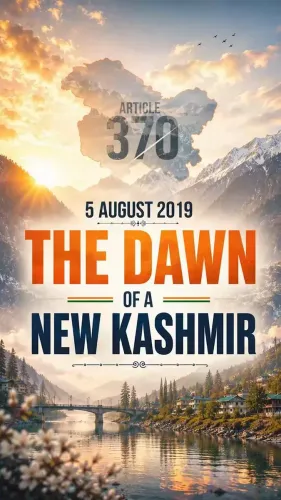
On 5 August 2019, the Modi government moved a presidential order and a parliamentary resolution that simultaneously abrogated Article 370 — which had granted Jammu and Kashmir its special autonomous status since 1949 — and dissolved Article 35A, which had restricted property rights and permanent residency to the state's own defined subjects. The former state was bifurcated into two Union Territories: Jammu and Kashmir, with a legislature, and Ladakh, administered directly by the Centre without one. It was among the most consequential constitutional interventions in independent India's history. Done in a single parliamentary session, it moved faster than almost anyone had anticipated.
Shyama Prasad Mukherjee's echo across seven decades
CM Sai's post leaned heavily on the legacy of Dr. Shyama Prasad Mukherjee, the founder of the Bharatiya Jana Sangh — ideological forerunner of the BJP — who campaigned against Article 370 with the slogan: 'Ek desh mein do vidhaan, do nishaan aur do pradhaan nahin chalenge' ('One country cannot have two constitutions, two flags, and two heads of state'). Mukherjee died in detention in 1953 while agitating against the permit system that restricted Indians from entering Jammu and Kashmir freely. For the BJP, the 2019 abrogation was the literal fulfilment of that seven-decade-old demand — a point Sai makes explicit in his anniversary post.
J&K and Ladakh six years on
CM Sai's post points to new dimensions being established in development, investment, tourism, education, infrastructure, and public welfare across both Union Territories. The research notes that the BJP's 2019 move shifted the region from special status to direct central administration, with an emphasis on uniform laws and centrally-sponsored development schemes — a framework the party had promised in its 2014 and 2019 general election manifestos. The specific figures and outcomes cited in the post as of 2026 go beyond independently verifiable data, but the broad policy direction — central investment, democratic restoration, and integration into national frameworks — has been the stated goal since day one.
The eyes of policy-watchers remain on the pace of assembly elections in Jammu and Kashmir and the delivery of infrastructure and investment commitments in Ladakh. Those outcomes will ultimately define whether the constitutional transformation translates into the lived reality that leaders like CM Sai are celebrating today.
Point of View
Frames constitutional uniformity as developmental justice, and keeps the 2019 abrogation alive as a mobilising symbol heading into future electoral cycles. The invocation of Shyama Prasad Mukherjee is deliberate — it roots a government decision in a 70-year-old moral claim, making it harder to contest on purely political grounds. With Jammu and Kashmir's assembly now restored and Ladakh's governance model still debated, the anniversary also serves as a subtle signal that the Centre views the integration project as settled and irreversible. Regional leaders echoing this line suggests the party is building a coordinated national narrative around the seventh-year milestone.
NationPress
5 Aug 2026
Frequently Asked Questions
What happened on 5 August 2019 in India?
On 5 August 2019 , the Indian government abrogated Article 370 and Article 35A through a presidential order and parliamentary resolution, revoking Jammu and Kashmir's special autonomous status and bifurcating it into two Union Territories: Jammu and Kashmir, and Ladakh.
What did Article 370 do?
Article 370 granted the former state of Jammu and Kashmir a special autonomous status, allowing it to have its own constitution and restricting the application of Indian laws without the state government's concurrence. Article 35A additionally restricted property ownership and permanent residency to state subjects.
Who was Shyama Prasad Mukherjee and why is he associated with Article 370?
Dr. Shyama Prasad Mukherjee was the founder of the Bharatiya Jana Sangh who campaigned against Article 370 with the slogan demanding one constitution, one flag, and one head of state for all of India. He died in detention in 1953 while agitating against restrictions on Indians entering Jammu and Kashmir.
Why is Chhattisgarh CM Vishnu Deo Sai posting about Article 370?
Chhattisgarh CM Vishnu Deo Sai , a senior BJP leader, marked the seventh anniversary of the 2019 abrogation to reaffirm his party's ideological commitment to constitutional uniformity and national integration, crediting PM Modi and Home Minister Amit Shah for the decision.
What is the current status of Jammu and Kashmir after Article 370 was removed?
After the 2019 abrogation, Jammu and Kashmir became a Union Territory with a legislature, while Ladakh became a separate Union Territory administered directly by the Centre. Both territories are subject to the same central laws as the rest of India.