CM Sai: PM Surya Ghar turning Chhattisgarh families into energy producers
Synopsis
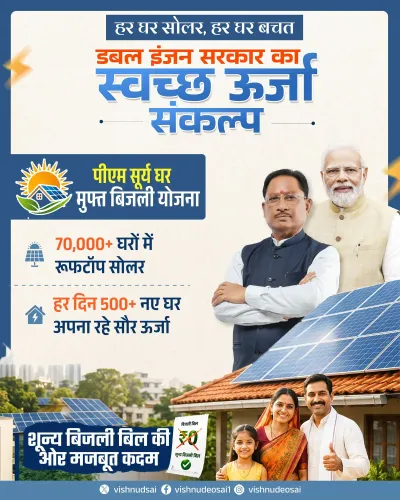
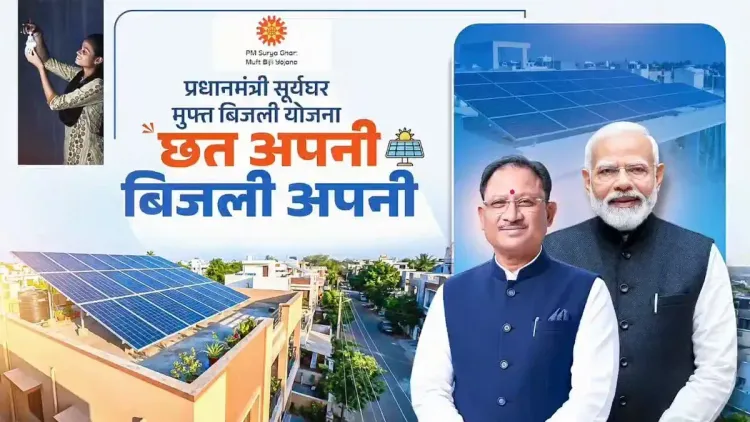
Chhattisgarh CM Vishnu Deo Sai highlighted the PM Surya Ghar: Muft Bijli Yojana on 6 October 2026, saying rooftop solar panels are transforming thousands of state households into clean-energy producers, advancing the state toward energy self-reliance and a green future.
Key Takeaways
CM Vishnu Deo Sai on 6 October 2026 spotlighted the reach of PM Surya Ghar: Muft Bijli Yojana in Chhattisgarh.
The scheme aims to deliver up to 300 units of free electricity per month to eligible households via rooftop solar installations.
The national target of the programme is one crore households covered with subsidised rooftop solar.
CM Sai described households shifting from energy consumers to energy producers as Chhattisgarh's new identity .
The state's push aligns with India's broader goal of 500 GW of non-fossil fuel capacity by 2030 .
Rooftop solar is seen as an equity tool, potentially making Chhattisgarh's least-served households the most energy-independent.
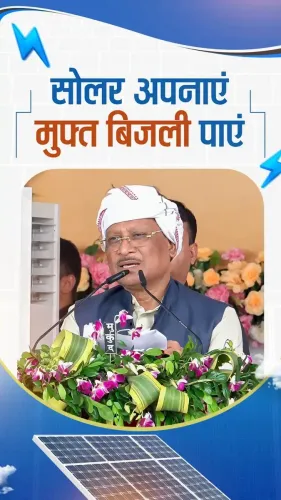
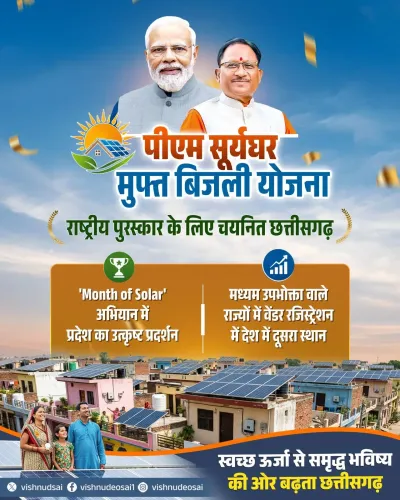
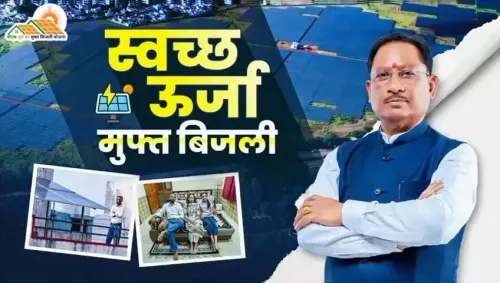
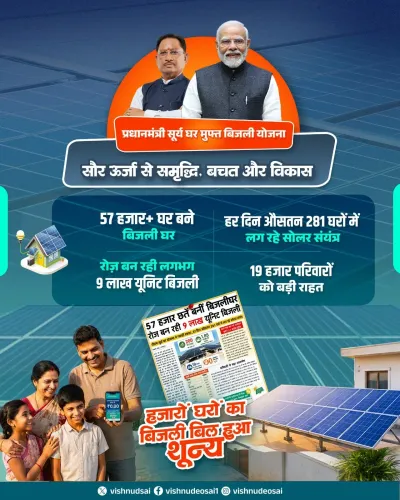
Sunlight is no longer just warming rooftops in Chhattisgarh — it is powering homes and reshaping how thousands of families think about electricity. Chhattisgarh Chief Minister Vishnu Deo Sai on Tuesday, 6 October 2026, highlighted the transformative reach of Prime Minister Narendra Modi's flagship PM Surya Ghar: Muft Bijli Yojana, saying the scheme is converting ordinary households into energy producers.
Posting on X, CM Sai wrote — 'Suraj ki roshni ab gharon ko ujala hi nahin, urja aatmanirbharta bhi de rahi hai' ('Sunlight is no longer just illuminating homes — it is now delivering energy self-reliance'). He described rooftop solar panels as driving both electricity savings and a cleaner environment, adding that Chhattisgarh was building a new identity as a state marching toward a green future.
From consumers to creators: what the scheme does
The PM Surya Ghar: Muft Bijli Yojana, launched by the central government, provides subsidised rooftop solar installations to residential households, with the goal of delivering up to 300 units of free electricity per month to eligible beneficiaries. The scheme targets one crore households nationally and offers direct financial assistance to reduce upfront installation costs, making solar adoption viable for middle- and lower-income families.
The core promise of the programme is a structural one: households stop being passive consumers drawing from the grid and begin generating their own power — with any surplus potentially fed back. That shift, from dependency to production, is precisely the 'energy self-reliance' CM Sai underscored in his post.
Chhattisgarh's rooftop solar push
Chhattisgarh's geography — abundant sunshine across its districts — makes it a natural candidate for solar scale-up. CM Sai's framing of 'solar light on every rooftop' as the state's new identity signals that the BJP-led state government is positioning itself as an active partner in the Centre's clean-energy agenda, not merely a passive recipient of central schemes.
The emphasis on clean environment and a green future ties the rooftop solar drive to a broader climate narrative — one that is increasingly central to India's domestic energy policy as the country moves to meet its renewable energy commitments.
The bigger grid: India's clean-energy moment
India has set an ambitious target of 500 GW of non-fossil fuel capacity by 2030. Rooftop solar — decentralised, household-level, subsidy-backed — is a critical piece of that puzzle, because it distributes generation rather than concentrating it in large utility projects. Each family that installs panels is, in a small but measurable way, reducing strain on the national grid and cutting carbon output.
When a state government amplifies that message, it accelerates local uptake. And in a state like Chhattisgarh, where energy access has historically been uneven, putting production capability directly on rooftops carries real equity weight. The kicker is this: if the scheme delivers on its promise, Chhattisgarh's poorest electricity consumers could end the decade as its most energy-independent households.
Point of View
The Chhattisgarh BJP government reinforces its ideological and programmatic unity with the Centre ahead of any electoral cycle. The 'consumer to producer' framing is also politically smart: it repackages a subsidy as an empowerment story, which travels better with voters. More broadly, the post reflects a growing pattern among BJP-governed states of using clean-energy milestones as both development narrative and climate-credential signalling. Whether on-ground adoption in Chhattisgarh matches the rhetoric will be the real test of the scheme's depth.
NationPress
7 Oct 2026
Frequently Asked Questions
What is PM Surya Ghar: Muft Bijli Yojana?
PM Surya Ghar: Muft Bijli Yojana is a central government scheme that provides subsidised rooftop solar panel installations to residential households, aiming to deliver up to 300 units of free electricity per month to eligible beneficiaries and targeting one crore households nationally.
How is the PM Surya Ghar scheme benefiting Chhattisgarh families?
According to CM Vishnu Deo Sai, thousands of Chhattisgarh families are installing rooftop solar panels under the scheme, reducing their electricity bills and becoming energy producers rather than just consumers, advancing the state toward energy self-reliance.
Who launched PM Surya Ghar: Muft Bijli Yojana?
The scheme was launched by Prime Minister Narendra Modi's central government as part of India's broader push to expand renewable energy access and reduce household electricity costs.
What is Chhattisgarh's role in India's solar energy targets?
Chhattisgarh, with its high sunshine availability, is positioned as an active partner in India's 500 GW non-fossil fuel capacity target by 2030. The state government under CM Vishnu Deo Sai is promoting rooftop solar adoption under the central scheme.
What did Chhattisgarh CM Vishnu Deo Sai say about solar energy?
CM Sai said that sunlight is now delivering 'energy self-reliance' to households, with rooftop panels enabling electricity savings and clean energy generation, and described solar energy on every rooftop as Chhattisgarh's new identity.