CM Sai Promotes PM Surya Ghar Free Power Scheme in Chhattisgarh
Synopsis
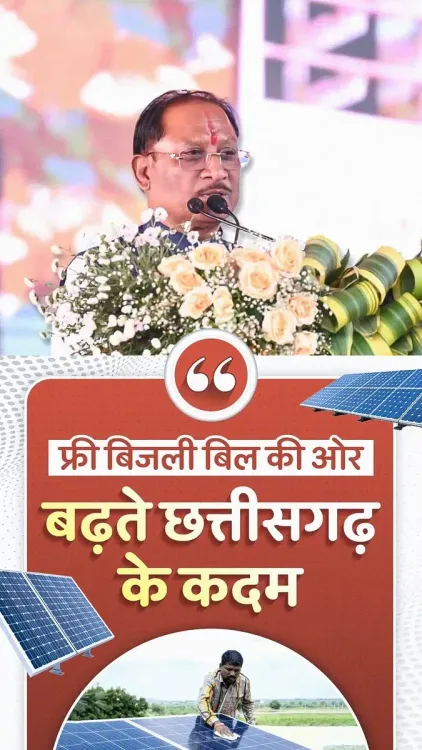
Chhattisgarh Chief Minister Vishnu Deo Sai promoted PM Surya Ghar Muft Bijli Yojana, highlighting a double-subsidy model that enables state residents to install rooftop solar panels and access up to 300 units of free electricity per month.
Key Takeaways
PM Surya Ghar Muft Bijli Yojana was launched by PM Narendra Modi in 2024 to subsidise rooftop solar adoption across India.
Eligible households can receive up to 300 units of free electricity per month under the scheme.
Chhattisgarh has layered state-level support on top of central subsidies, creating a 'double subsidy' incentive for residents.
CM Vishnu Deo Sai publicly championed the scheme on 19 November 2026 , encouraging citizens to install rooftop solar panels.
The scheme is part of India's broader push to diversify power generation through distributed rooftop solar installations.
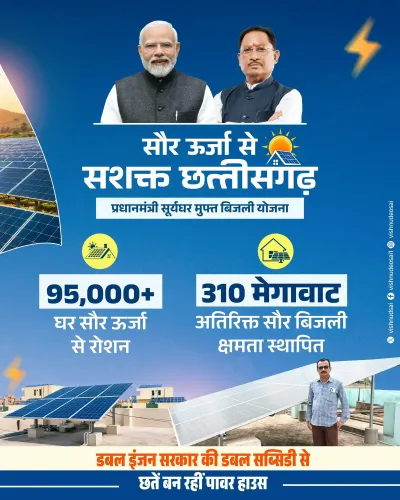
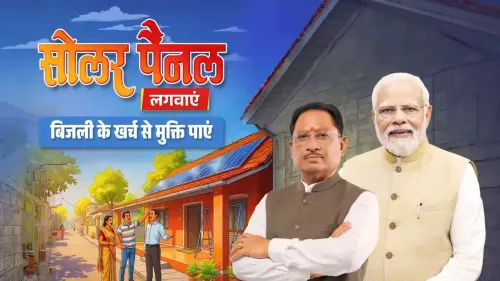
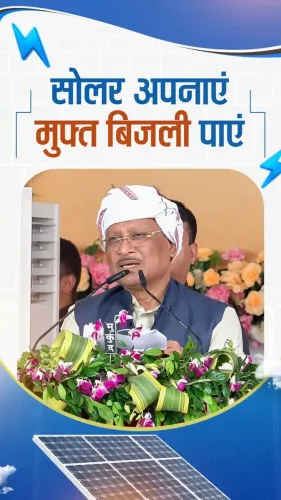
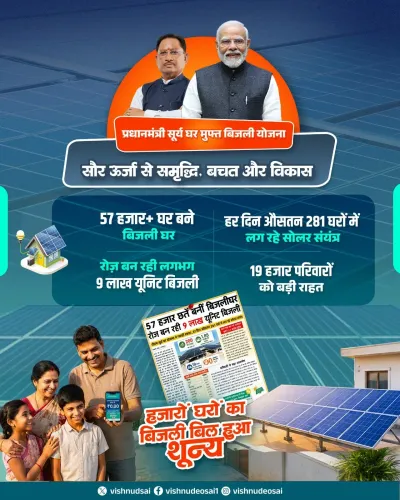
Electricity bills are a daily burden for millions of Indian households — and Chhattisgarh Chief Minister Vishnu Deo Sai wants residents of his state to know there is now a solar-powered escape route. On Thursday, 19 November 2026, CM Sai took to X to champion the PM Surya Ghar Muft Bijli Yojana, highlighting how Chhattisgarh residents are leveraging the scheme's double subsidy to install rooftop solar panels and dramatically cut their monthly power costs.
What PM Surya Ghar Promises — and What 'Double Subsidy' Means for Chhattisgarh
Launched by Prime Minister Narendra Modi in 2024, the PM Surya Ghar Muft Bijli Yojana is a central government scheme designed to accelerate rooftop solar adoption across India. Under the scheme, eligible households can receive up to 300 units of free electricity per month, with the central government providing direct subsidies to reduce the upfront cost of installing solar panels.
CM Sai's post points to a 'double subsidy' arrangement — a combination of the central government's support and an additional state-level contribution — that makes the proposition even more attractive for Chhattisgarh households. 'डबल सब्सिडी के माध्यम से छत्तीसगढ़वासी अपनी छतों पर सोलर पैनल लगवाकर इस योजना का लाभ उठा रहे हैं' — ['Through double subsidy, residents of Chhattisgarh are installing solar panels on their rooftops and benefiting from this scheme.'] The goal is straightforward: bring down household electricity bills and put energy self-sufficiency within reach of ordinary families.
Chhattisgarh's Role in India's Distributed Solar Push
Chhattisgarh is among the states that have chosen to stack their own fiscal support on top of central incentives, a model that reflects a broader national pattern. With India aggressively pursuing solar capacity targets, rooftop installations — spread across millions of homes rather than concentrated in large parks — represent a critical piece of the grid diversification puzzle.
For the state's households, particularly those in semi-urban and rural areas where electricity costs eat into tight monthly budgets, the dual-subsidy route lowers the financial barrier to ownership. The panel becomes an asset, not an expense, generating electricity and potentially feeding surplus back into the grid.
The Policy Logic Behind Freeing Homes from the Grid
India's rooftop solar drive is about more than bill relief. It is a structural shift away from dependence on coal-heavy grid power, pushing energy generation to the edge — to individual rooftops — and distributing both the benefits and the resilience. Every household that goes solar marginally reduces peak-load pressure on the state grid.
CM Sai's amplification of the scheme signals that the Chhattisgarh government is actively encouraging uptake, not merely implementing a central directive. The practical test now lies in how quickly installation pipelines, subsidy disbursements, and grid-connection approvals can scale to meet demand from households across the state.
Chhattisgarh's rooftop solar numbers — and how fast subsidy disbursal keeps pace with applications — will be the real measure of whether the double-incentive model delivers on its promise.
Point of View
The post reflects the BJP's strategic use of energy-cost relief as a welfare narrative that cuts across urban and rural constituencies, directly competing with opposition electricity-subsidy promises. The real scrutiny will fall on ground-level implementation — how efficiently Chhattisgarh processes applications, disburses subsidies, and clears grid-connection bottlenecks determines whether the political narrative holds up.
NationPress
19 Nov 2026
Frequently Asked Questions
What is PM Surya Ghar Muft Bijli Yojana?
PM Surya Ghar Muft Bijli Yojana is a central government scheme launched by Prime Minister Narendra Modi in 2024 that provides subsidies to households for installing rooftop solar panels, offering up to 300 units of free electricity per month.
How does the double subsidy work for Chhattisgarh residents under PM Surya Ghar?
Chhattisgarh residents benefit from both the central government's subsidy under PM Surya Ghar and an additional state-level contribution, reducing the upfront cost of rooftop solar panel installation further than the central scheme alone provides.
How much free electricity can a household get under PM Surya Ghar Yojana?
Under PM Surya Ghar Muft Bijli Yojana, eligible households can receive up to 300 units of free electricity per month through energy generated by their subsidised rooftop solar panels.
What did Chhattisgarh CM Vishnu Deo Sai say about PM Surya Ghar?
CM Vishnu Deo Sai posted on X on 19 November 2026 promoting the scheme, saying the double subsidy is enabling Chhattisgarh residents to install solar panels on their rooftops and reduce their daily electricity bill burden.
How can Chhattisgarh residents apply for PM Surya Ghar Muft Bijli Yojana?
Residents of Chhattisgarh can apply for PM Surya Ghar Muft Bijli Yojana through the scheme's national portal to register for rooftop solar installation and access both central and state subsidies, though specific application steps should be confirmed on the official government portal.