CM Sai Pushes Grid Power to 461 Remote Bastar Villages
Synopsis
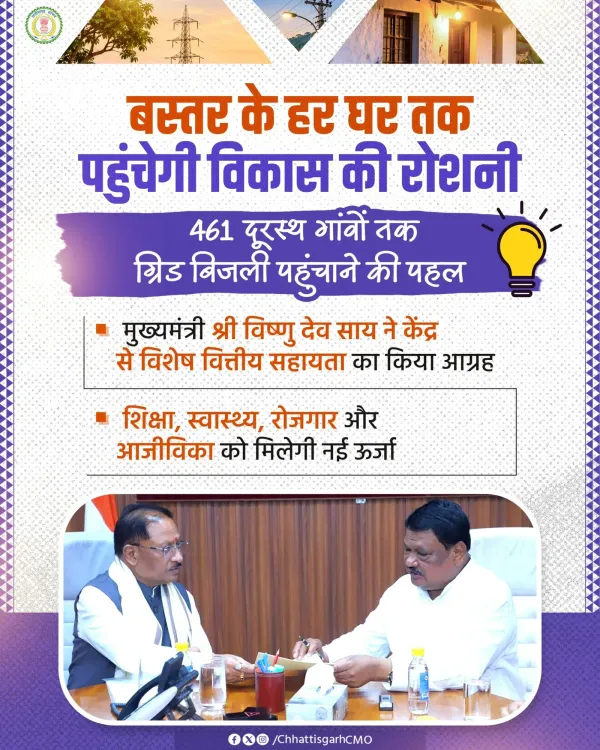
Chief Minister Vishnu Deo Sai has initiated a drive to bring grid electricity to 461 remote and formerly Naxal-affected villages in Chhattisgarh's Bastar division, marking it the state government's highest development priority as security conditions improve.
Key Takeaways
461 remote and formerly Naxal-affected villages in Bastar division are targeted for grid electricity connectivity.
CM Vishnu Deo Sai , in office since December 2023 , has personally driven this initiative as a top state priority.
Decades of Naxal violence had blocked basic infrastructure from reaching these habitations.
The push follows India's combined security-and-development doctrine in Left Wing Extremism districts, with improved ground conditions enabling infrastructure access.
The central Saubhagya scheme (2017) provides the policy foundation for last-mile rural electrification that this initiative extends.
Specific project timelines and funding allocations have not yet been officially disclosed.
For villages that spent decades cut off from the grid — not by geography alone, but by the shadow of Naxal violence — electricity is now a state promise. The Chief Minister's Office of Chhattisgarh announced on Sunday, August 2, 2026 that Chief Minister Vishnu Deo Sai has initiated a push to extend grid electricity to 461 remote and formerly Naxal-affected villages in the Bastar division, framing it as the state government's highest priority.
Darkness that development skipped
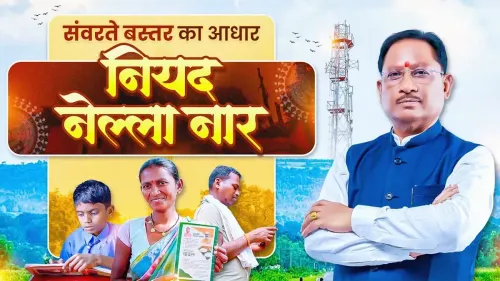
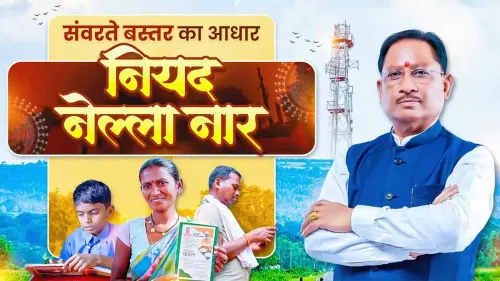
Bastar, the vast southern division of Chhattisgarh, carries one of independent India's most stubborn development deficits. Decades of Left Wing Extremism made it impossible for contractors, engineers, and grid infrastructure to reach deep forest habitations — not because the will was absent, but because the road in was dangerous. The CMO's post put it plainly: 'जिन गांवों तक नक्सल हिंसा के कारण वर्षों तक विकास नहीं पहुंच सका' — 'villages where development could not reach for years due to Naxal violence.'
That isolation is now the explicit target. Grid electricity — not solar micro-grids or diesel generators, but full grid connectivity — is what the state is committing to these 461 villages.
Security gains opening the door for power lines
The timing matters. Indian states have long pursued a combined security-and-development doctrine in Left Wing Extremism districts: as counter-insurgency operations reduce militant presence, roads and power lines follow. Chhattisgarh has repeatedly identified Bastar as the frontline of this approach, and the current administration under CM Sai — in office since December 2023 — has made tribal-region infrastructure a signature priority.
The central government's Saubhagya scheme, launched in 2017, established the policy architecture for last-mile rural electrification across India, including in challenging Left Wing Extremism zones. The current Bastar initiative builds on that foundation, directing it at habitations that even Saubhagya's first wave could not fully reach.
What 461 villages actually means on the ground
Each village in this count represents a community of tribal households — predominantly Adivasi families — for whom electricity would mean functional health centres, charged mobile phones, children studying after dark, and small enterprises coming alive. The state government says electrifying these villages will give 'Bastar ke vikas ko nayi gati' — 'new momentum to Bastar's development.' Specific project timelines, funding allocations, and contractor details are yet to be officially disclosed.
Watch for the implementation schedule: the distance between a policy announcement and a live grid connection in deep Bastar forest is measured not just in kilometres, but in logistics, security cover, and community trust built over years.
Point of View
And it consolidates the state's political narrative that the Naxal era is receding. The real test will be implementation speed — Bastar's terrain and residual security sensitivities have a history of stretching timelines well beyond announcements. If the grid connections materialise at scale, it would mark a meaningful inflection point in one of India's longest-running development emergencies.
NationPress
2 Aug 2026
Frequently Asked Questions
Which villages in Bastar will get electricity under CM Sai's initiative?
The initiative targets 461 remote and formerly Naxal-affected villages in the Bastar division of Chhattisgarh. A specific village-by-village list has not been publicly released yet.
Why did these Bastar villages not have electricity before?
Decades of Naxal insurgency made it dangerous and logistically impossible to extend grid infrastructure into deep forest habitations in Bastar. Violence disrupted construction work and kept contractors and engineers away from these areas for years.
What is the Saubhagya scheme and how does it relate to Bastar electrification?
The Saubhagya scheme was launched by the central government in 2017 to achieve last-mile rural household electrification across India, including in Left Wing Extremism-affected districts. The current Bastar initiative extends that framework to villages that earlier phases could not fully reach.
Who is Vishnu Deo Sai and when did he become Chief Minister of Chhattisgarh?
Vishnu Deo Sai became Chief Minister of Chhattisgarh in December 2023 . He has focused on extending basic services and infrastructure to the state's tribal regions, with Bastar as a stated priority zone.
When will the 461 Bastar villages actually get grid electricity?
The state government has not yet announced specific project timelines or completion dates. Details on funding allocations and implementation schedules are awaited.