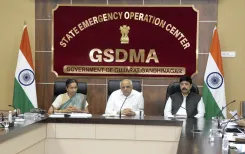
CM Saini Backs Cabinet Nod for BHAVYA Rasayan Scheme
Synopsis
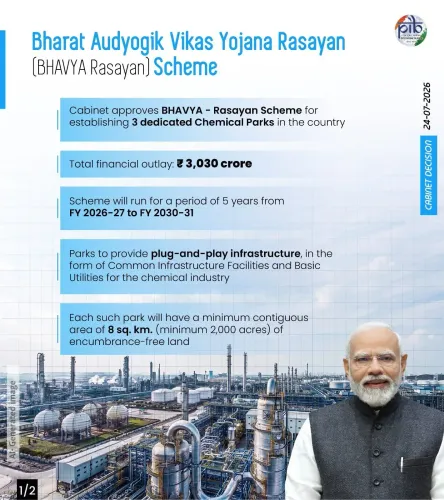
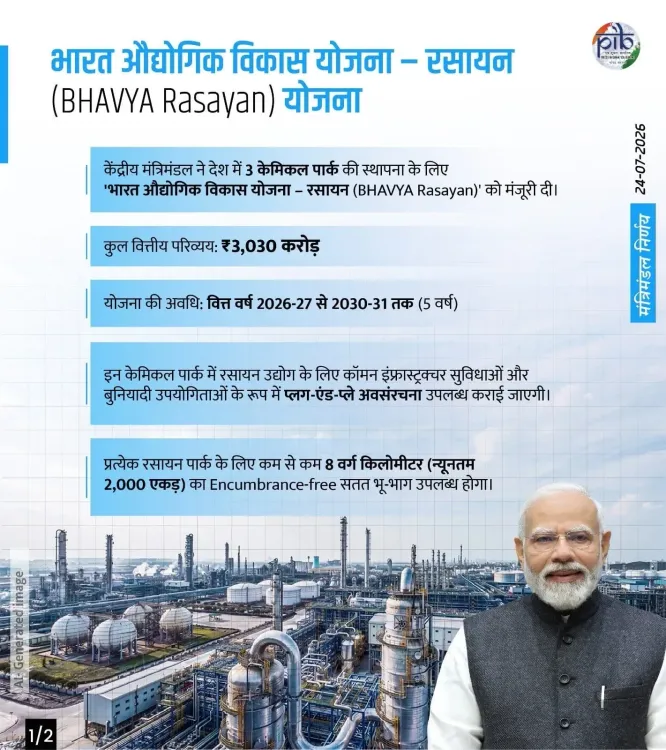
The Union Cabinet has approved the BHAVYA - Rasayan Scheme with a ₹3,030 crore outlay to develop chemical parks across India. Haryana CM Nayab Singh Saini welcomed the decision, crediting PM Modi's leadership and calling it a step toward making India's chemical industry globally competitive.
Key Takeaways
The Union Cabinet approved the BHAVYA - Rasayan Scheme on 24 July 2026 .
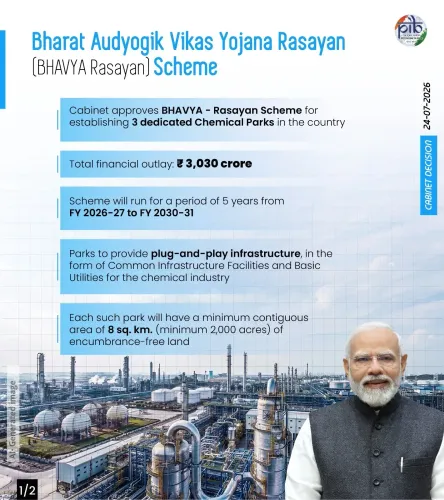
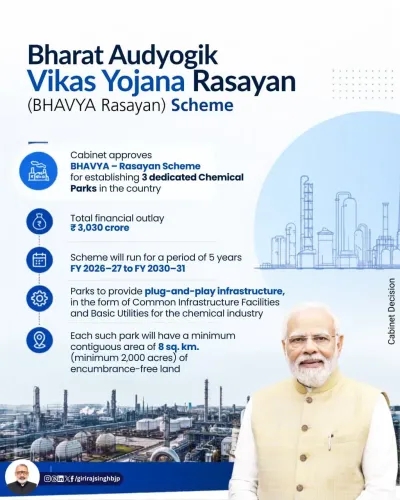
The scheme carries a total outlay of ₹3,030 crore for developing dedicated chemical parks.
The parks aim to strengthen industrial infrastructure, attract investment, and generate large-scale employment.
Haryana CM Nayab Singh Saini publicly welcomed the decision, attributing it to PM Narendra Modi's leadership.
The scheme aligns with India's Viksit Bharat vision and the broader Atmanirbhar Bharat manufacturing push.
Next steps include release of scheme guidelines and state-level identification of chemical park locations.
Haryana Chief Minister Nayab Singh Saini on Friday, 24 July 2026, welcomed the Union Cabinet's approval of the BHAVYA - Rasayan Scheme, calling it a landmark decision that will give India's chemical industry a new identity in global competition. The scheme carries an outlay of ₹3,030 crore and envisages the development of dedicated chemical parks across the country.
Context
Posting on X, CM Saini described the cabinet decision as one that will strengthen industrial infrastructure, attract investment, and generate employment at scale. In his post, he wrote — 'BHAVYA - Rasayan Scheme ko mili swikriti Bharat ke rasayanik udyog ko vaishvik pratispardha mein nayi pahchaan dilaane wala mahatvapurna nirnay hai' — [The approval of the BHAVYA - Rasayan Scheme is an important decision that will give India's chemical industry a new identity in global competition.] He extended his gratitude to Prime Minister Narendra Modi, whose leadership he credited for the decision.
Policy Backdrop
The BHAVYA - Rasayan Scheme fits within a broader industrial policy push that the central government has pursued over recent years. Dedicated chemical and petrochemical parks have been a recurring instrument in India's strategy to cut import dependence in the sector and raise its share in global value chains, building on the Atmanirbhar Bharat manufacturing framework and earlier Production Linked Incentive programmes covering chemicals and petrochemicals launched in 2020.
The ₹3,030 crore outlay signals a significant capital commitment to physical infrastructure — land, utilities, and common facilities — that industry stakeholders have long sought to reduce the cost of setting up chemical manufacturing units in India. The scheme aligns with the government's overarching Viksit Bharat vision, which targets a fully developed Indian economy by 2047.
Stakeholders and Impact
The primary beneficiaries of the scheme are expected to be chemical manufacturers, industrial investors, and the manufacturing workforce. Dedicated parks lower entry barriers for smaller producers by providing shared infrastructure, while also offering large-scale investors the certainty of planned industrial zones with regulatory clarity.
Employment generation is a stated objective of the scheme, as highlighted by CM Saini in his post. The chemical sector is a significant contributor to India's industrial output and export earnings, and expanding its domestic manufacturing base is seen as key to reducing the country's reliance on imports, particularly from China.
What's Next
Attention will now shift to the release of detailed scheme guidelines, the identification of locations for chemical parks, and state-level execution frameworks. Haryana, with its existing industrial belt along the Delhi-Mumbai Industrial Corridor, is among the states that could potentially host such facilities. Industry bodies are expected to engage with the government on investment proposals in the weeks ahead.
The cabinet approval marks the beginning of an implementation cycle whose outcomes — in terms of investment mobilisation and job creation — will determine whether the scheme delivers on its stated ambitions for India's chemical sector.
Point of View
Textiles, and pharmaceuticals. CM Saini's swift endorsement reflects the BJP's consistent pattern of aligning state-level messaging with central government policy announcements, particularly ahead of electoral cycles. The ₹3,030 crore commitment is substantial, but the scheme's credibility will ultimately rest on execution timelines and whether the parks attract anchor investors. If implemented effectively, it could meaningfully shift India's position in global chemical value chains, where the country has historically punched below its weight.
NationPress
24 Jul 2026
Frequently Asked Questions
What is the BHAVYA Rasayan Scheme?
The BHAVYA - Rasayan Scheme is a central government initiative approved by the Union Cabinet to develop dedicated chemical parks across India with a total outlay of ₹3,030 crore, aimed at boosting industrial infrastructure, investment, and employment in the chemical sector.
What is the budget for the BHAVYA Rasayan Scheme?
The Union Cabinet has approved an outlay of ₹3,030 crore for the BHAVYA - Rasayan Scheme to fund the development of chemical parks in India.
Why did CM Nayab Singh Saini praise the BHAVYA Rasayan Scheme?
Haryana CM Nayab Singh Saini welcomed the scheme as a significant step to make India's chemical industry globally competitive, crediting PM Narendra Modi's leadership for the cabinet decision.
How does the BHAVYA Rasayan Scheme connect to Viksit Bharat?
The scheme aligns with the government's Viksit Bharat vision of building a fully developed India by 2047, using industrial infrastructure investment to strengthen domestic manufacturing and reduce import dependence.
What are chemical parks and how will they help India?
Chemical parks are dedicated industrial zones with shared infrastructure, utilities, and facilities that lower costs for chemical manufacturers, attract investment, and support large-scale job creation — helping India compete in global chemical value chains.