CM Samrat Choudhary Backs India's Resilience Under PM Modi
Synopsis
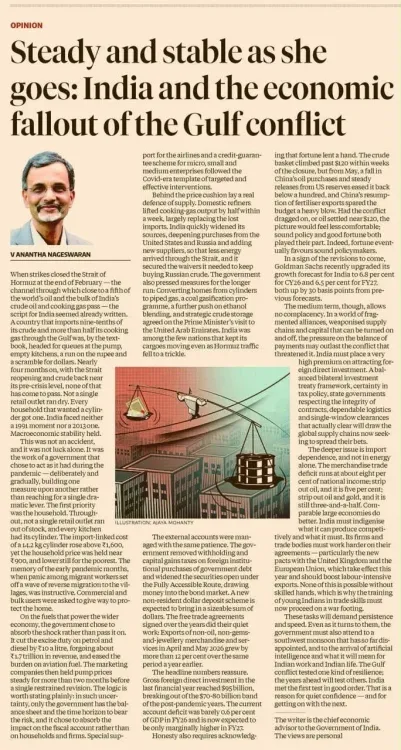
Bihar Chief Minister Samrat Choudhary has amplified Chief Economic Adviser Dr. V Anantha Nageswaran's article arguing that PM Modi's decade of decisive policy choices built India's resilience through global crises, framing it as proof of a self-reliant Aatmanirbhar Bharat.
Key Takeaways
Bihar CM Samrat Choudhary shared and endorsed an article by Chief Economic Adviser Dr.
V Anantha Nageswaran on 29 June 2026 .
The article argues that ten years of policy decisions under PM Narendra Modi have built structural economic resilience in India.
Choudhary invoked the Aatmanirbhar Bharat framework, launched in May 2020 , as a symbol of India's self-reliant approach to global disruptions.
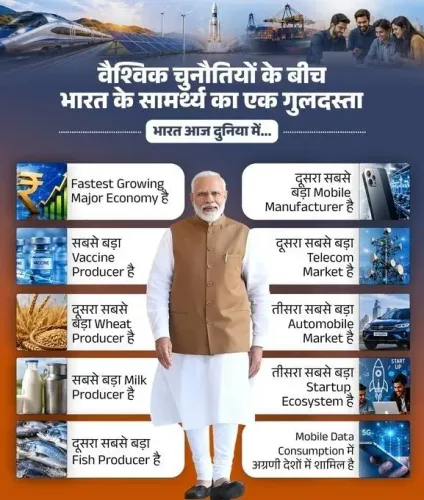
India's crisis-era record cited includes navigating the COVID-19 pandemic , global supply-chain shocks, and energy-price volatility.
The post also references India's role in 'supporting partner nations,' aligning with the country's vaccine-diplomacy and G20 presidency legacy.
The amplification by a senior BJP state leader signals coordinated political messaging around economic resilience ahead of upcoming electoral cycles.
Bihar Chief Minister Samrat Choudhary on Monday, 29 June 2026, shared an endorsement of Chief Economic Adviser Dr. V Anantha Nageswaran's article, highlighting how India's policy decisions over the last decade under Prime Minister Narendra Modi have enabled the country to weather successive global crises while supporting both its citizens and partner nations.
Context
Choudhary's post draws attention to a piece authored by Dr. V Anantha Nageswaran, India's Chief Economic Adviser, which argues that decisive governance choices made over the past ten years have built structural resilience into the Indian economy. The Bihar CM summarised the article's thrust as proof that India did not merely survive global disruptions — it emerged stronger. The post frames this as evidence of an Aatmanirbhar Bharat (self-reliant India) in action.
The reference to 'the last decade' points to the period since 2014, when the BJP-led National Democratic Alliance came to power at the Centre under Prime Minister Modi. During this period, India navigated multiple overlapping shocks: the COVID-19 pandemic, global supply-chain disruptions, the Russia-Ukraine conflict's inflationary spillover, and volatility in energy and food markets.
Policy Backdrop
The Aatmanirbhar Bharat initiative, launched in May 2020 as part of India's pandemic-response package, became the overarching framework for domestic production, import substitution, and supply-chain localisation across sectors including defence, electronics, pharmaceuticals, and agriculture. The government paired this with production-linked incentive (PLI) schemes, infrastructure investment through the PM Gati Shakti master plan, and direct-benefit transfer programmes to shield vulnerable populations from inflationary pressures.
Dr. Nageswaran, appointed Chief Economic Adviser in January 2022, has consistently argued in official documents — including successive Economic Surveys — that India's macroeconomic fundamentals are structurally stronger than peer emerging economies, citing controlled fiscal deficits, a rebuilt foreign-exchange reserve buffer, and a formalised digital-payments infrastructure. His article, as cited by Choudhary, appears to extend that argument into a broader narrative of crisis-era governance success.
Stakeholders and Impact
For Bihar, one of India's largest states by population, the framing of national resilience carries direct political resonance. The state has been a significant beneficiary of centrally sponsored welfare schemes — from PM Awas Yojana housing grants to Jal Jeevan Mission tap-water connections — which the ruling alliance regularly cites as evidence of pro-poor governance. Choudhary, as a senior BJP leader and the state's Chief Minister, amplifying a narrative of decade-long policy success aligns with the party's broader electoral messaging ahead of state and national cycles.
On the international dimension, the post's phrase 'supporting partner nations' echoes India's vaccine-diplomacy record during COVID-19, its food-grain exports to crisis-hit countries, and its role in the G20 presidency in 2023, during which New Delhi positioned itself as a voice for the Global South. Choudhary's endorsement signals that this foreign-policy posture is being actively woven into domestic political communication.
What's Next
With the Union Budget 2026-27 cycle underway and state assembly elections on the horizon in several states, the BJP's communication apparatus is likely to intensify its messaging around economic resilience and self-reliance. Dr. Nageswaran's article, amplified by senior state leaders like Choudhary, suggests a coordinated effort to anchor public discourse around India's crisis-management record as a governance credential. If the article gains wider traction, it could shape the terms of the economic debate heading into the next political season — positioning Aatmanirbhar Bharat not just as a scheme but as a proven national doctrine.
Point of View
The messaging gains an air of institutional credibility beyond partisan assertion. The invocation of Aatmanirbhar Bharat signals that the self-reliance doctrine, originally a pandemic emergency response, is now being cemented as a long-term ideological pillar. Expect this framing to intensify as the party builds its economic record ahead of the next major electoral contests.
NationPress
28 Sept 2026
Frequently Asked Questions
What did Bihar CM Samrat Choudhary post about on 29 June 2026?
Samrat Choudhary shared Chief Economic Adviser Dr. V Anantha Nageswaran's article arguing that PM Modi's policy decisions over the last decade enabled India to navigate global crises and support partner nations, calling it evidence of a resilient, self-reliant Aatmanirbhar Bharat.
Who is Dr. V Anantha Nageswaran?
Dr. V Anantha Nageswaran is India's Chief Economic Adviser, appointed in January 2022. He advises the Union government on economic policy and is the principal author of the annual Economic Survey presented before the Union Budget.
What is Aatmanirbhar Bharat?
Aatmanirbhar Bharat, meaning 'self-reliant India,' is a policy initiative launched by PM Narendra Modi in May 2020 as part of India's COVID-19 economic response. It encompasses production-linked incentives, import substitution, and domestic manufacturing promotion across key sectors.
How has India demonstrated resilience during global crises under PM Modi?
India navigated the COVID-19 pandemic through large-scale vaccine production and distribution, managed energy and food-price shocks from the Russia-Ukraine conflict, and maintained macroeconomic stability through fiscal consolidation and foreign-exchange reserve management, according to government assessments.
Why is Bihar CM Samrat Choudhary sharing articles about national economic policy?
As a senior BJP leader and Bihar's Chief Minister, Choudhary regularly amplifies the central government's governance narrative. Sharing articles that credit PM Modi's economic policies aligns with the party's political communication strategy, particularly ahead of state and national elections.