CM Samrat Choudhary Cites NFHS-6 Data on India's Health Gains
Synopsis
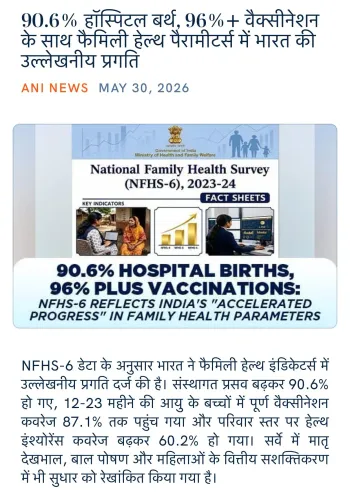
Bihar Chief Minister Samrat Choudhary cited NFHS-6 data on 30 May 2026, highlighting institutional deliveries at 90.6%, ANC coverage at 95.9%, and full immunisation at 87.1%, attributing the gains to health reforms under Prime Minister Narendra Modi.
Key Takeaways
Bihar CM Samrat Choudhary shared NFHS-6 health data on 30 May 2026 , crediting PM Modi's leadership for the improvements.
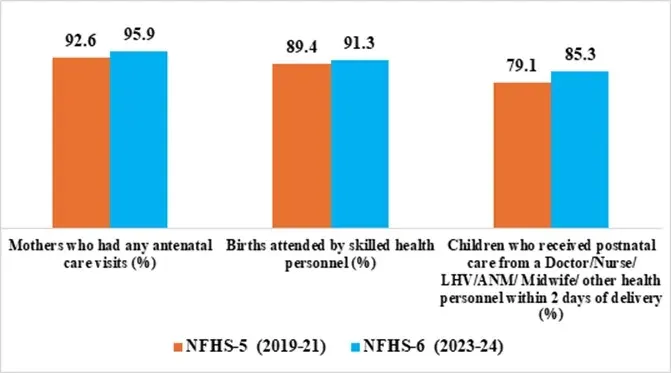
Institutional deliveries in India have reached 90.6 per cent according to NFHS-6, a significant marker for maternal safety.
Antenatal care (ANC) coverage stands at 95.9 per cent , indicating near-universal reach for pregnant women.
Full immunisation coverage has climbed to 87.1 per cent , reflecting the impact of programmes like Mission Indradhanush.
Key policy drivers include the National Health Mission (2005) , Mission Indradhanush (2014) , and Ayushman Bharat (2018) .
Detailed state-level NFHS-6 data is awaited from the Union Health Ministry for targeted programme planning.
Bihar Chief Minister Samrat Choudhary on Saturday, 30 May 2026, highlighted key findings from the National Family Health Survey (NFHS-6), pointing to significant improvements in maternal and child health, immunisation coverage, and institutional deliveries across India. Citing the survey data, he credited the gains to health-sector reforms under Prime Minister Narendra Modi.
Context
In his post, CM Choudhary wrote: 'सशक्त स्वास्थ्य व्यवस्था, समृद्ध भारत' ['A strong health system, a prosperous India'], framing the NFHS-6 data as evidence of the country's public health progress. He specifically cited three headline figures: institutional deliveries reaching 90.6 per cent, antenatal care (ANC) coverage at 95.9 per cent, and full immunisation coverage climbing to 87.1 per cent.
The NFHS-6 is the sixth round of India's National Family Health Survey, a large-scale, multi-round survey that tracks population-level health, nutrition, and demographic indicators. Its findings are widely used by both central and state governments to benchmark programme performance.
Policy Backdrop
The improvements cited by CM Choudhary are rooted in a series of centrally-sponsored health initiatives that have been scaled over the past decade. The National Health Mission (NHM), launched in 2005, laid the foundation for strengthening rural and urban healthcare delivery, with a particular focus on maternal and child health services.
Mission Indradhanush, initiated in 2014, was specifically designed to accelerate routine immunisation coverage among children and pregnant women who had been left out of regular immunisation programmes. The Ayushman Bharat scheme, announced in 2018, further expanded health insurance coverage and established Health and Wellness Centres at the primary care level, broadening the reach of preventive and promotive health services to crores of families.
Stakeholders and Impact
The metrics highlighted by CM Choudhary carry direct implications for mothers and infants, who are the primary beneficiaries of institutional delivery protocols and immunisation drives. A rise in institutional deliveries to 90.6 per cent is associated with reduced maternal and neonatal mortality, as hospital-based births allow for skilled attendance and emergency obstetric care.
Similarly, the ANC coverage figure of 95.9 per cent indicates that nearly all pregnant women are receiving at least some formal antenatal check-ups, a critical intervention for detecting and managing high-risk pregnancies. State health departments, including Bihar's, are key implementers of these centrally-designed programmes and will be expected to use the NFHS-6 data to identify gaps and refine their outreach strategies.
What's Next
Attention will now turn to the release of detailed state-level NFHS-6 tables by the Union Health Ministry, which will allow individual states to assess their own performance against the national averages cited in the survey. For a state like Bihar, which has historically faced challenges in health infrastructure and delivery, the granular data will be critical for targeted programme planning.
The broader trajectory points toward India's long-term goal of reducing maternal and infant mortality rates as part of its development commitments. Sustained investment in primary healthcare infrastructure and community-level outreach will be essential to maintain and build on the gains reflected in the NFHS-6 findings.
Point of View
He reinforces the party's claim that welfare delivery — not just infrastructure — is improving under Modi's tenure. The framing of a 'healthy citizen as the greatest strength of a developed India' is a conscious echo of the government's human-capital argument for health spending. Notably, the post avoids any state-specific Bihar data, suggesting the intent is national credit-sharing rather than a Bihar-specific accountability claim.
NationPress
19 Sept 2026
Frequently Asked Questions
What is NFHS-6 and what does it measure?
NFHS-6 is the sixth round of India's National Family Health Survey, a large-scale national survey that tracks health, nutrition, and demographic indicators including maternal health, child immunisation, and disease prevalence across the country.
What are the key NFHS-6 figures cited by Bihar CM Samrat Choudhary?
CM Choudhary cited three figures from NFHS-6: institutional deliveries at 90.6 per cent , antenatal care (ANC) coverage at 95.9 per cent , and full immunisation coverage at 87.1 per cent .
What government schemes are behind India's improvement in maternal and child health?
Key schemes include the National Health Mission (launched 2005), Mission Indradhanush (launched 2014) for immunisation, and Ayushman Bharat (announced 2018) for health insurance and wellness centres.
What does institutional delivery rate mean and why does it matter?
Institutional delivery refers to childbirths that take place in a hospital or health facility rather than at home. A higher rate, such as the 90.6 per cent cited in NFHS-6, is associated with lower maternal and newborn mortality due to access to skilled care.
What is Bihar CM Samrat Choudhary's role in India's health policy?
Samrat Choudhary is the Chief Minister of Bihar and a senior BJP leader. As CM, he oversees implementation of centrally-sponsored health programmes in Bihar and uses platforms like X to amplify national health policy achievements.