NFHS-6: India's maternal health, child nutrition and financial inclusion show major gains

Synopsis
India's latest national health survey paints a markedly improved picture — institutional deliveries at 90.6%, rotavirus vaccine uptake more than doubling, child stunting falling nearly 6 percentage points, and women's internet use nearly doubling. The NFHS-6 data offer the most comprehensive evidence yet that India's public health delivery is reaching further than before, even as gaps in nutrition persist.
Key Takeaways
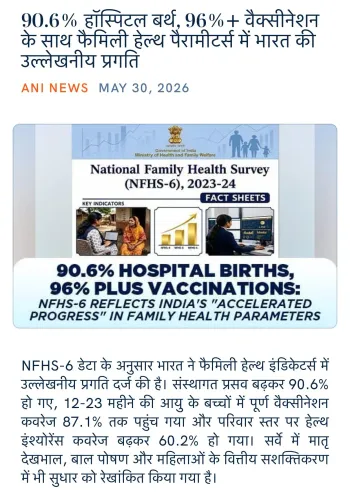
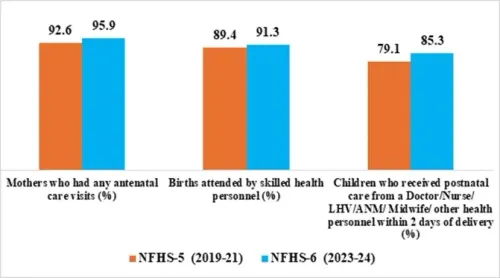
Institutional deliveries in India rose to 90.6 per cent and antenatal care coverage reached 95.9 per cent , per NFHS-6 .
Rotavirus vaccine uptake surged to 85.4 per cent from 36.4 per cent ; second-dose measles coverage climbed to 71.8 per cent from 58.6 per cent .
Child stunting among under-fives fell to 29.3 per cent from 35.5 per cent ; severe wasting dropped to 5.2 per cent from 7.7 per cent .
Women holding bank or savings accounts rose to 89 per cent from 78.6 per cent ; internet use among women nearly doubled to 64.3 per cent .
Findings cited as evidence of India's progress toward the Sustainable Development Goals .
India has recorded significant progress across maternal health, child nutrition, vaccination coverage, and financial inclusion, according to findings from the National Family Health Survey 6 (NFHS-6), cited in a report published by Daily Finland. The data point to broad-based improvements in public health delivery and women's economic access, reinforcing the country's trajectory toward the Sustainable Development Goals (SDGs).
Maternal Health and Antenatal Care
Institutional deliveries in India climbed to 90.6 per cent, while antenatal care (ANC) coverage reached 95.9 per cent. First-trimester ANC uptake rose to 76.2 per cent from a previous 70 per cent, reflecting stronger early engagement with the formal healthcare system. These figures suggest that government schemes aimed at incentivising facility-based births have continued to gain traction at the ground level.
Vaccination and Child Health
Full vaccine coverage for children aged 12–23 months remained consistently above 96 per cent, with 95.6 per cent of children receiving most vaccinations through public health facilities as their preferred choice. Notably, rotavirus vaccine uptake jumped sharply to 85.4 per cent from 36.4 per cent previously, and second-dose measles coverage rose to 71.8 per cent from 58.6 per cent — a significant narrowing of a historically stubborn immunisation gap.
Child Nutrition Trends
Stunting among children under five fell to 29.3 per cent from 35.5 per cent, and severe wasting declined to 5.2 per cent from 7.7 per cent. Infant and young child feeding practices also improved: the share of children aged 6–8 months receiving solid or semi-solid food alongside breastmilk rose from 45.9 per cent to 59.5 per cent, according to the report. Despite the gains, India's stunting rate remains above global averages, indicating that sustained intervention is still needed.
Women's Empowerment and Financial Inclusion
The NFHS-6 data recorded notable strides in women's digital and financial access. The share of women who have ever used the internet nearly doubled, rising from 33.3 per cent to 64.3 per cent. Women holding a bank or savings account increased from 78.6 per cent to 89 per cent, while mobile phone ownership among women grew from 53.9 per cent to 63.6 per cent. This comes amid a broader national push on digital financial services and direct benefit transfers, which have made bank accounts a practical necessity for millions of households.
Outlook
According to the Finland-based media house, 'Overall, the findings reaffirm India's steady progress towards achieving the Sustainable Development Goals.' It added that 'with a continued emphasis on convergence, last-mile delivery and inclusive growth, India is well-positioned to sustain these gains and further improve the health and well-being of its population.' The NFHS-6 findings are expected to inform the next phase of national health planning and resource allocation across states.
Point of View
But they demand careful reading. A stunting rate of 29.3 per cent still means nearly three in ten Indian children are not growing as they should — progress, yes, but not resolution. The near-doubling of women's internet use is striking, yet the gap between digital access and meaningful digital agency remains under-measured in national surveys. The financial inclusion numbers are similarly double-edged: bank account ownership at 89 per cent is impressive, but dormant accounts have historically inflated such figures. The real test of these gains will come when the next NFHS round disaggregates outcomes by state, district, and caste — where the averages tend to fracture.
NationPress
21 Sept 2026
Frequently Asked Questions
What is the NFHS-6 and what does it measure?
The National Family Health Survey 6 (NFHS-6) is a large-scale, nationally representative household survey that tracks health, nutrition, and demographic indicators across India. It covers areas including maternal and child health, vaccination coverage, nutrition, and women's empowerment and financial inclusion.
What are the key maternal health findings in NFHS-6?
Institutional deliveries rose to 90.6 per cent and antenatal care coverage reached 95.9 per cent. First-trimester ANC uptake improved from 70 per cent to 76.2 per cent, indicating earlier engagement with formal healthcare during pregnancy.
How has child nutrition changed according to NFHS-6?
Stunting among children under five fell from 35.5 per cent to 29.3 per cent, and severe wasting dropped from 7.7 per cent to 5.2 per cent. Complementary feeding for infants aged 6–8 months also improved significantly, rising from 45.9 per cent to 59.5 per cent.
What progress has India made on women's financial inclusion?
The share of women with a bank or savings account rose from 78.6 per cent to 89 per cent, while mobile phone ownership among women grew from 53.9 per cent to 63.6 per cent. Women's internet use nearly doubled, from 33.3 per cent to 64.3 per cent.
Do the NFHS-6 findings mean India has achieved its health goals?
The findings show significant progress toward the Sustainable Development Goals, but gaps remain — particularly in child nutrition, where India's stunting rate, though falling, is still above global benchmarks. Sustained focus on last-mile delivery and inclusive growth is considered essential to consolidate these gains.