Giriraj Singh hails NFHS-6 data on hospital births, vaccination
Synopsis
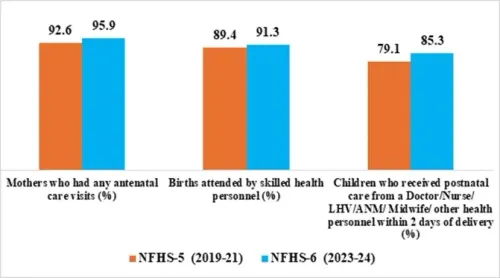
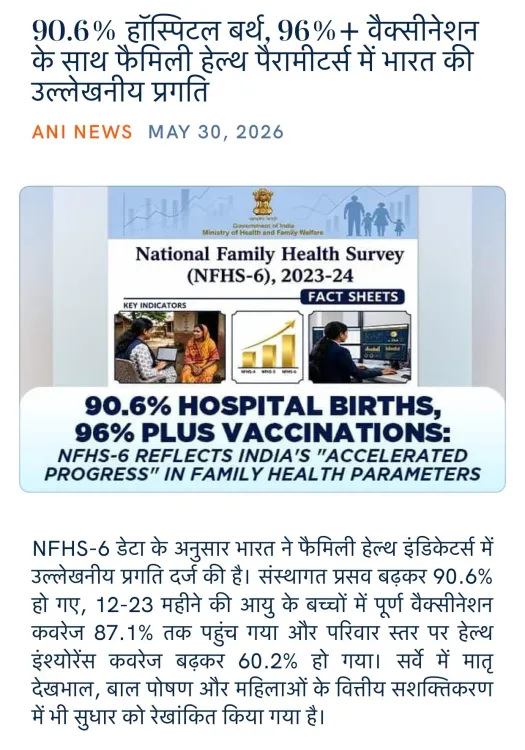
Union Textiles Minister Giriraj Singh cited NFHS-6 data on 31 May 2026 showing 90.6% institutional deliveries and over 96% vaccination coverage, highlighting India's accelerated progress in family health parameters driven by schemes such as Janani Suraksha Yojana and Mission Indradhanush.
Key Takeaways
Union Textiles Minister Giriraj Singh shared NFHS-6 data on 31 May 2026 via the NaMo App.
NFHS-6 records an institutional delivery rate of 90.6% , up from 88.6% in NFHS-5 (2019-21) .
Vaccination coverage has crossed 96% according to the latest survey round.
Janani Suraksha Yojana (2005) and Mission Indradhanush (2014) are the key policy drivers behind these gains.
Detailed NFHS-6 state-level fact sheets are awaited to assess whether progress is uniform across states.
Data will inform future resource allocation under the National Health Mission and Mission Indradhanush Phase-III .
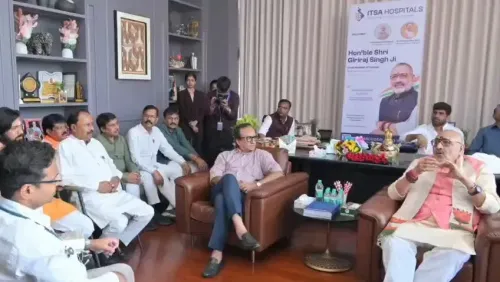
Union Textiles Minister Giriraj Singh on Sunday, 31 May 2026 shared data from the Sixth National Family Health Survey (NFHS-6) highlighting what he described as India's remarkable progress in family health parameters, citing 90.6% hospital births and 96%-plus vaccination coverage across the country.
Context
Singh's post, shared via the NaMo App, quoted NFHS-6 findings and described them as evidence of India's 'उल्लेखनीय प्रगति' ('remarkable progress') in family health. The two headline figures — institutional delivery rate at 90.6% and vaccination coverage exceeding 96% — represent the latest data points in a decadal series of nationally representative health surveys conducted by the Ministry of Health and Family Welfare.
The NFHS is India's primary demographic and health survey, providing state-level data on population, health, and nutrition. Each successive round has been used to benchmark progress on maternal and child health targets under the National Health Policy 2017 and India's commitments to the Sustainable Development Goals.
Policy Backdrop
The trajectory of institutional deliveries has climbed steadily across survey rounds: NFHS-4 (2015-16) and NFHS-5 (2019-21) recorded an institutional delivery rate of 88.6%, making the NFHS-6 figure of 90.6% a further incremental gain. The improvement is attributed in part to the Janani Suraksha Yojana, a conditional cash transfer scheme launched in 2005 under the National Health Mission to incentivise hospital deliveries and reduce maternal mortality.
On the immunisation front, Mission Indradhanush, launched in 2014 and expanded in subsequent phases, was designed specifically to accelerate routine childhood vaccine coverage in high-risk districts. The National Health Mission, later integrated with Ayushman Bharat (2018), has provided the operational backbone for free delivery services and reproductive health outreach in public facilities.
Stakeholders and Impact
The primary beneficiaries of the trends reflected in NFHS-6 are women of reproductive age, children under five, and rural households — historically the most underserved groups in India's health system. Higher institutional delivery rates directly correlate with reductions in maternal and neonatal mortality, while vaccination coverage above 96% signals near-elimination of coverage gaps that once left millions of children vulnerable to preventable diseases.
State governments, health workers under the ASHA and Anganwadi networks, and civil society organisations working in last-mile health delivery are key actors whose on-ground efforts are reflected in these aggregate numbers. NFHS data also directly informs resource allocation decisions under the National Health Mission's annual programme implementation plans.
What's Next
Attention will now turn to the publication of detailed NFHS-6 state-level fact sheets, which will reveal whether gains are evenly distributed or concentrated in better-performing states. Any revisions to health budget outlays or targets under Mission Indradhanush Phase-III are likely to be shaped by these granular findings.
If the survey data holds up at the state level, it could reinforce the government's case for expanding demand-side financing schemes and shifting focus from coverage to quality of institutional care — a debate that health policymakers and researchers have flagged as the next frontier for India's maternal and child health agenda.
Point of View
Linking flagship programmes like Janani Suraksha Yojana and Mission Indradhanush to tangible outcomes. However, aggregate national figures can obscure inter-state disparities; the real test will come when state-level NFHS-6 sheets are published. The post also underscores how senior ministers outside the health portfolio are being mobilised to build a whole-of-government narrative around social sector performance.
NationPress
22 Sept 2026
Frequently Asked Questions
What is NFHS-6 and what does it measure?
NFHS-6 is the Sixth National Family Health Survey, a nationwide study conducted by India's Ministry of Health and Family Welfare that provides state-level data on population, health, and nutrition indicators including maternal health, child immunisation, and fertility rates.
What is India's hospital birth rate according to NFHS-6?
According to NFHS-6 data cited by Union Textiles Minister Giriraj Singh, India's institutional delivery rate stands at 90.6%, up from 88.6% recorded in NFHS-5 (2019-21).
What schemes helped improve India's vaccination coverage?
Mission Indradhanush, launched in 2014, was specifically designed to accelerate routine childhood vaccination in high-risk districts. It operates under the National Health Mission, which also encompasses Ayushman Bharat and free delivery services at public health facilities.
What is the Janani Suraksha Yojana and how does it relate to hospital births?
Janani Suraksha Yojana is a conditional cash transfer scheme launched in 2005 under the National Health Mission that incentivises pregnant women, particularly in rural and low-income households, to deliver in government health facilities, thereby boosting institutional delivery rates.
Why is Giriraj Singh, a textiles minister, commenting on health data?
Senior cabinet ministers across portfolios routinely amplify government performance data on social indicators as part of broader political communication. Singh shared the NFHS-6 findings via the NaMo App to highlight overall governance outcomes under the current administration.