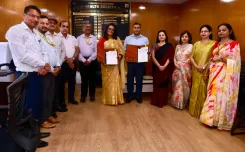
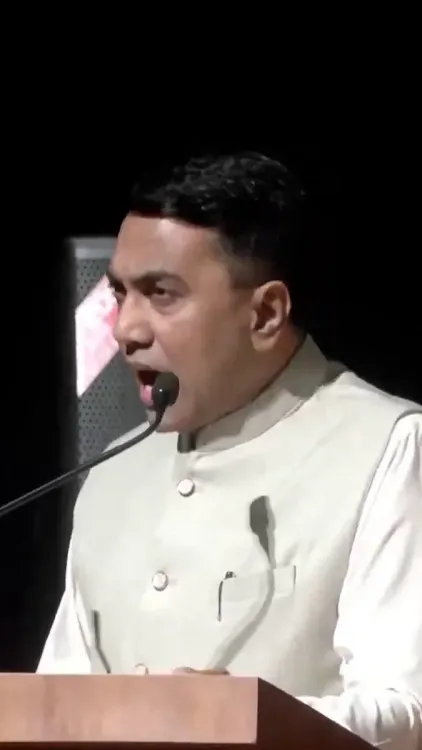
CM Sawant flags Goa's 18,000-hectare Khazan revival via NITI Aayog
Synopsis
Goa CM Pramod Sawant has highlighted the proposed revival of nearly 18,000 hectares of Khazan wetlands under a NITI Aayog initiative, linking the effort to Mann Ki Baat and framing Goa as an active partner in India's climate-resilient agriculture push.
Key Takeaways
Goa CM Pramod Sawant announced the proposed revival of nearly 18,000 hectares of Khazan lands under a NITI Aayog initiative.
Khazan lands are traditional saline wetlands used for paddy cultivation and aquaculture, critical to Goa's coastal ecology.
The initiative was highlighted in the context of Mann Ki Baat , PM Modi's monthly radio address, amplifying its national visibility.
NITI Aayog , established in 2015 , is facilitating the scheme as part of its cooperative federalism mandate with states.
Goan farmers and coastal fishing communities stand to benefit most from restored wetland systems and improved flood resilience.
Project approvals, funding allocation, and implementation timelines remain the key milestones to watch.
Goa's ancient coastal wetlands are back in the national conversation. Goa Chief Minister Pramod Sawant on Tuesday, July 28, 2026, highlighted the proposed revival of nearly 18,000 hectares of Khazan lands under a NITI Aayog initiative — crediting a young interlocutor for drawing his attention to the scheme's grassroots impact.
What Khazan lands are — and why they matter
Khazan lands are Goa's centuries-old saline wetland systems, historically engineered with a network of bunds and sluice gates to support paddy cultivation and aquaculture along the coast. They are not just farmland — they act as natural buffers against tidal flooding and saltwater intrusion, making them ecologically irreplaceable in a coastal state already exposed to monsoon volatility.
Decades of neglect, urban encroachment, and shifting agricultural priorities have left large stretches of these wetlands degraded. The proposed revival under the NITI Aayog initiative would, if implemented at scale, represent one of the most significant interventions in Goa's coastal land management in recent memory.
NITI Aayog's role and the Mann Ki Baat connection
NITI Aayog, established in 2015 to replace the Planning Commission, was designed to function as a bridge between central policy ambition and state-level execution — exactly the kind of cooperative federalism this initiative embodies. The Chief Minister's post carried the hashtag #MannKiBaat, signalling that the Khazan revival was referenced in Prime Minister Narendra Modi's monthly radio address, which routinely amplifies state-level participation in central schemes.
Sawant wrote that NITI Aayog's initiatives are 'creating an impact at the grassroots' and expressed pride in Goa being 'part of this journey.' The framing is deliberate: it positions the state government as an active partner in a centrally-backed sustainability push, not a passive recipient of policy.
Farmers and coastal communities in the frame
The stakeholders with the most at stake are Goa's farming and fishing communities who depend on functional Khazan systems for their livelihoods. A successful revival would restore paddy fields, improve aquaculture conditions, and strengthen natural flood defences for villages that sit at the intersection of river estuaries and the Arabian Sea.
The broader national pattern is clear: climate-resilient agriculture and the restoration of traditional land-water systems are gaining traction as policy priorities. Khazan revival fits squarely into that agenda — local in character, but national in ambition.
The real test now is whether project approvals, funding allocation, and implementation timelines can match the scale of the proposal. Eighteen thousand hectares is an ambitious number. The momentum generated by a Mann Ki Baat mention is a start — delivery is the next chapter.
Point of View
If it moves from proposal to implementation, would be a genuinely significant environmental intervention, but the gap between announcement and on-ground delivery in coastal land restoration projects has historically been wide. The framing around a 'young friend' pointing out grassroots impact also reflects a broader BJP communications pattern of humanising policy through citizen voices. The real measure of this initiative's seriousness will be the speed and scale of funding disbursement.
NationPress
28 Jul 2026
Frequently Asked Questions
What are Khazan lands in Goa?
Khazan lands are centuries-old saline wetland systems in Goa, traditionally managed using bunds and sluice gates for paddy farming and aquaculture along the coast. They also serve as natural buffers against tidal flooding.
How many hectares of Khazan land will be revived under the NITI Aayog initiative?
Goa CM Pramod Sawant cited the proposed revival of nearly 18,000 hectares of Khazan lands under the NITI Aayog initiative.
What is the NITI Aayog's role in the Khazan land revival?
NITI Aayog, India's central policy think-tank established in 2015, is facilitating the initiative as part of its cooperative federalism approach, working with states like Goa on locally relevant sustainable land and agriculture projects.
What is Mann Ki Baat and why was Khazan revival mentioned in it?
Mann Ki Baat is Prime Minister Narendra Modi's monthly radio address, which regularly highlights state-level participation in central government schemes. The Khazan revival mention signals national-level recognition of Goa's involvement in the NITI Aayog initiative.
Who benefits from the revival of Khazan lands in Goa?
Goan farmers and coastal fishing communities are the primary beneficiaries, as restored Khazan systems improve paddy cultivation, aquaculture conditions, and natural flood defences for coastal villages.