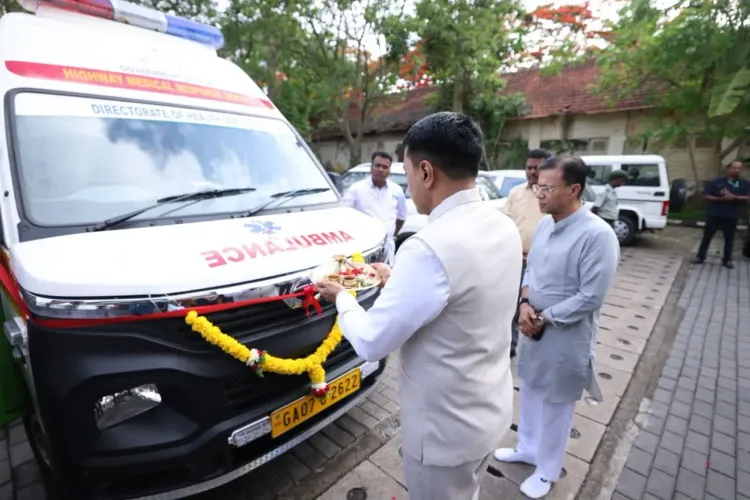
CM Sawant Flags Off 4 Highway Ambulances in Goa
Synopsis
Goa Chief Minister Pramod Sawant flagged off four advanced ambulances procured at ₹1.43 crore under the state's Disaster Management framework in Panaji on 22 June 2026. The vehicles will be deployed exclusively for Highway Medical Response to improve emergency care during road accidents across the state.
Key Takeaways
Four advanced ambulances were flagged off by CM Pramod Sawant in Panaji on 22 June 2026 .
Total procurement cost stands at ₹1.43 crore , funded under the Disaster Management framework.
The ambulances are assigned exclusively to Highway Medical Response , not general deployment.
Goa Health Minister Vishwajeet Rane was present at the flagging-off ceremony alongside senior officials.
The fleet has been handed over to the Directorate of Health Services for operational management.
The initiative targets faster emergency response on key highway corridors, including NH-66 and NH-748 .
Goa Chief Minister Pramod Sawant on Monday, 22 June 2026, flagged off four advanced ambulances under the state's Disaster Management framework at a ceremony in Panaji, Goa, marking a fresh push to bolster highway emergency response across the state. The ambulances, procured at a total cost of ₹1.43 crore, will be deployed exclusively for Highway Medical Response and are intended to provide faster emergency healthcare assistance during road accidents and other emergencies.
Context
The flagging-off ceremony was held in the presence of Goa Health Minister Vishwajeet Rane, senior officials, and dignitaries, with the ambulances handed over to the Directorate of Health Services, the state body responsible for managing public hospitals and emergency medical infrastructure. Chief Minister Sawant described the procurement as part of the government's commitment to 'strengthening emergency healthcare infrastructure, disaster response systems and accessible medical services for the people of the State.'
The four units represent a targeted addition to Goa's fleet, specifically earmarked for highway corridors rather than general deployment — a distinction that signals a more strategic approach to pre-hospital trauma care.
Policy Backdrop
Goa's highway network, particularly NH-66 and NH-748, has historically recorded significant road-accident fatalities, compounded by the state's high tourist footfall and seasonal traffic spikes. Emergency response times on these stretches have been a persistent concern for both residents and the health administration.
States across coastal and hilly India have increasingly procured advanced life-support ambulances under disaster management and trauma-care frameworks, often co-funded through state budgets and central scheme allocations. Goa's latest procurement follows this broader national pattern of incremental fleet expansion at the state level.
Stakeholders and Impact
Goa residents and the large population of highway users — including tourists, truck drivers, and inter-city commuters — stand to benefit most directly from faster medical response on major road corridors. The Directorate of Health Services will be responsible for operational deployment, crew training, and maintenance of the new units.
Road accident victims, who often face critical delays in receiving pre-hospital care on highway stretches, are the primary intended beneficiaries. Faster response windows can materially improve survival rates and reduce long-term disability from trauma injuries.
What's Next
The operational effectiveness of the new fleet will depend on deployment planning, crew readiness, and coordination with highway patrol authorities. Analysts and civil society groups are likely to watch for response-time data once the ambulances are operational.
Any follow-up announcements on fleet maintenance budgets or procurement of additional units in the next fiscal plan will indicate whether this initiative is a one-time addition or part of a sustained expansion of Goa's emergency medical services. The government's stated commitment to disaster response infrastructure suggests further investments could follow in subsequent budget cycles.
Point of View
The event is also a visible governance signal ahead of any electoral cycle, demonstrating tangible health infrastructure delivery. The involvement of Health Minister Vishwajeet Rane underscores a coordinated executive push on emergency services, a domain that has faced public scrutiny following high-profile highway fatalities. Whether this translates into measurable improvements in response times will ultimately determine its policy value beyond the optics of the launch.
NationPress
22 Jun 2026
Frequently Asked Questions
How many ambulances did Goa CM Pramod Sawant flag off in Panaji?
CM Pramod Sawant flagged off four advanced ambulances in Panaji on 22 June 2026 under the state's Disaster Management framework.
What is the cost of the new ambulances procured by the Goa government?
The four ambulances were procured at a total cost of ₹1.43 crore by the Directorate of Health Services, Goa .
Where will the new Goa ambulances be deployed?
The ambulances are earmarked exclusively for Highway Medical Response , targeting faster emergency healthcare assistance during road accidents on Goa's national highway corridors.
Who is Goa's Health Minister and was he present at the event?
Vishwajeet Rane is Goa's Health Minister. He was present at the flagging-off ceremony in Panaji alongside senior officials and dignitaries.
Which government body will manage the new highway ambulances in Goa?
The Directorate of Health Services , the Goa government department overseeing public hospitals and emergency medical services, will manage and deploy the new ambulances.