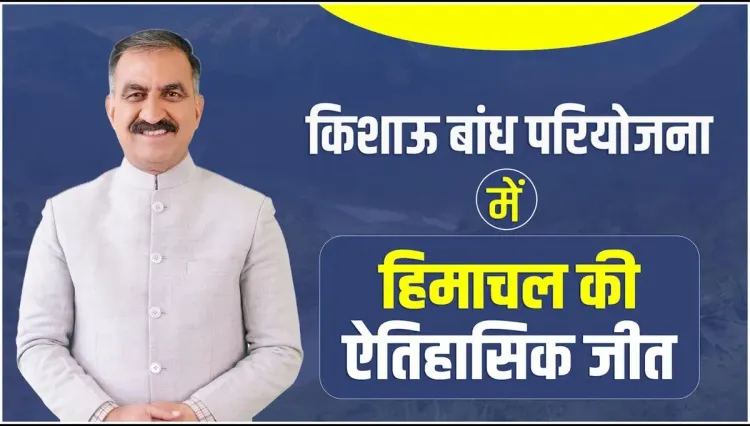
CM Sukhu Claims Historic Win in Kishau Dam Row
Synopsis
Chief Minister Sukhvinder Singh Sukhu announced on 20 June 2026 that Himachal Pradesh has achieved a historic win in the decades-old Kishau Dam dispute, claiming it will generate Rs 600 crore annually for the state. He also cited earlier victories in the Wild Flower Hall and Karcham-Wangtoo cases, while vowing to continue fighting for BBMB representation and Chandigarh asset rights.
Key Takeaways
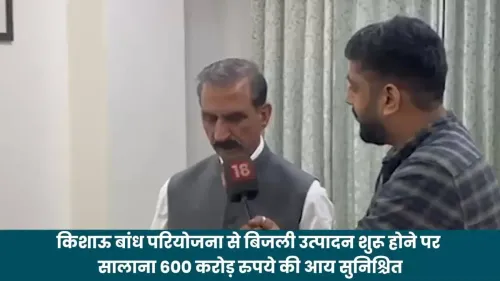
CM Sukhvinder Singh Sukhu declared a 'historic victory' for Himachal Pradesh in the long-pending Kishau Dam project dispute on 20 June 2026 .
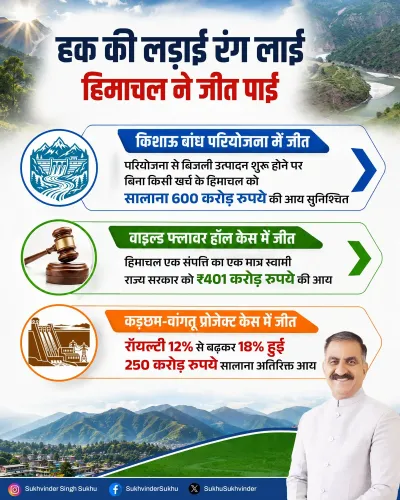
The resolution is claimed to secure the state an annual revenue of Rs 600 crore from the project.
The government also cited prior wins in the Wild Flower Hall property case and the Karcham-Wangtoo (1,000 MW) hydroelectric project dispute.
Outstanding demands include a fair share in Chandigarh assets, adequate representation in the BBMB , and payment of pending royalties.
CM Sukhu contrasted his administration's record with the previous BJP government , accusing it of failing to protect state resources.
Himachal Pradesh relies heavily on hydropower royalties due to its limited tax base, making these disputes central to the state's fiscal stability.
Himachal Pradesh Chief Minister Sukhvinder Singh Sukhu on Saturday, 20 June 2026, declared a landmark victory for the state in the long-pending Kishau Dam project dispute, asserting that the resolution would secure the hill state an annual revenue of Rs 600 crore. The announcement, made via a post on X, framed the outcome as the result of a sustained commitment his government made upon taking office in December 2022 to protect Himachal Pradesh's natural assets and fiscal interests.
Context
In the post, written in Hindi, CM Sukhu declared: 'Pradesh ki sampada logon ka swabhiman hai' ('The state's assets are the people's pride'), framing natural resources not merely as revenue sources but as a matter of collective dignity. He listed the Kishau Dam settlement alongside earlier wins in the Wild Flower Hall property dispute and the Karcham-Wangtoo hydroelectric project as evidence of his government's resolve. He also pointedly contrasted his administration's approach with what he described as the previous BJP government's failure to safeguard state assets.
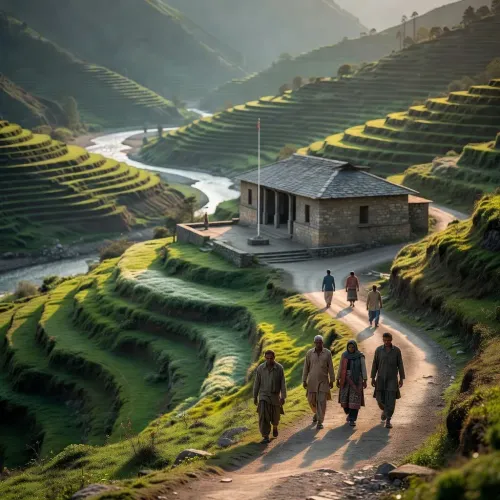
The Kishau Dam is a multi-purpose project proposed on the Tons river, a tributary of the Yamuna, involving both Himachal Pradesh and Uttarakhand. Negotiations over power and water sharing between the two states, and with the Centre, have remained unresolved for decades. A favourable outcome on revenue allocation would mark a significant fiscal gain for a state that relies heavily on hydropower royalties given its narrow tax base.
Policy Backdrop
The roots of Himachal Pradesh's resource disputes stretch back to the Punjab Reorganisation Act of 1966, which left a web of unresolved claims over Chandigarh assets, river royalties, and representation on the Bhakra Beas Management Board (BBMB). Successive state governments — across party lines — have pursued enhanced royalties and greater participation in the BBMB through central tribunals and bilateral negotiations for over three decades.
The Karcham-Wangtoo project, a 1,000 MW run-of-river scheme in Kinnaur district, became entangled in revenue-sharing litigation after agreements signed in the 2000s were contested. The Wild Flower Hall case involved a heritage property in Shimla whose ownership and revenue rights were disputed. CM Sukhu has cited both as precedents for his administration's legal and negotiating strategy.
Stakeholders and Impact
The primary beneficiaries of a resolved Kishau Dam revenue framework would be the residents of Himachal Pradesh, whose state budget depends significantly on royalties from hydroelectric projects. An assured annual inflow of Rs 600 crore — as claimed by CM Sukhu — would provide meaningful fiscal headroom for a state that has faced persistent revenue stress. Hydroelectric developers operating in the state also have a stake in stable, negotiated revenue-sharing terms that reduce litigation risk.
Beyond Kishau, CM Sukhu indicated that the government continues to press for Himachal Pradesh's share in Chandigarh assets, fair representation in the BBMB, and payment of pending royalties — issues that affect the state's long-term fiscal architecture and its relationship with neighbouring states Punjab and Haryana, as well as the Centre.
What's Next
The government's stated agenda now extends to resolving outstanding claims on BBMB reconstitution, pending royalty arrears, and the division of Chandigarh assets — each of which involves either central arbitration or inter-state negotiation. Any formal central notification or revised power purchase agreement formalising the Kishau Dam revenue terms will be closely watched as a test of whether the claimed victory translates into guaranteed annual receipts. The political dimension is equally significant: with state elections on the horizon, CM Sukhu's framing of these wins as a contrast to BJP-era governance signals that resource rights will remain a central campaign theme for the Congress government in Himachal Pradesh.
Point of View
The gap between a negotiated position and a formalised, enforceable revenue stream remains critical: until a central notification or revised power purchase agreement is in place, the Rs 600 crore figure is a political claim rather than a budgetary certainty. The broader pattern of Himalayan states litigating hydropower and asset rights against the Centre and neighbours suggests this is a structural fiscal battle that outlasts any single government's tenure.
NationPress
20 Jun 2026
Frequently Asked Questions
What is the Kishau Dam project and why is it significant for Himachal Pradesh?
The Kishau Dam is a long-pending multi-purpose project on the Tons river, a Yamuna tributary, involving Himachal Pradesh and Uttarakhand. It is significant because a favourable revenue-sharing settlement could provide Himachal Pradesh with an estimated Rs 600 crore in annual income, a major boost for a state that depends heavily on hydropower royalties.
What did CM Sukhu announce about the Kishau Dam on 20 June 2026?
CM Sukhvinder Singh Sukhu announced on 20 June 2026 that Himachal Pradesh had achieved a 'historic victory' in the Kishau Dam dispute, claiming the resolution would secure the state Rs 600 crore per year. He made the announcement through a post on X.
What is the BBMB and why does Himachal Pradesh want greater representation in it?
The Bhakra Beas Management Board (BBMB) manages shared northern river dams and allocates power among states including Punjab, Haryana, Rajasthan, and Himachal Pradesh. Himachal Pradesh has long sought greater representation and a larger power allocation, arguing that its rivers are the primary source of the board's water resources.
What is the Wild Flower Hall case that CM Sukhu referred to?
Wild Flower Hall is a heritage property in Shimla whose ownership and revenue rights were disputed. CM Sukhu's government has cited a favourable outcome in this case as one of several legal and administrative wins it has secured for Himachal Pradesh since taking office in December 2022.
Why does Himachal Pradesh have pending asset claims over Chandigarh?
Chandigarh's asset division remains unresolved following the Punjab Reorganisation Act of 1966, which created Himachal Pradesh, Punjab, and Haryana as separate entities but did not fully settle the distribution of the joint capital's properties. Himachal Pradesh continues to press for its share through negotiations with the Centre.