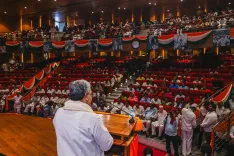
CM Sukhu launches ₹1,500/month scheme for 3.5 lakh HP women
Synopsis
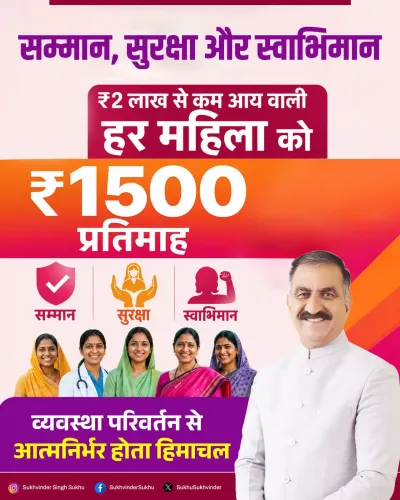
Himachal Pradesh CM Sukhvinder Singh Sukhu's cabinet has approved the 'Mukhyamantri Apna Parivar, Sukhi Parivar Yojana', offering ₹1,500/month to 3.5 lakh women aged 18-59, 300 free electricity units per household, and a pension hike from ₹1,050 to ₹1,500 for women above 59.
Key Takeaways
₹1,500 per month in direct financial assistance for eligible women aged 18 to 59 years in Himachal Pradesh.
3.50 lakh women are projected to benefit from the scheme statewide.
Beneficiary households will receive 300 units of free electricity per month.
Monthly pension for women aged above 59 years raised from ₹1,050 to ₹1,500 , an increase of ₹450.
Scheme approved by the Himachal Pradesh Cabinet under CM Sukhvinder Singh Sukhu , who took office in December 2022 .
The announcement is part of the Congress-led state government's broader women's economic empowerment agenda.
Household prosperity runs through women's economic empowerment — and Himachal Pradesh Chief Minister Sukhvinder Singh Sukhu is now backing that conviction with hard cash. The state cabinet has approved the 'Mukhyamantri Apna Parivar, Sukhi Parivar Yojana', a multi-pronged welfare scheme offering monthly financial assistance, free electricity, and enhanced pensions to eligible women across the state.
What the scheme actually delivers
The package has four concrete pillars. Women aged 18 to 59 years will receive ₹1,500 per month in direct financial assistance. Beneficiary households will get 300 units of free electricity — a meaningful relief at a time when household energy costs have climbed steadily. An estimated 3.50 lakh eligible women across Himachal Pradesh stand to gain from the scheme.
The fourth pillar addresses older women: those aged above 59 years will see their monthly pension rise from ₹1,050 to ₹1,500 — a jump of ₹450 per month. That revision updates a pension rate that had been pegged at ₹1,050 under earlier policy, closing a gap that welfare advocates had flagged for years.
Direct cash transfers as the new political grammar in Indian states
Himachal Pradesh is not operating in isolation here. Across the country, state governments — irrespective of party — have leaned hard into direct benefit transfers and utility subsidies targeted at women, treating them as both social policy and electoral currency. What distinguishes the Sukhu cabinet's approach is bundling cash assistance, an electricity subsidy, and a pension revision into a single branded scheme, rather than announcing them piecemeal.
CM Sukhu, who took office in December 2022 after the Congress party's victory in the state assembly elections, has consistently framed welfare spending as the cornerstone of his administration's first term. "घर की खुशहाली का रास्ता महिलाओं के आर्थिक सशक्तीकरण से होकर गुजरता है" ('The path to household prosperity runs through women's economic empowerment'), he wrote, anchoring the announcement in a clear ideological frame rather than bureaucratic language.
3.50 lakh beneficiaries — and the implementation test ahead
The ambition is substantial. Reaching 3.50 lakh women with monthly cash transfers demands a reliable disbursement infrastructure, an up-to-date beneficiary database, and a state budget that can absorb the recurring cost. Himachal Pradesh has historically struggled with fiscal pressure, and the scheme's rollout timeline and annual budget allocation will be the first real test of whether the cabinet approval translates into money in women's hands.
The electricity component adds another layer: the 300-unit free electricity benefit means coordination between the welfare department and the state power utility. How quickly the two systems sync will determine how fast households actually see the relief.
What is clear today is the political and policy direction: the Congress government in Shimla has chosen to anchor its welfare identity in women's economic agency — and has staked a specific number, ₹1,500 a month, as the proof point. The scheme's real legacy will be written in its execution.
Point of View
Sukhi Parivar Yojana' fits squarely into a nationwide pattern where state governments use direct cash transfers and utility subsidies to consolidate women voters as a core constituency — a playbook that has reshaped electoral mathematics from Delhi to Karnataka. For CM Sukhu, the scheme is also a governance credibility test: his Congress government in Himachal Pradesh has faced persistent questions about fiscal management since 2022, and a commitment to reach 3.50 lakh beneficiaries with monthly transfers will invite close legislative scrutiny on funding and delivery. The bundling of cash assistance, electricity relief, and pension revision into a single branded scheme signals a deliberate attempt to create a durable, name-able welfare identity for the administration ahead of the next electoral cycle. Whether the scheme's rollout matches its ambition will determine whether it becomes a replicable model or a cautionary tale on the gap between cabinet approval and last-mile delivery.
NationPress
14 Nov 2026
Frequently Asked Questions
What is the Mukhyamantri Apna Parivar Sukhi Parivar Yojana?
It is a Himachal Pradesh state welfare scheme approved by the cabinet under CM Sukhvinder Singh Sukhu, providing ₹1,500 per month to eligible women aged 18-59, 300 units of free electricity to beneficiary households, and a pension hike to ₹1,500 for women above 59 years of age.
Who is eligible for the HP women's scheme announced by CM Sukhu?
Women aged 18 to 59 years who meet the state's eligibility criteria are entitled to ₹1,500 per month. Women above 59 years will see their existing pension raised from ₹1,050 to ₹1,500 per month. An estimated 3.50 lakh women across Himachal Pradesh are expected to benefit.
How much free electricity will families get under the new HP scheme?
Households with a qualifying beneficiary under the Mukhyamantri Apna Parivar Sukhi Parivar Yojana will receive 300 units of free electricity per month.
What was the old age pension for women in Himachal Pradesh before the latest hike?
Women aged above 59 years were receiving ₹1,050 per month. The new scheme raises this to ₹1,500 per month — an increase of ₹450.
When did Sukhvinder Singh Sukhu become Chief Minister of Himachal Pradesh?
Sukhvinder Singh Sukhu assumed office as Chief Minister of Himachal Pradesh in December 2022, following the Indian National Congress party's victory in the state assembly elections.