CM Vijay lays ₹3,108 cr Ring Main water project stone in Chennai

Synopsis
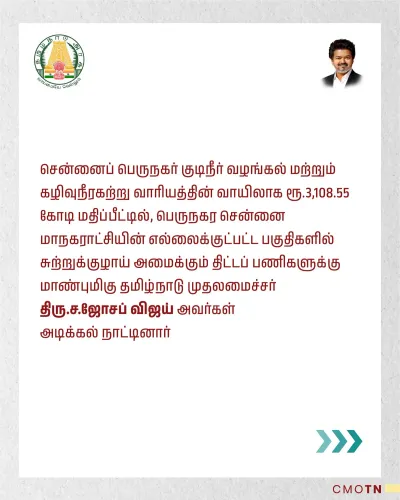
Tamil Nadu Chief Minister C. Joseph Vijay laid the foundation stone for a ₹3,108.55 crore Ring Main water distribution project in Chennai and inspected Okkiyam Maduvu at Karapakkam, reviewing flood mitigation preparations ahead of the northeast monsoon season.
Key Takeaways
₹3,108.55 crore Ring Main System project launched via the Chennai Metropolitan Water Supply and Sewerage Board to improve water distribution across Greater Chennai Corporation limits.
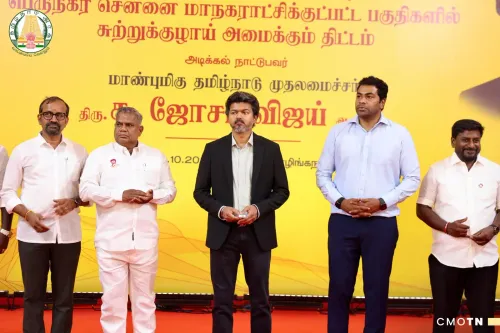
Foundation stone laid at the Board's pumping station in Sholinganallur on 14 October 2026 .
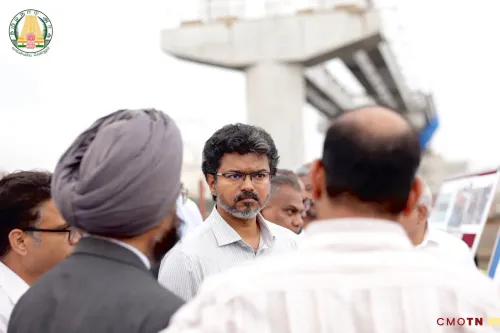
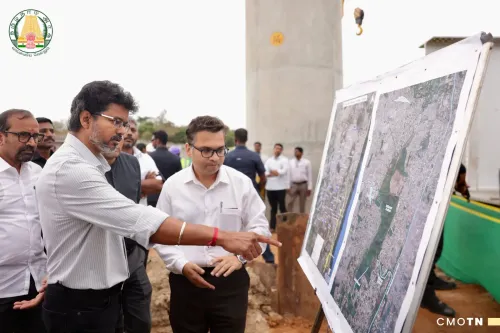
Joseph Vijay personally inspected Okkiyam Maduvu at Karapakkam, a key south Chennai stormwater storage and drainage body.
Inter-departmental flood preparedness review covered the Water Resources Department , Highways Department , and Greater Chennai Corporation .
The visit comes ahead of the northeast monsoon — the season responsible for Chennai's most severe historical flooding, including the catastrophic 2015 floods .
Ring-main architecture is designed to reduce pressure inequity and cut non-revenue water losses across expanding urban networks.
With the northeast monsoon weeks away and Chennai's water infrastructure under perennial strain, Tamil Nadu Chief Minister C. Joseph Vijay spent Wednesday, 14 October 2026 at the sharp end of both problems — breaking ground on a ring-main water distribution network worth ₹3,108.55 crore and personally wading into the city's flood-readiness review in a single, action-packed field visit.
What a ₹3,108 crore ring main actually means for Chennai's taps
The foundation stone was laid at the Chennai Metropolitan Water Supply and Sewerage Board's pumping station in Sholinganallur. The project — formally a 'Ring Main System' — will create a continuous loop of distribution pipes across areas within the Greater Chennai Corporation limits. Ring-main architecture is the engineering community's standard prescription for two chronic urban-water ailments: uneven pressure across the network and high non-revenue water loss through leakage. As Chennai has expanded outward, its legacy radial pipes have struggled to serve peripheral zones at adequate pressure; a loop system effectively gives every node a second supply route.
The Chennai Metropolitan Water Supply and Sewerage Board will be the implementing agency. At ₹3,108.55 crore, this ranks among the larger single urban-water investments the state has announced in recent years, though project timelines and tendering milestones are yet to be made public.
Okkiyam Maduvu and the northeast monsoon countdown
After the foundation-stone ceremony, the Chief Minister drove to Karapakkam to inspect Okkiyam Maduvu — the sprawling stormwater storage and drainage body that acts as south Chennai's primary flood buffer. The visit was explicitly framed as a pre-monsoon review: the northeast monsoon, which historically makes landfall over the Coromandel Coast between October and December, is the season that has brought Chennai to its knees before.
The 2015 Chennai floods remain the defining trauma in the city's urban-resilience story — over 400 lives lost, entire neighbourhoods submerged for days, and an economic toll running into thousands of crores. Since then, successive state governments have layered flood-mitigation investments onto the metropolitan framework, from desilting stormwater drains to upgrading pumping stations along the Buckingham Canal corridor.
Inter-departmental flood review: who was in the room
CM Vijay reviewed preparedness work being carried out by three key agencies: the Water Resources Department, the Highways Department, and the Greater Chennai Corporation. The convergence of these three departments signals that the review spanned drainage infrastructure, road-level waterlogging mitigation, and civic de-silting — the full spectrum of interventions that determine whether a heavy-rain event becomes a manageable disruption or a humanitarian crisis.
For Chennai residents in flood-prone zones — Velachery, Madipakkam, Pallikaranai, and the low-lying arterials of the south — the timing of these reviews matters as much as the announcements. What happens in October's preparatory window often decides November's outcome.
The ring-main foundation stone is a long-cycle infrastructure bet; the Okkiyam Maduvu inspection is an immediate operational signal. Together, they represent Chennai's dual water challenge — getting enough of it year-round, and managing too much of it when the clouds arrive.
Point of View
By contrast, is about November: it tells worried Chennaians that the administration is not waiting for disaster before acting. For the CM, threading both messages in one field day is smart political economy — balancing long-term infrastructure credibility with immediate pre-monsoon accountability.
NationPress
14 Oct 2026
Frequently Asked Questions
What is the Ring Main System project launched by Tamil Nadu CM in Chennai?
The Ring Main System is a ₹3,108.55 crore water distribution project to create a continuous loop of supply pipes across Greater Chennai Corporation limits, aimed at improving pressure equity and reducing leakage. CM C. Joseph Vijay laid its foundation stone on 14 October 2026 at the Chennai Metropolitan Water Supply and Sewerage Board's Sholinganallur pumping station.
What is Okkiyam Maduvu and why did the CM inspect it?
Okkiyam Maduvu is a major stormwater storage and drainage body in Karapakkam that functions as south Chennai's primary flood buffer. CM Vijay inspected it on 14 October 2026 ahead of the northeast monsoon to review flood mitigation readiness.
Which departments were reviewed for Chennai flood preparedness in October 2026?
CM Vijay reviewed flood preparedness work by the Water Resources Department, the Highways Department, and the Greater Chennai Corporation during his 14 October 2026 visit to Karapakkam.
How much is Tamil Nadu investing in Chennai's water infrastructure in 2026?
Tamil Nadu announced a ₹3,108.55 crore investment in the Ring Main System water distribution project for Chennai, to be implemented through the Chennai Metropolitan Water Supply and Sewerage Board.
When does the northeast monsoon hit Chennai and why does it cause flooding?
The northeast monsoon typically arrives over the Coromandel Coast, including Chennai, between October and December. The city's low-lying topography and historically inadequate drainage infrastructure make it prone to severe waterlogging and flooding during this period, as dramatically demonstrated in the 2015 floods.