CM Vijay lays ₹3,108 cr water ring-main stone in Chennai
Synopsis
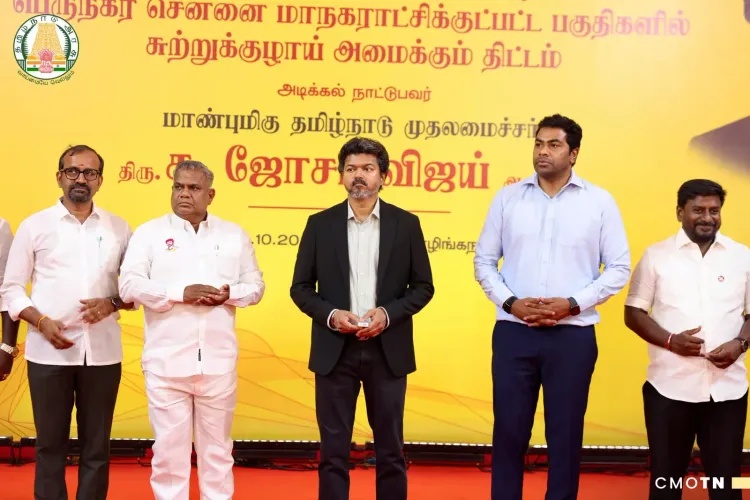
Tamil Nadu CM C. Joseph Vijay laid the ₹3,108.55 crore foundation stone for Chennai's Ring Main Water System at Sholinganallur on 14 October 2026, then personally inspected Okkiyam Maduvu at Karapakkam and reviewed multi-department flood mitigation readiness ahead of the Northeast Monsoon.
Key Takeaways
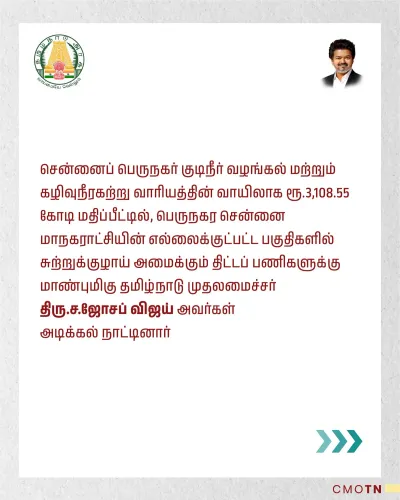
Joseph Vijay laid the foundation stone for a ₹3,108.55 crore Ring Main System for Chennai on 14 October 2026 .
The project will be implemented by the Chennai Metropolitan Water Supply and Sewerage Board (CMWSSB) across Greater Chennai Corporation limits.
Foundation stone ceremony was held at CMWSSB's pumping station in Sholinganallur , southern Chennai.
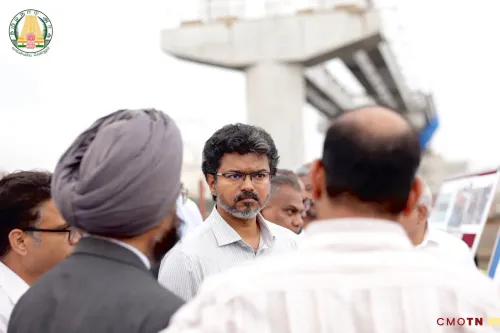
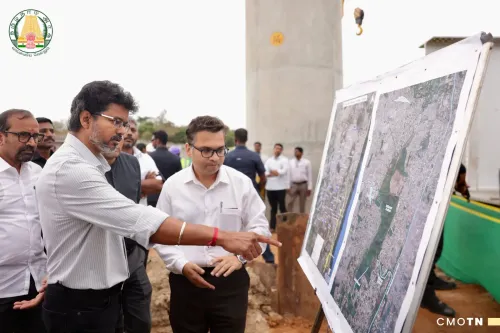
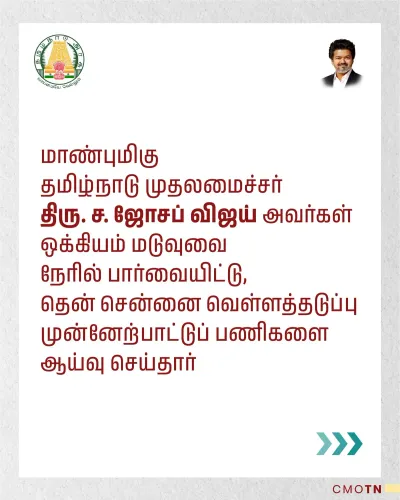
The CM personally inspected Okkiyam Maduvu at Karapakkam to assess its flood-readiness status.
Flood mitigation preparedness was reviewed across three departments: Water Resources , Highways , and Greater Chennai Corporation .
The multi-department review reflects coordination lessons drawn from the catastrophic 2015 Chennai floods .
A city that has wrestled with burst pipes and bone-dry summers in the same calendar year just got its most consequential water infrastructure bet in years. Tamil Nadu Chief Minister C. Joseph Vijay on Wednesday, 14 October 2026, laid the foundation stone for a ₹3,108.55 crore Ring Main System for Chennai — and on the same afternoon drove to the city's flood-prone eastern flank to personally inspect flood-readiness ahead of the Northeast Monsoon.
What the Ring Main System promises for Greater Chennai
The project, to be executed by the Chennai Metropolitan Water Supply and Sewerage Board (CMWSSB), will lay a network of interconnected trunk mains across areas within the Greater Chennai Corporation (GCC) limits. A ring main architecture — standard in cities like Mumbai and Bengaluru — allows operators to reroute supply instantly when any single pipeline fails, eliminating the prolonged dry spells that follow a burst main.
The foundation stone was laid at CMWSSB's pumping station in Sholinganallur, in the city's rapidly urbanising southern corridor. The ₹3,108.55 crore outlay is among the largest single water-infrastructure commitments for Chennai in recent memory, reflecting the pressure that decades of unchecked urban expansion have placed on a distribution network built for a far smaller population.
Okkiyam Maduvu and the Northeast Monsoon countdown
From Sholinganallur, CM Vijay moved to Karapakkam to personally inspect Okkiyam Maduvu, the low-lying wetland-basin that has historically acted as a natural buffer — and, when overwhelmed, a flashpoint — during heavy October-December rainfall. Personal site visits by the Chief Minister signal the administration's intent to hold departments accountable before the first heavy spell arrives, not after.
The CM reviewed flood-mitigation preparedness with officials from the Water Resources Department, the Highways Department, and the Greater Chennai Corporation. The three agencies cover the full chain of urban flood response: reservoir and canal management, road-level drainage and underpasses, and last-mile stormwater systems inside the city.
Chennai's flood memory and what drives inter-agency urgency
The shadow of the 2015 Chennai floods — which killed over 200 people and caused estimated losses exceeding ₹20,000 crore — has never fully lifted from the city's infrastructure planning. That disaster exposed the cost of siloed departmental responses, and successive state governments have since institutionalised multi-agency coordination drills before every Northeast Monsoon season.
Chennai's geographic reality makes the stakes unusually high: the city sits on a flat coastal plain with limited natural gradient for drainage, making engineered solutions — ring mains, retention basins, widened storm drains — the only reliable defence against both water scarcity and flood extremes.
Wednesday's events fused both problems into a single political and administrative statement: the same city that needs more water reliably delivered also needs that water kept out of its streets when the clouds open. The Ring Main System and the flood-readiness review are, in that sense, two sides of the same urban-resilience wager.
With tendering and construction timelines yet to be publicly detailed, the real test of the ₹3,108.55 crore pledge lies ahead — but for a city that measures infrastructure promises in monsoons survived, the clock is already ticking.
Point of View
Not just welfare schemes. The Ring Main System, if executed on schedule, would address one of the city's most persistent civic complaints: unequal and unreliable piped water access across older and newer neighbourhoods. At the same time, the personal inspection of Okkiyam Maduvu signals awareness that the Northeast Monsoon is an annual credibility test for any sitting Tamil Nadu government. The pairing of long-term infrastructure with immediate seasonal readiness is a deliberate bid to own both the development and the governance narrative heading into the monsoon cycle.
NationPress
14 Oct 2026
Frequently Asked Questions
What is the Chennai Ring Main System project announced in October 2026?
It is a ₹3,108.55 crore water-distribution project to be implemented by the Chennai Metropolitan Water Supply and Sewerage Board, laying interconnected trunk pipelines across Greater Chennai Corporation limits to ensure reliable and reroutable water supply.
What is a ring main system in water supply?
A ring main system is a circular or looped pipeline network that allows water to reach any point from two directions, so if one section fails or bursts, supply can be maintained by rerouting through the other side of the loop — minimising disruption to residents.
Where is Okkiyam Maduvu and why was it inspected?
Okkiyam Maduvu is a low-lying water body and natural drainage basin in Karapakkam, on Chennai's eastern flank. It is inspected before the Northeast Monsoon because it is historically vulnerable to overflow during heavy rainfall, potentially causing urban flooding in surrounding areas.
Which departments are involved in Chennai's Northeast Monsoon flood preparedness?
The Water Resources Department, the Highways Department, and the Greater Chennai Corporation are the primary agencies coordinating flood mitigation and infrastructure readiness ahead of Chennai's Northeast Monsoon season.
Why is the Northeast Monsoon particularly significant for Chennai?
The Northeast Monsoon, which runs from October to December, is Chennai's primary annual rainfall season and has historically caused severe urban flooding — most notably in 2015 — due to the city's flat coastal topography and limited natural drainage gradient.