CM Mohan Yadav Hails Northeast India's Infra Leap Under Modi

Synopsis
MP Chief Minister Dr. Mohan Yadav has lauded 12 years of infrastructure transformation in Northeast India under PM Modi, citing airports doubling to 17, over 46,290 km of rural roads, 1,840 km of new rail track, and landmark projects like the Sela Tunnel and Bogibeel Bridge as milestones toward Viksit Bharat 2047.
Key Takeaways
Mohan Yadav credited PM Narendra Modi with 12 years of unprecedented infrastructure growth in India's eight northeastern states.
Airports in the Northeast have expanded from 9 to 17 , with 90 UDAN flight routes now operational in the region.
Over 1,840 km of new railway track and more than 46,290 km of rural roads have been added in the Northeast since 2014.
The Sela Tunnel at 13,000 feet and the Bogibeel Bridge over the Brahmaputra are cited as landmark connectivity projects.
The post links these milestones to the government's Viksit Bharat @ 2047 national development vision.
The #12YearsOfRisingNorthEast campaign signals a coordinated BJP effort to highlight the region's development record.
Madhya Pradesh Chief Minister Dr. Mohan Yadav on Saturday, 20 June 2026, credited Prime Minister Narendra Modi's leadership over the past 12 years for transforming Northeast India's infrastructure landscape, calling the eight northeastern states — collectively referred to as the 'Ashtlakshmi' (Eight Goddesses of Prosperity) — the new centre of India's development story.
Context
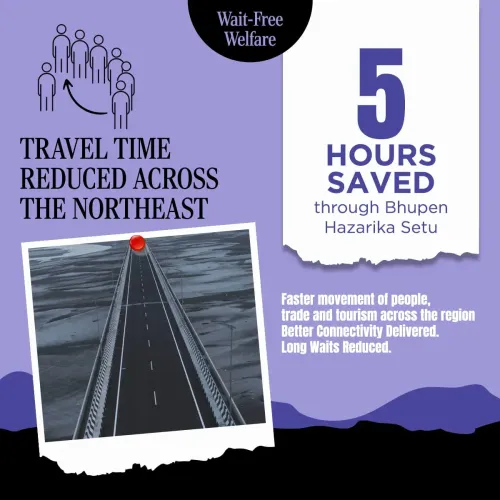
In his post on X, Dr. Yadav highlighted a sweeping list of connectivity milestones achieved in the Northeast, stating that the region has undergone an 'unprecedented journey of development and prosperity' under Modi's 'visionary leadership.' He specifically cited the Sela Tunnel — built at an altitude of 13,000 feet in Arunachal Pradesh — and the Bogibeel Bridge over the Brahmaputra in Assam as landmark projects that have eased movement for local communities.
The post, tagged #12YearsOfRisingNorthEast, also cited expansion of airports from 9 to 17, addition of 1,840 km of new railway track, construction of more than 46,290 km of rural roads, and the opening of 90 UDAN flight routes connecting the region to the national mainstream.
Policy Backdrop
The figures cited by Dr. Yadav align with the central government's Act East Policy, announced in 2014, which repositioned the Northeast as a strategic gateway to Southeast Asia rather than a peripheral zone. Complementing this, the UDAN regional connectivity scheme, launched in 2016, specifically targeted underserved airports and routes across the eight northeastern states.
The Special Accelerated Road Development Programme for North East (SARDP-NE) was also expanded in successive phases after 2014, channelling significant central funds toward rural and border road connectivity. The Bogibeel Bridge, inaugurated in 2018, is the longest rail-cum-road bridge in India and was seen as a strategic asset for both civilian movement and defence logistics along the China border.
These investments are presented by the ruling BJP as foundational pillars of the Viksit Bharat @ 2047 vision — the government's stated goal of making India a fully developed nation by the centenary of its independence.
Stakeholders and Impact
For the roughly 45 million residents of India's eight northeastern states — Arunachal Pradesh, Assam, Manipur, Meghalaya, Mizoram, Nagaland, Sikkim, and Tripura — improved road and rail connectivity has direct implications for access to markets, healthcare, and education. Rural road expansion under programmes such as PMGSY has been particularly significant for remote hill communities historically cut off during monsoon months.
Aviation expansion through UDAN has made air travel more affordable in a region where difficult terrain makes surface travel slow and seasonal. The increase from 9 to 17 airports and 90 flight routes represents a substantial shift in the region's connectivity profile, with potential multiplier effects on tourism and trade.
What's Next
The #12YearsOfRisingNorthEast campaign signals a coordinated BJP effort to consolidate the Northeast's development record as a political and policy narrative ahead of upcoming state electoral cycles in the region. Observers will watch whether the next Union Budget or NITI Aayog review announces fresh allocations to sustain momentum on pending connectivity projects.
As India moves closer to the 2047 milestone, the Northeast's integration into national economic corridors — and its role as a land bridge to Southeast Asia — will remain a key test of whether the 'Viksit Bharat' (Developed India) vision translates into measurable ground-level change for the region's diverse communities.
Point of View
Using verifiable infrastructure numbers to anchor the BJP's broader 'development decade' narrative ahead of electoral cycles in the Northeast. The invocation of 'Ashtlakshmi' — a term popularised by PM Modi — signals coordinated party communication rather than an independent state-level statement. By tying road, rail, and aviation data to the Viksit Bharat 2047 vision, the post frames infrastructure not merely as governance delivery but as ideological fulfilment. The Northeast's transformation from a conflict-affected periphery to a connectivity hub remains one of the more substantive planks the ruling dispensation can point to, even as questions about economic inclusion and local employment in the region persist.
NationPress
18 Sept 2026
Frequently Asked Questions
What is the Sela Tunnel and why is it significant?
The Sela Tunnel is a high-altitude road tunnel built at approximately 13,000 feet in Arunachal Pradesh, designed to provide all-weather connectivity to the Tawang region near the China border, reducing travel time and improving strategic access for both civilians and defence forces.
What is the Bogibeel Bridge?
The Bogibeel Bridge is India's longest rail-cum-road bridge, spanning the Brahmaputra river in Assam. Inaugurated in 2018, it significantly reduced travel time between upper Assam and Arunachal Pradesh and holds strategic importance for border logistics.
What are India's 'Ashtlakshmi' states?
The 'Ashtlakshmi' or Eight Goddesses of Prosperity is a term used by PM Narendra Modi to collectively refer to India's eight northeastern states: Arunachal Pradesh, Assam, Manipur, Meghalaya, Mizoram, Nagaland, Sikkim, and Tripura.
What is the UDAN scheme and how has it helped the Northeast?
UDAN (Ude Desh ka Aam Naagrik) is a regional aviation connectivity scheme launched in 2016 to make air travel affordable and expand routes to underserved areas. In the Northeast, it has contributed to growing the number of operational airports from 9 to 17 and establishing 90 flight routes.
What is Viksit Bharat 2047?
Viksit Bharat 2047 is the Indian government's national vision to transform India into a fully developed nation by 2047, the centenary of independence, with integrated infrastructure, economic growth, and social progress as its core pillars.