CM Yogi echoes Modi's 'four castes' welfare framework
Synopsis
Chief Minister Yogi Adityanath reaffirmed that Uttar Pradesh's welfare programmes are anchored in PM Modi's 'four castes' formulation — the poor, farmers, women, and youth — signalling continued alignment between state and central government welfare priorities.
Key Takeaways
CM Yogi Adityanath cited PM Narendra Modi's declaration that India has only four 'castes': the poor, farmers, women, and youth.
The 'four castes' framing was first prominently articulated by PM Modi during the 2019 general election campaign.
Uttar Pradesh has aligned state welfare delivery with this framework through schemes including PM Awas Yojana , PM-KISAN , and Ayushman Bharat.
The statement reflects the BJP's broader strategy of organising welfare around demographic categories rather than traditional caste or religious groupings.
Upcoming state budget allocations and scheme performance reviews will test how deeply this four-category model is institutionalised in UP .
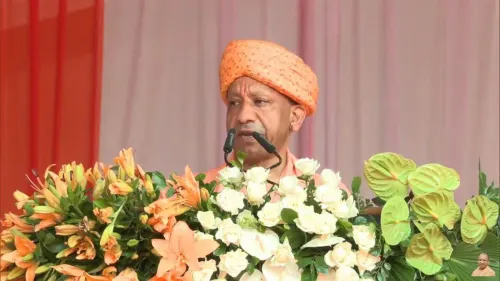
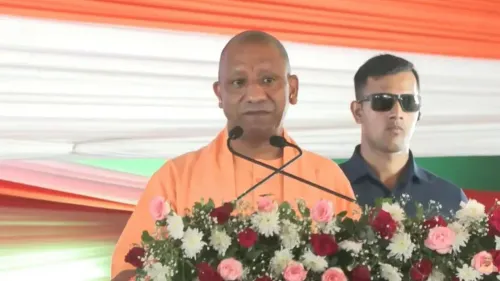
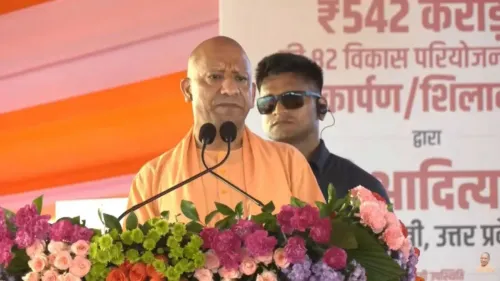
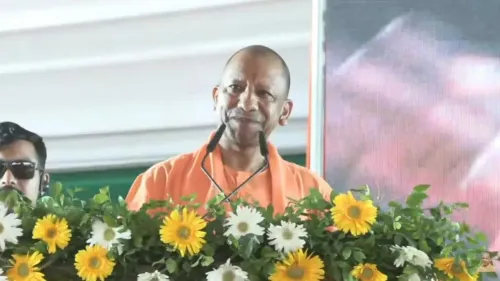
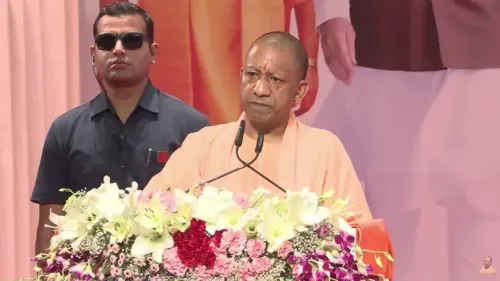
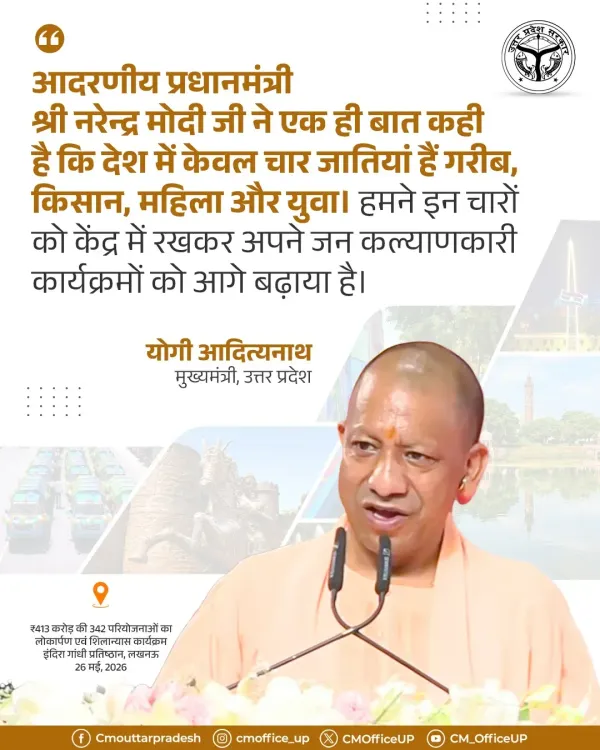
The Chief Minister's Office of Uttar Pradesh, quoting Chief Minister Yogi Adityanath, on Tuesday, 26 May 2026, reaffirmed the BJP government's welfare philosophy — that India recognises only four 'castes': the poor, farmers, women, and youth.
Context
The post quotes CM Yogi Adityanath attributing a defining formulation to Prime Minister Narendra Modi: 'देश में केवल चार जातियां हैं—गरीब, किसान, महिला और युवा' ('In this country there are only four castes — the poor, the farmer, the woman, and the youth'). CM Yogi added that all state welfare programmes have been designed with these four groups at the centre. The statement is a deliberate reframing of India's traditionally caste-driven political discourse into a demographic-welfare lens.
Policy Backdrop
Prime Minister Modi first popularised this 'four castes' formulation during the 2019 general election campaign as a way to shift political mobilisation away from traditional caste and religious groupings toward broad-based economic welfare. The framing has since become a recurring rhetorical anchor for the BJP at both the national and state levels. Uttar Pradesh, as the country's most populous state, has been a key laboratory for this approach, rolling out centrally sponsored schemes — including PM Awas Yojana (housing), PM-KISAN (farmer income support), Ayushman Bharat (health insurance), and state-level skill and women-empowerment programmes — all targeted at these four demographic categories.
Stakeholders and Impact
The four categories cited — the poor, farmers, women, and youth — together encompass the vast majority of Uttar Pradesh's population of over 24 crore people. For poor households, flagship programmes such as free ration distribution and housing subsidies have been the primary delivery mechanisms. Women have been targeted through schemes covering free cooking gas connections, maternity benefits, and self-help group financing, while youth have been the focus of skill development and employment-linked incentive programmes. Farmers in the state have accessed direct income transfers and crop insurance under centrally sponsored frameworks.
What's Next
Attention will now turn to the upcoming state budget cycle and scheme performance reviews to assess whether allocations for PM Awas Yojana, PM-KISAN, and UP-specific women and youth programmes are being scaled in line with the stated priority. The reiteration of this framework by CM Yogi Adityanath ahead of any major policy announcement signals continued alignment between Lucknow and New Delhi on welfare delivery architecture. How effectively the four-category model translates into measurable outcomes — jobs created, houses built, women enrolled — will determine its political and policy durability.
Point of View
Yogi simultaneously deflects caste-based political criticism and positions the state government as a faithful executor of the central mandate. The timing, absent a specific policy trigger, suggests the statement is part of a broader communication strategy to consolidate the BJP's welfare narrative ahead of budget and electoral cycles. Whether the rhetoric is matched by measurable scheme outcomes will be the harder test.
NationPress
10 Oct 2026
Frequently Asked Questions
What are the 'four castes' PM Modi talks about?
PM Modi has articulated that India's only four 'castes' are the poor, farmers, women, and youth — a framing designed to shift welfare policy focus away from traditional caste and religious categories toward broad demographic groups.
What did CM Yogi Adityanath say about welfare programmes in UP?
CM Yogi Adityanath stated that all of Uttar Pradesh's welfare programmes have been built around PM Modi's 'four castes' — the poor, farmers, women, and youth — as the central beneficiary groups.
Which welfare schemes in UP target these four groups?
Key schemes include PM Awas Yojana for the poor, PM-KISAN for farmers, Ayushman Bharat for health coverage, and various state-level skill development and women-empowerment programmes targeting youth and women respectively.
When did Modi first use the 'four castes' formulation?
PM Modi prominently articulated the 'four castes' framing — poor, farmer, woman, youth — during the 2019 general election campaign as a way to reframe welfare politics around demographics rather than caste identity.
Why is CM Yogi repeating this welfare framework now?
The reiteration signals continued alignment between the Uttar Pradesh government and the central BJP leadership on welfare delivery, and is seen as part of a broader communication strategy reinforcing the party's welfare narrative.