CM Yogi honours 68,000 Gram Praharis in Bareilly

Synopsis
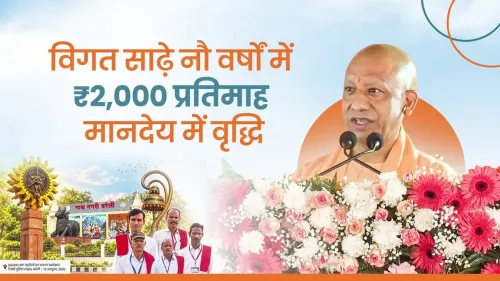
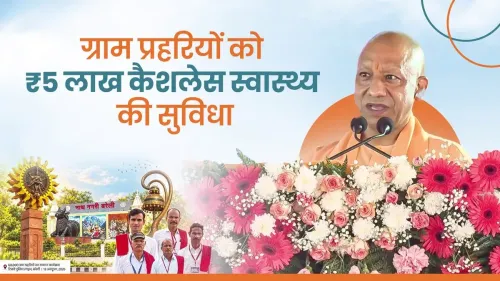
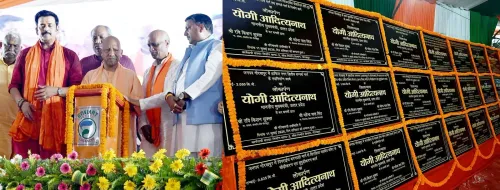
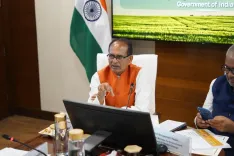
Chief Minister Yogi Adityanath attended a felicitation ceremony in Bareilly on 13 October 2026 to honour 68,000 Gram Praharis — village guards who support police in rural crime prevention — marking a significant public endorsement of UP's community-policing model.
Key Takeaways
CM Yogi Adityanath personally attended the honour ceremony for Gram Praharis in Bareilly on 13 October 2026 .
A total of 68,000 Gram Praharis from across Uttar Pradesh were felicitated for their contribution to police cooperation and crime control.
The Gram Prahari programme deploys locally-recruited village guards to support formal police forces in rural UP.
The ceremony was held in Bareilly , a major city in western Uttar Pradesh.
The event forms part of the Yogi administration's broader push to strengthen grassroots law-and-order mechanisms across the state's 75 districts.
Sixty-eight thousand village guards stood at the centre of a rare public celebration on Tuesday, 13 October 2026, as Chief Minister Yogi Adityanath joined their felicitation ceremony in Bareilly — a formal acknowledgment by the state that grassroots policing is now a pillar of Uttar Pradesh's law-and-order architecture.
Who are the Gram Praharis — and why they matter
The Gram Prahari programme deploys locally-recruited village guards as the first line of contact between rural communities and the formal police apparatus. Operating across UP's vast rural belt, they gather intelligence on petty crime, assist in verification drives, and relay alerts that would otherwise take hours to reach a district police station. The scheme is designed to fill the gap that a uniformed constabulary stretched thin across 75 districts simply cannot bridge alone.
Their contribution sits at the intersection of community policing and state capacity — cheap to run, deeply local in knowledge, and increasingly consequential in the administration's crime-reduction narrative.
Bareilly as the stage for a statewide reckoning
Bareilly, a commercial hub in western Uttar Pradesh, was chosen to host what amounts to a statewide honour roll. Yogi Adityanath's physical presence at the event — not a virtual address, not a delegation — signals that the government wants the Gram Prahari corps to feel seen. Felicitation ceremonies of this scale are also deliberate morale multipliers: they bind auxiliary volunteers more tightly to the state's institutional identity.
The Chief Minister's Office framed the event as recognition of 'praiseworthy contribution to police cooperation and crime control' — polis sahayog evam apradh niyantran mein sarahniya yogdan. In a state where crime data and policing optics are closely watched ahead of every electoral cycle, that framing carries weight.
Where community policing fits in the Yogi governance model
Since March 2017, the Yogi administration has consistently emphasised visible, muscular law-enforcement as a signature. Community-level schemes like Gram Prahari extend that project into the last mile of governance — villages where conventional policing is episodic at best. Recognition events are also expansion signals: past ceremonies of this type in UP have preceded fresh recruitment or training drives for auxiliary security units.
Whether the Bareilly ceremony foreshadows a new phase — broader deployment, enhanced stipends, or formal integration into the policing chain — is the question officials and village guards alike will be watching closely.
Sixty-eight thousand pairs of eyes on India's most populous state's villages: the Yogi government has just reminded them — and the electorate — that it knows they are watching back.
Point of View
000 auxiliary village guards, the Yogi government reinforces its core governance brand: that law and order reaches every village, not just district headquarters. Community-policing schemes have historically served dual purposes in UP — extending state capacity where the formal apparatus is thin, and building a loyal, visible constituency of locally-embedded 'order-keepers.' The felicitation, timed well into the government's tenure, also preempts any narrative of rural neglect ahead of future electoral cycles, anchoring security gains to a named, celebrated programme.
NationPress
13 Oct 2026
Frequently Asked Questions
What is the Gram Prahari scheme in Uttar Pradesh?
The Gram Prahari scheme is a state-supported village guard programme in Uttar Pradesh that deploys locally-recruited volunteers to assist regular police in rural crime prevention, intelligence gathering, and community security coordination.
Why did CM Yogi Adityanath go to Bareilly on 13 October 2026?
Chief Minister Yogi Adityanath attended a felicitation ceremony in Bareilly to honour 68,000 Gram Praharis from across UP for their praiseworthy contribution to police cooperation and crime control.
How many Gram Praharis are there in Uttar Pradesh?
According to the Chief Minister's Office of Uttar Pradesh, there are 68,000 Gram Praharis serving across the state.
What role do Gram Praharis play in UP's law and order?
Gram Praharis act as the first point of contact between rural communities and the formal police force. They assist in crime prevention, local verification drives, and passing on intelligence alerts to district police, bridging the gap in areas where regular policing is stretched.
How long has Yogi Adityanath been Chief Minister of Uttar Pradesh?
Yogi Adityanath has been Chief Minister of Uttar Pradesh since March 2017, with law-and-order reform as one of the defining pillars of his administration.