CM Yogi Launches Hydrogen Buses, Touts UP EV Plants
Synopsis
Chief Minister Yogi Adityanath announced the launch of three hydrogen buses in the YEIDA region and highlighted that Uttar Pradesh now has two domestic electric bus manufacturing plants, marking a shift from external procurement to local green mobility production.
Key Takeaways
Three hydrogen buses have been launched for operations in the YEIDA (Yamuna Expressway Industrial Development Authority) region as of June 12, 2026 .
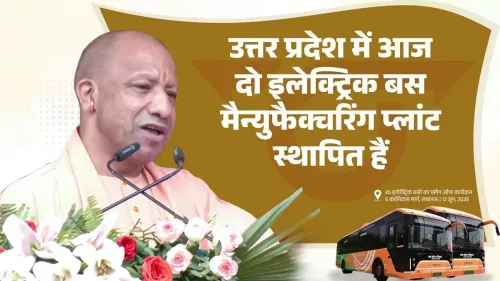
Two Electric Bus Manufacturing Plants are now operational within Uttar Pradesh , ending the state's earlier dependence on externally sourced electric buses.
The development aligns with Uttar Pradesh's Electric Vehicle Policy (2019) and the central government's FAME-II scheme .
The National Green Hydrogen Mission provides the national framework under which hydrogen bus pilots like this are being rolled out across Indian states.
Uttar Pradesh joins states like Tamil Nadu and Maharashtra in building green mobility manufacturing clusters under the Atmanirbhar Bharat initiative.
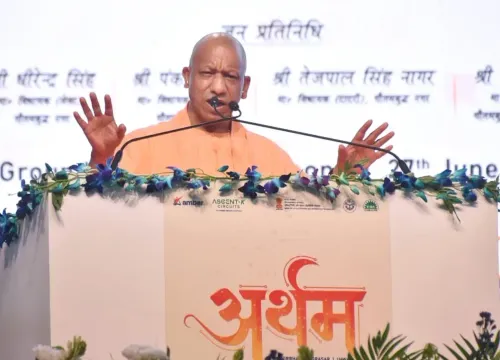
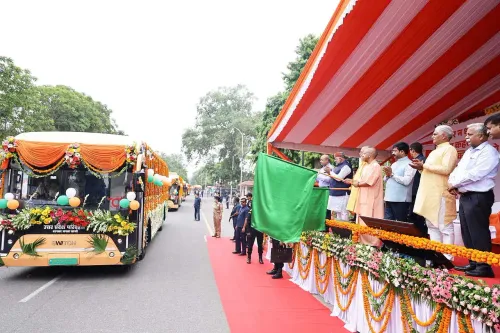
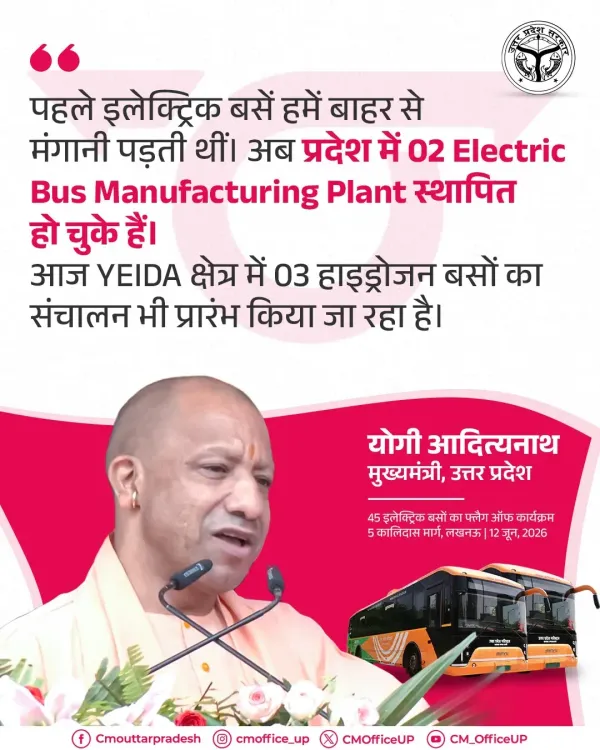
The Chief Minister's Office of Uttar Pradesh, citing remarks by Chief Minister Yogi Adityanath, announced on Friday, June 12, 2026 that three hydrogen buses have been launched for operations in the YEIDA (Yamuna Expressway Industrial Development Authority) region, while also highlighting that two electric bus manufacturing plants are now operational within the state.
Context
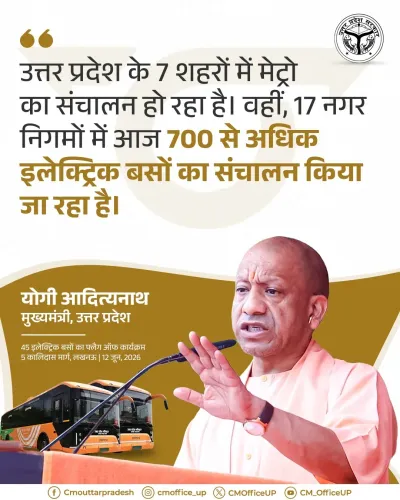
Speaking on the development, CM Yogi Adityanath stated: 'Pehle electric busein hamein bahar se mangani padti theen' ['Earlier, we had to source electric buses from outside the state']. He underlined that the state has moved from dependence on external suppliers to establishing domestic manufacturing capacity, with two Electric Bus Manufacturing Plants now set up within Uttar Pradesh. Alongside this, the commencement of three hydrogen buses in the YEIDA corridor marks a new phase in the state's green mobility push.
Policy Backdrop
Uttar Pradesh introduced its Electric Vehicle Policy in 2019, aimed at attracting EV manufacturing investments and reducing the state's reliance on buses procured from other states or imported components. The policy aligned with the central government's FAME-II scheme, which provided financial support for state-level electric bus adoption and charging infrastructure. More recently, the National Green Hydrogen Mission has provided a framework for states to pilot hydrogen fuel-cell mobility, and Uttar Pradesh is among the early movers in deploying hydrogen buses on a defined public corridor.
The YEIDA region, which stretches along the Yamuna Expressway between Greater Noida and Agra, has been developed as a major industrial and urban growth hub. Its selection as the launch zone for hydrogen bus operations reflects the authority's role as a testbed for new infrastructure investments in the state.
Stakeholders and Impact
Urban commuters along the YEIDA corridor stand to benefit directly from the introduction of zero-emission hydrogen buses, which produce only water vapour as a byproduct. Domestic EV manufacturers operating within Uttar Pradesh gain a stable state-level procurement pipeline, reducing logistics costs and reinforcing the Atmanirbhar Bharat self-reliance framework championed by the central government. The dual approach — scaling electric bus manufacturing while piloting hydrogen technology — positions Uttar Pradesh alongside states such as Tamil Nadu and Maharashtra that have pursued green mobility manufacturing clusters.
For the broader national agenda, India has committed to achieving net-zero emissions by 2070, and building domestic hydrogen and electric vehicle capacity at the state level is considered essential to meeting that target while cutting crude oil import costs.
What's Next
Attention will now turn to whether the three hydrogen buses in the YEIDA region represent a contained pilot or the beginning of a larger fleet expansion under state transport corporations. Upcoming industrial policy reviews in Uttar Pradesh are expected to signal whether additional manufacturing investments in both electric and hydrogen mobility will be announced. The state's ability to scale operations beyond the Yamuna Expressway corridor to other urban centres will be a key indicator of how seriously it is pursuing a full green transport transition.
Point of View
CM Yogi Adityanath is anchoring the announcement firmly within the Atmanirbhar Bharat narrative, which carries significant political weight ahead of any state-level policy reviews. The choice of the YEIDA corridor as the hydrogen bus launch zone is also telling — it is a high-visibility industrial belt that attracts investor attention and can showcase the state's infrastructure ambitions. Whether this pilot translates into a scalable fleet will determine if Uttar Pradesh becomes a genuine leader in India's green transport transition or remains at the demonstration stage.
NationPress
13 Sept 2026
Frequently Asked Questions
What is the YEIDA region where hydrogen buses have been launched?
YEIDA stands for Yamuna Expressway Industrial Development Authority, the nodal agency overseeing industrial and urban development along the Yamuna Expressway corridor between Greater Noida and Agra in Uttar Pradesh.
How many hydrogen buses has Uttar Pradesh launched?
Three hydrogen buses have been launched for operations in the YEIDA region, as announced by the Chief Minister's Office of Uttar Pradesh on June 12, 2026.
Does Uttar Pradesh manufacture electric buses locally?
Yes. As of June 2026, two Electric Bus Manufacturing Plants are operational within Uttar Pradesh, reducing the state's earlier dependence on sourcing electric buses from outside.
What is India's National Green Hydrogen Mission?
The National Green Hydrogen Mission, launched in 2021, is a central government initiative to develop hydrogen production, storage, and mobility applications, providing a policy framework for state-level hydrogen bus pilots like the one in YEIDA.
How does UP's hydrogen bus launch fit India's climate goals?
India has committed to net-zero emissions by 2070, and deploying hydrogen and electric buses at the state level is part of the broader strategy to reduce oil imports and cut transport sector emissions.