CM Yogi Pitches 'Yogi ki Paati' as Bridge to Last-Mile Welfare

Synopsis
The Uttar Pradesh Chief Minister's Office says CM Yogi Adityanath's 'Yogi ki Paati' initiative uses personal letters to bridge the gap between government welfare schemes and citizens at the grassroots, framing direct written communication as 'intimate dialogue' with the public.
Key Takeaways
CM Yogi Adityanath describes 'Yogi ki Paati' as a 'powerful medium' for taking welfare scheme benefits to the last rung of society.
The initiative is a Chief Minister's Office of Uttar Pradesh communication effort using personal letters to inform citizens about government schemes and achievements.
The stated goal is aatmiya samvad — intimate dialogue — between the state government and ordinary citizens.
Yogi Adityanath has prioritised last-mile welfare delivery through multiple outreach mechanisms since taking office in March 2017 .
Rural and marginalised households are the primary target audience of the initiative.
Direct citizen communication of this kind mirrors approaches used across several Indian states, though Uttar Pradesh's scale — over 240 million people — makes the stakes particularly significant.
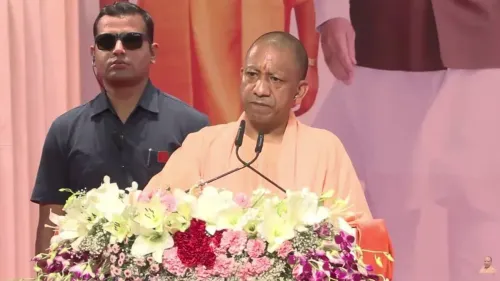
A letter, it turns out, can travel further than a policy circular. The Chief Minister's Office of Uttar Pradesh, on Monday, 16 November 2026, shared a pointed observation from Chief Minister Yogi Adityanath — that 'Yogi ki Paati' (Yogi's Letter) has become the state government's most direct channel for taking welfare scheme benefits to citizens at 'the last rung of society.'
The post quotes CM Yogi Adityanath describing the initiative as 'jan-jan tak pahunchane ka ek sashakt madhyam' — 'a powerful medium for reaching every person' — and frames it explicitly as an exercise in 'aatmiya samvad', or intimate dialogue, between the government and its citizens.
What 'Yogi ki Paati' is designed to do
Yogi ki Paati is a communication initiative by the Uttar Pradesh Chief Minister's Office aimed at disseminating information on government welfare programmes and administrative achievements directly to ordinary citizens. The idea is straightforward but pointed: in a state of over 240 million people, awareness of entitlements is often the first barrier to accessing them. A personally-addressed letter from the Chief Minister cuts through bureaucratic distance in a way that a government circular rarely does.
The initiative sits within a broader pattern Yogi Adityanath has pursued since taking office in March 2017 — using multiple outreach channels to close the gap between scheme design and ground-level delivery. Rural and marginalised households, who are both the primary targets of welfare programmes and the least likely to know their entitlements, are the stated audience.
A tactic seen across Indian states, sharpened in UP
Direct public communication by chief ministers — personal letters, radio addresses, SMS campaigns — has precedent across several Indian states, but Uttar Pradesh's scale makes the stakes unusually high. Getting a welfare message wrong, or failing to deliver it at all, affects constituencies measured in tens of millions. Yogi ki Paati positions written correspondence as a trust-building instrument rather than merely an information-distribution exercise.
The emphasis on 'aatmiya samvad' — intimate conversation — signals a deliberate choice of register: not a government notice, but something closer to a personal appeal. That framing is itself a governance signal, suggesting the administration views citizen buy-in, not just scheme rollout, as the measure of success.
How far the letters actually travel — in terms of verified reach, feedback loops, and measurable uptake of schemes — will be the real test of whether the medium matches its ambition.
Point of View
Framing a letter campaign as 'intimate dialogue' is a deliberate political choice: it personalises the welfare state at a time when visible delivery, not just budgetary allocation, defines electoral credibility. The initiative also hints at an acknowledgement that formal bureaucratic channels alone cannot bridge awareness gaps among marginalised communities. Watch whether the UP government releases verifiable reach or uptake metrics tied to the initiative — that data will determine whether 'Yogi ki Paati' is governance innovation or communication theatre.
NationPress
16 Nov 2026
Frequently Asked Questions
What is 'Yogi ki Paati'?
'Yogi ki Paati' (Yogi's Letter) is a communication initiative by the Uttar Pradesh Chief Minister's Office, in which the state government sends personal letters from CM Yogi Adityanath to citizens to inform them about government welfare schemes and administrative achievements.
Who is the target audience of Yogi ki Paati?
The initiative primarily targets rural and marginalised households — citizens at what CM Yogi Adityanath calls 'the last rung of society' — who may not otherwise be aware of their entitlements under government welfare programmes.
When did Yogi Adityanath become Chief Minister of Uttar Pradesh?
Yogi Adityanath has served as Chief Minister of Uttar Pradesh since March 2017, when he was first appointed to the post.
Why is direct citizen communication important for welfare delivery in UP?
In a state of over 240 million people, awareness of welfare entitlements is often the first barrier to accessing them. Direct communication like 'Yogi ki Paati' aims to bridge the gap between government scheme design and actual uptake at the grassroots.
Is 'Yogi ki Paati' unique to Uttar Pradesh?
Direct public communication by chief ministers — through letters, radio addresses, or digital platforms — has been used across several Indian states, but Uttar Pradesh's scale and the specific 'Yogi ki Paati' format are distinctive to the Yogi Adityanath administration.