CM Yogi Defines Good Governance: No One Left Behind

Synopsis
Chief Minister Yogi Adityanath defines good governance as welfare schemes reaching the last person without discrimination. The statement, shared by the UP CM's office on 3 November 2026, reflects the Adityanath administration's consistent Antyodaya-linked messaging on inclusive, bias-free delivery of state benefits.
Key Takeaways
CM Yogi Adityanath defined sushasan (good governance) as welfare benefits reaching the last citizen without discrimination.
The statement was shared by the Chief Minister's Office of Uttar Pradesh on 3 November 2026 .
The framing draws on the Antyodaya principle, a recurring theme in UP government communications since 2017 .
Uttar Pradesh , with a population exceeding 240 million across 75 districts , represents one of India's most complex last-mile welfare delivery challenges.
The statement sets an implicit accountability standard: scheme benefits that do not reach marginalised communities fall short of the CM's own definition of good governance.
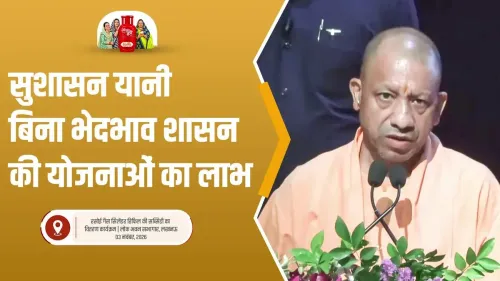
When the last person in the queue finally receives what the state promised — without favour, without friction — that, says Chief Minister Yogi Adityanath, is what governance is truly for. The Chief Minister's Office of Uttar Pradesh shared the CM's statement on Tuesday, 3 November 2026, anchoring it in a single, precise idea: welfare without discrimination is not a slogan, it is the definition of good governance.
Posted in Hindi, the statement reads: 'Jab antim paaydaan par khade vyakti tak shaasan ki yojanaon ka laabh bina kisi bhedbhaav ke pahunchta hai to isi ko sushasan kehte hain.' — 'When the benefits of the government's schemes reach the person standing on the last rung, without any discrimination, that is what is called good governance.'The Antyodaya Thread Running Through UP's Governance Pitch
The framing is deliberate. Since 2017, the Yogi Adityanath-led government in Uttar Pradesh has consistently invoked the Antyodaya principle — the idea, rooted in Indian social thought, that a state must be judged by how it treats its most marginalised citizen. Repeated across official communications over nearly a decade, the language has become a signature of the administration's public positioning on welfare delivery.
The statement does not name a specific scheme or launch a new initiative. Instead, it functions as a philosophical anchor — a reminder, directed at both administrators and citizens, that the purpose of the state's welfare architecture is inclusion at scale, not selective reach.
What 'Without Discrimination' Actually Demands
Uttar Pradesh, India's most populous state with a population exceeding 240 million, presents one of the most complex last-mile delivery challenges in the country. Housing, food security, health coverage, and direct-benefit transfers must navigate enormous demographic diversity and geographic spread. The CM's framing implicitly sets a high bar: scheme benefits that stop at the district headquarters, or that reach only connected communities, fall short of sushasan — good governance — by his own definition.
District-level implementation reports and any forthcoming audits of scheme penetration across UP's 75 districts will be the real test of whether the principle translates to ground-level reality.
Point of View
The CM sets a citizen-facing accountability standard that is simultaneously aspirational and difficult to audit. In a state as large and diverse as Uttar Pradesh, the gap between the stated principle and ground-level penetration of welfare schemes remains the central tension in evaluating the government's actual record. Expect this messaging to intensify as the administration approaches any electoral cycle, with district-level delivery data becoming the battleground for competing claims.
NationPress
3 Nov 2026
Frequently Asked Questions
What did CM Yogi Adityanath say about good governance?
CM Yogi Adityanath defined good governance as a state where the benefits of government schemes reach the last person in society without any discrimination. The statement was shared by the UP Chief Minister's Office on 3 November 2026.
What is the Antyodaya principle in Uttar Pradesh governance?
Antyodaya is the principle of prioritising the welfare of the most marginalised citizen. The Yogi Adityanath government in Uttar Pradesh has invoked this idea consistently since 2017, framing its welfare delivery goals around reaching the last beneficiary.
What does 'sushasan' mean in Indian governance?
'Sushasan' is the Hindi term for good governance. In CM Yogi Adityanath's framing, it specifically means the non-discriminatory delivery of government scheme benefits to every citizen, including those at the lowest rung of society.
How many districts does Uttar Pradesh have?
Uttar Pradesh has 75 districts. With a population exceeding 240 million, the state represents one of India's most complex last-mile welfare delivery challenges.
Why does UP's welfare delivery matter nationally?
Uttar Pradesh is India's most populous state. How effectively it delivers welfare schemes to marginalised communities is seen as a key indicator of governance quality and a template — or cautionary tale — for large-state administration across the country.