CM Yogi: UP Produces 55% of India's Ethanol, Leads in CBG Plants
Synopsis
Chief Minister Yogi Adityanath has declared Uttar Pradesh the country's largest ethanol producer, supplying roughly 55 per cent of national output, and announced a target of 100 new Compressed Biogas plants in the state within one year, citing gains for the sugar industry and clean energy goals.
Key Takeaways
Uttar Pradesh is now India's largest ethanol-producing state, accounting for approximately 55 per cent of national ethanol output.
The surge follows implementation of the Central government's Ethanol Blending Policy , which set a target of 20% petrol blending by 2025 .
CM Yogi Adityanath credited the policy with giving 'new strength' to UP's sugar industry , which has diversified into distilleries.
Uttar Pradesh already hosts the highest number of Compressed Biogas (CBG) plants in India.
The state government has set a target of commissioning 100 CBG plants within the next one year .
Key beneficiaries include sugarcane farmers , sugar mill operators , and biofuel investors across the state.
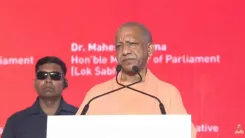
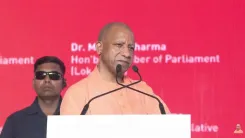
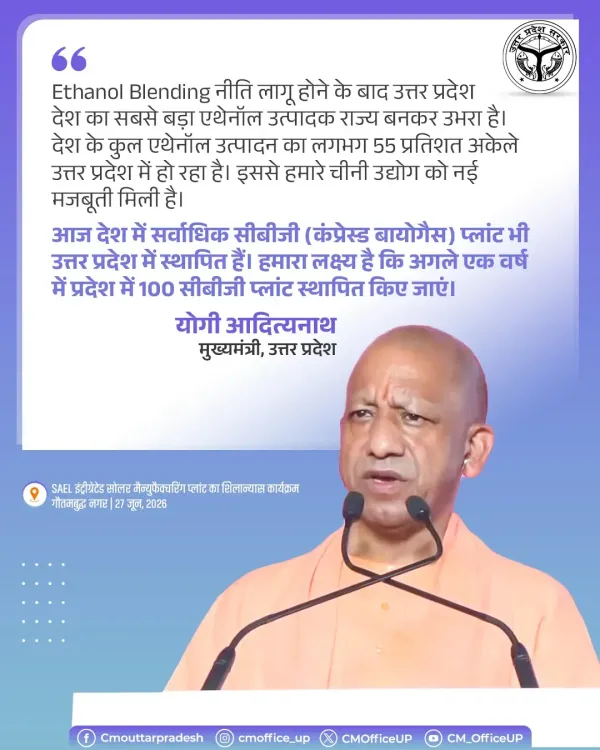
The Chief Minister's Office of Uttar Pradesh on 27 June 2026 quoted Chief Minister Yogi Adityanath as saying that Uttar Pradesh has emerged as the country's largest ethanol-producing state following the implementation of the national Ethanol Blending Policy, contributing approximately 55 per cent of India's total ethanol output.
What the Chief Minister Said
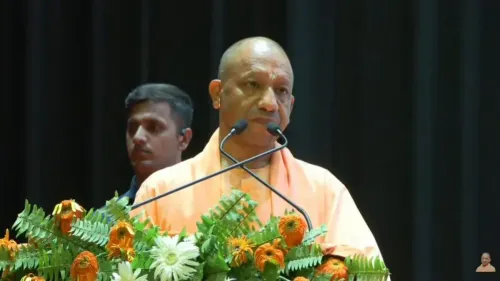
In his statement, CM Yogi Adityanath declared: 'Ethanol Blending neeti laagu hone ke baad Uttar Pradesh desh ka sabse bada ethanol utpadak rajya bankar ubhara hai' ['After the Ethanol Blending Policy came into effect, Uttar Pradesh has emerged as the country's largest ethanol-producing state']. He added that this development has given 'new strength' to the state's sugar industry. The Chief Minister also noted that Uttar Pradesh today hosts the highest number of Compressed Biogas (CBG) plants in the country, and set a target of commissioning 100 CBG plants in the state within the next one year.
Context
Uttar Pradesh is India's most populous state and its largest sugarcane producer, making it a natural anchor for the country's molasses-based ethanol supply chain. The Central government's National Policy on Biofuels, notified in 2018, set the framework for expanding domestic biofuel production and progressively raised blending targets, with a goal of 20 per cent ethanol blending in petrol by 2025. Sugar mills across UP have since diversified into ethanol distilleries, channelling surplus molasses and B-heavy syrup into fuel production rather than letting excess sugar depress market prices.
The SATAT (Sustainable Alternative Towards Affordable Transportation) initiative, launched by the Ministry of Petroleum and Natural Gas in 2018, runs parallel to the ethanol programme and aims to establish a network of CBG plants across India, converting agricultural residue and biomass into clean compressed gas for transport and industrial use.
Policy Backdrop
The ethanol blending programme has served a dual purpose at the national level: reducing India's dependence on imported crude oil and providing sugar mills with an alternative revenue stream that stabilises cane arrears owed to farmers. Sugarcane-rich states, particularly Uttar Pradesh and Maharashtra, have been the primary beneficiaries of this policy shift. UP's dominance — accounting for roughly 55 per cent of national ethanol production by the state government's own account — reflects both the scale of its cane cultivation and the rapid expansion of distillery capacity in recent years.
The CBG push complements ethanol blending by targeting a different feedstock: paddy straw, press mud, and municipal solid waste. For Uttar Pradesh, which generates vast quantities of agricultural residue, CBG plants offer a waste-to-energy solution that also addresses stubble-burning concerns.
Stakeholders and Impact
The primary beneficiaries of this policy trajectory are sugarcane farmers, who receive more timely payments when mills earn from ethanol sales, and sugar mill operators, who gain a price-supported off-take channel for by-products. Biofuel producers and investors in CBG infrastructure also stand to gain from the state's stated target of 100 new CBG plants within a year. At the consumer end, higher ethanol blending is designed to moderate retail petrol prices by substituting a domestically produced fuel for imported crude derivatives.
What's Next
The benchmark to watch is whether Uttar Pradesh can commission 100 CBG plants within the one-year window set by CM Yogi Adityanath. Progress reports on plant commissioning, updates to the state's ethanol production share in national statistics, and any revision of blending targets by the Central government will determine how quickly this ambition translates into operational capacity. If the target is met, UP would significantly deepen India's clean-energy transition in both the transport fuel and rural waste-management sectors.
Point of View
Positioning the state as a model for biofuel-led rural industrialisation ahead of any future electoral cycle. The 55 per cent ethanol share claim, if sustained by official data, would be a significant policy win for both the state and the Centre's import-substitution strategy. The 100-CBG-plant target in one year is an ambitious benchmark that will be scrutinised by investors and farmers alike — success would reinforce UP's pitch as a renewable-energy destination, while delays could expose the gap between political announcements and ground-level execution. Broader context suggests this announcement fits a pattern of sugarcane-state governments leveraging biofuel policy to neutralise the chronic sugar-price and cane-arrear crises that have historically cost ruling parties rural votes.
NationPress
27 Jun 2026
Frequently Asked Questions
Is Uttar Pradesh the largest ethanol producer in India?
According to Chief Minister Yogi Adityanath , Uttar Pradesh is now India's largest ethanol-producing state, contributing approximately 55 per cent of the country's total ethanol output following the implementation of the national Ethanol Blending Policy .
What is the ethanol blending policy in India?
The Ethanol Blending Policy is a Central government programme, formalised under the National Policy on Biofuels 2018 , that mandates mixing domestically produced ethanol with petrol to reduce crude oil imports. The revised target is 20 per cent blending by 2025 .
What is a CBG plant and why is UP building 100 of them?
Compressed Biogas (CBG) plants convert agricultural residue, press mud, and biomass into clean compressed gas for use as fuel. CM Yogi Adityanath has set a target of commissioning 100 CBG plants in Uttar Pradesh within one year to expand clean energy capacity and utilise the state's large agricultural waste streams.
How does ethanol production benefit sugarcane farmers in UP?
When sugar mills in Uttar Pradesh sell ethanol to oil companies, they earn an additional revenue stream that helps them pay cane arrears to farmers more promptly. The policy reduces the mills' dependence on volatile sugar prices, improving financial stability across the supply chain.
What is the SATAT scheme for CBG in India?
The SATAT (Sustainable Alternative Towards Affordable Transportation) scheme was launched by the Ministry of Petroleum and Natural Gas in 2018 to promote the establishment of CBG plants across India, offering long-term off-take agreements to producers of biogas made from agricultural and municipal waste.