Chhattisgarh CMO spotlights Narayanpur farmer's nano-fertilizer success
Synopsis
The Chief Minister's Office of Chhattisgarh has spotlighted Kalendra Kumeti, a farmer from Kerlapal village in Narayanpur district, for adopting nano urea and nano DAP. The CMO said the shift cut costs and raised productivity, framing him as a progressive farmer and a template for sustainable agriculture in the state's tribal belts.
Key Takeaways
The Chhattisgarh CMO featured farmer Kalendra Kumeti of Kerlapal village, Narayanpur district, on 3 June 2026.
Kumeti reportedly raised crop productivity by switching from conventional inputs to nano urea and nano DAP.
The CMO described the shift as a model of lower cost, higher output and sustainable farming.
Nano urea was commercially launched by IFFCO in 2021, with nano DAP following as part of a national efficiency push.
Narayanpur lies in Chhattisgarh's tribal Bastar division, signalling outreach beyond commercial farming belts.
Independent, state-wide data on nano-fertilizer yield gains in Chhattisgarh is still limited.
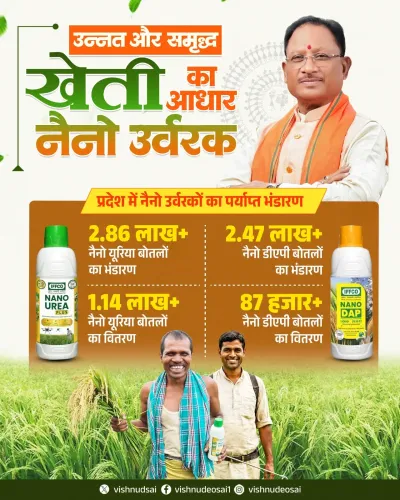
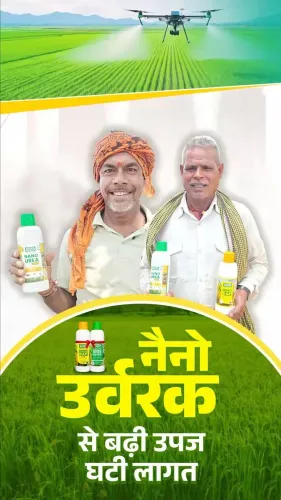
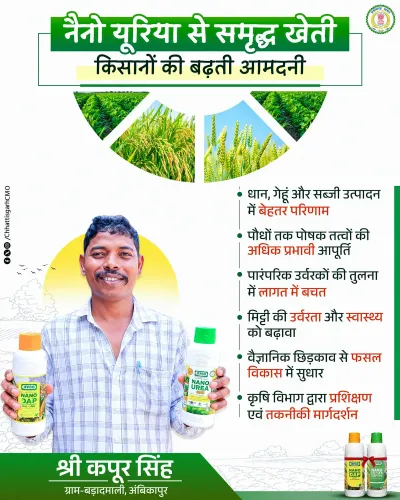
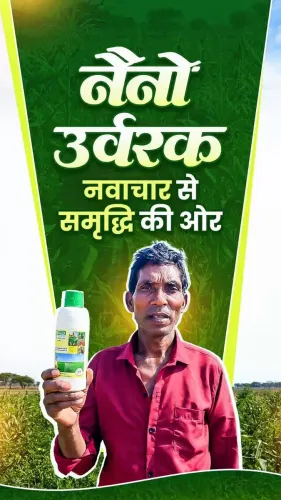
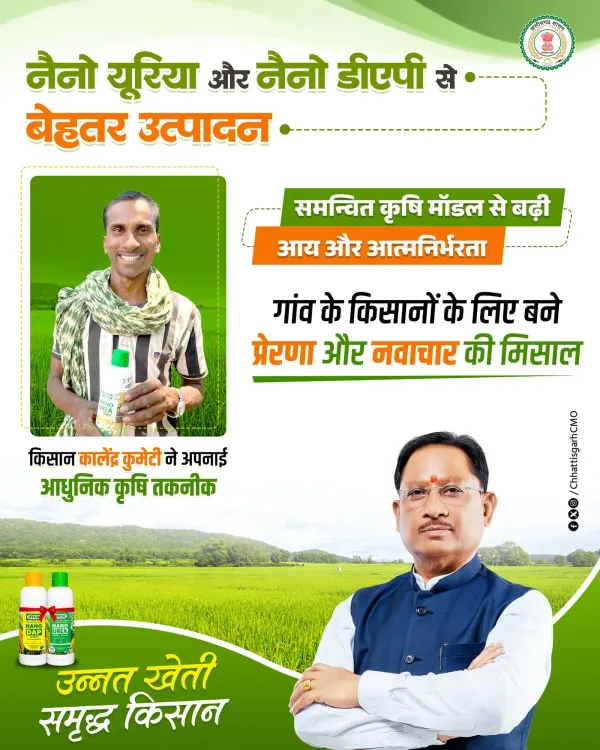
The Chief Minister's Office of Chhattisgarh on 3 June 2026 spotlighted a tribal-belt farmer's switch to nano fertilizers as a model for sustainable agriculture in the state. In a post on X, the CMO featured Kalendra Kumeti, a cultivator from Kerlapal village in Narayanpur district, who reported a notable rise in crop productivity after moving beyond conventional practices to use nano urea and nano DAP.
Context
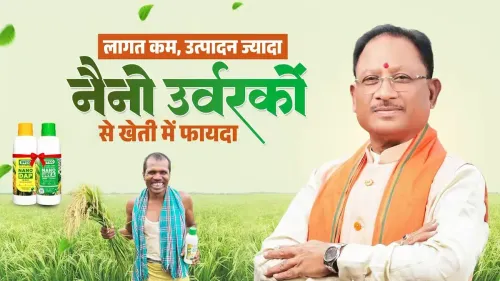
The CMO's post, headlined 'Unnat kheti, samriddh kisan' (Advanced farming, prosperous farmer), said Kumeti's shift to liquid nano fertilizers led to a 'remarkable increase' in yields. It described his approach as a combination of 'lower costs, better output and sustainable farming' that has earned him recognition as a progressive farmer in the region.
The office added that his success is an 'excellent example of the power of modern agricultural techniques and the innovation capacity of farmers'. The accompanying image showed the farmer at his field in Kerlapal, a village in the largely tribal Bastar division.
Policy backdrop
Nano urea was commercially launched by the Indian Farmers Fertiliser Cooperative Limited (IFFCO) in 2021, followed by nano DAP, as part of a national push to improve nutrient-use efficiency and cut reliance on conventional granular fertilizers. A 500 ml bottle of nano urea is positioned by IFFCO as a substitute for one 45 kg bag of conventional urea.
Since 2021, the Government of India has promoted these products across states with the stated aims of trimming the fertilizer subsidy bill, reducing import dependence on key raw materials, and supporting sustainable farming. State governments, including Chhattisgarh, have run awareness drives and demonstration plots to encourage adoption among small and marginal cultivators.
Stakeholders and impact
Narayanpur is a district in southern Chhattisgarh with a significant tribal population and an economy anchored in agriculture and forest produce. Highlighting a farmer from this district carries a specific signal: the state administration is framing nano-fertilizer uptake as accessible even in remote, Scheduled-Area blocks, not just in irrigated commercial belts.
For farmers, the pitch rests on three claims commonly cited by promoters of nano fertilizers: lower per-acre input cost, easier transport and storage of a small bottle compared with heavy bags, and reduced soil and water residue. Cooperative bodies and state agriculture departments are the main distribution channels, with IFFCO as the principal manufacturer.
The CMO's framing also fits a broader narrative the state government has pushed around 'progressive farmers' — individual cultivators held up as templates for peers. Such case-led communication is often used to accelerate adoption of new inputs and machinery in districts where extension services have historically been thin.
What's next
The key indicators to watch are state-level data on nano-fertilizer distribution, adoption rates and measured yield changes across Chhattisgarh districts during the coming kharif and rabi seasons. Independent field assessments of yield gains from nano urea and nano DAP remain limited, and outcomes have varied by crop, soil and irrigation conditions.
If the Chhattisgarh government follows up the Kerlapal showcase with district-wise uptake figures and crop-cutting data, it would help establish whether individual success stories like Kumeti's translate into a wider productivity shift — and whether the model can be scaled across the state's tribal belts without crowding out traditional soil-health practices.
Point of View
Then scale the message through state channels. For Chhattisgarh, anchoring that story in Narayanpur is deliberate — it positions nano fertilizers as relevant to tribal, rain-fed farming, not just to irrigated cash-crop zones. The real test will be whether district-level adoption and yield data, rather than individual case studies, validate the shift. Until then, such showcases are best read as policy signalling, not as evidence of statewide transformation.
NationPress
18 Oct 2026
Frequently Asked Questions
What did the Chhattisgarh CMO say about farmer Kalendra Kumeti?
The Chhattisgarh CMO said Kalendra Kumeti of Kerlapal village in Narayanpur district adopted nano urea and nano DAP in place of conventional fertilizers, leading to a notable rise in crop productivity and lower input costs.
What are nano urea and nano DAP?
Nano urea and nano DAP are liquid fertilizer formulations developed by IFFCO that deliver nutrients in nanoparticle form. A small bottle is designed to substitute for a conventional fertilizer bag, with the aim of improving nutrient-use efficiency and cutting input volumes.
When was nano urea launched in India?
IFFCO commercially launched nano urea in 2021, followed by nano DAP, as part of a national push to reduce conventional fertilizer use and import dependence.
Where is Kerlapal village located?
Kerlapal is a village in Narayanpur district of Chhattisgarh, which lies in the state's Bastar division and has a significant tribal population.
Why is the Chhattisgarh government promoting nano fertilizers?
The state, in line with central policy, is promoting nano fertilizers to lower input costs for farmers, reduce the fertilizer subsidy burden, cut import dependence on raw materials, and support more sustainable farming practices.