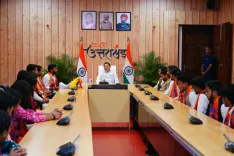
Giriraj Singh Flags Record 40% CNG-EV Car Sales in June
Synopsis
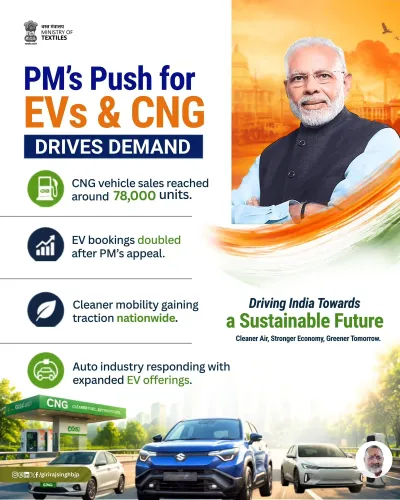
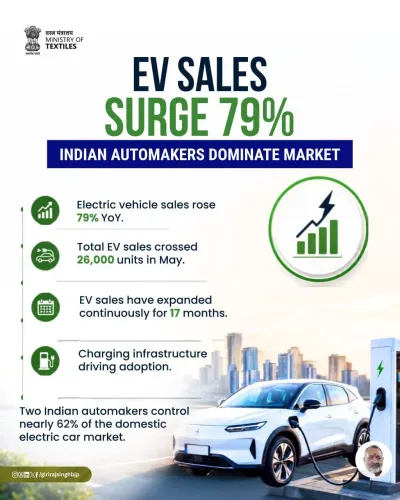
CNG and electric vehicles together captured a record 40 per cent of India's passenger car sales in June 2026, Union Textiles Minister Giriraj Singh highlighted on X, pointing to surging demand for cleaner powertrains backed by years of government policy support.
Key Takeaways
CNG and EVs together accounted for a record 40 per cent of India's total passenger car sales in June 2026 .
Union Textiles Minister Giriraj Singh shared the milestone data via the NaMo App on 7 July 2026 .
The surge is underpinned by the FAME-II scheme (launched 2019, outlay Rs 10,000 crore ) and the expanding City Gas Distribution network .
India's EV policy lineage dates to the National Electric Mobility Mission Plan 2020 , unveiled in 2013 .
BS-VI emission norms rolled out in 2020 accelerated manufacturer investment in cleaner powertrains, contributing to the current sales trend.
Further updates to FAME scheme guidelines and new state-level EV policies are expected in upcoming budget cycles.
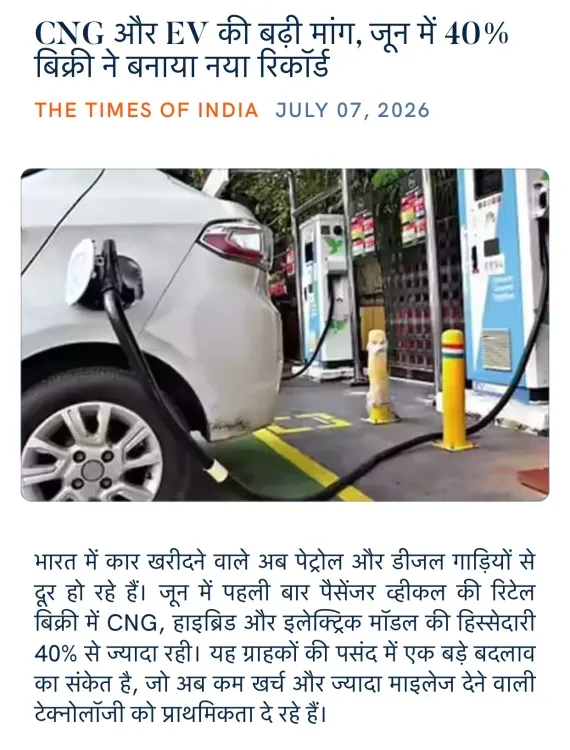
Union Textiles Minister Giriraj Singh on Tuesday, 7 July 2026 shared a report highlighting that CNG and electric vehicles together accounted for a record 40 per cent of total passenger car sales in June 2026, signalling a structural shift in India's automobile market toward cleaner powertrains.
The minister shared the report via the NaMo App, citing surging demand for both Compressed Natural Gas (CNG) and electric vehicles (EVs) as the driver behind the milestone. His post, written in Hindi, noted: 'CNG aur EV ki badhi maang, June mein 40% bikri ne banaya naya record' ('Rising demand for CNG and EV, 40% sales in June set a new record').
Context
The 40 per cent combined share of CNG and EVs in monthly passenger vehicle sales marks a new high for India's auto market. For years, petrol and diesel vehicles dominated the segment, but rising fuel costs, expanding CNG infrastructure, and government incentives have steadily tilted buyer preference toward alternative powertrains. June 2026 appears to be the clearest inflection point yet in that trend.
While Giriraj Singh holds the Textiles portfolio and does not directly oversee the automobile or energy sectors, senior ruling-party legislators frequently amplify economic data that reflects positively on the government's broader development agenda. His sharing of this data underscores the BJP's interest in projecting green-economy momentum ahead of upcoming legislative sessions.
Policy Backdrop
India's push toward fuel diversification has been built on two parallel pillars. The City Gas Distribution (CGD) policy has steadily expanded the CNG pipeline network to dozens of new cities, making factory-fitted and retro-fitted CNG cars a practical choice for urban and semi-urban buyers. On the electric side, the government's FAME-II scheme, launched in 2019 with an outlay of Rs 10,000 crore, provided demand-side subsidies and supported charging infrastructure rollout.
These efforts trace back even further to the National Electric Mobility Mission Plan 2020, unveiled in 2013, which set the original ambition for significant EV penetration. The BS-VI emission norms, rolled out in 2020, also accelerated manufacturer investment in cleaner engine technologies, making CNG variants more fuel-efficient and EV platforms more competitive on range and price.
Stakeholders and Impact
Automobile manufacturers stand to benefit most immediately, as the record alternative-powertrain share validates their investments in CNG and EV product lines. Companies that front-loaded capacity in these segments are now seeing volume rewards, while those dependent on conventional diesel variants face pressure to accelerate their transition roadmaps.
Urban vehicle buyers are the other key stakeholder group. Lower running costs for CNG cars and falling EV prices — driven partly by domestic battery manufacturing incentives — have made the total cost of ownership argument compelling. Analysts have noted that first-time buyers in Tier-1 and Tier-2 cities are increasingly choosing CNG as a default over petrol, a pattern now visible in national sales aggregates.
What's Next
The record June figure will likely intensify pressure on policymakers to extend or upgrade the FAME scheme framework, with industry bodies expected to push for higher subsidy ceilings and faster CGD network expansion in the next round of budgetary consultations. Several state governments are also preparing their own EV policies, and the national sales milestone gives those efforts fresh political momentum.
If the 40 per cent alternative-powertrain share holds or rises through the second half of 2026, it would mark a decisive tipping point — one that could reshape fuel-import projections, urban air quality targets, and the government's own climate commitments under its NDC pledges to the international community.
Point of View
From the 2013 mobility mission through FAME-II subsidies and CGD network rollouts. That a Textiles Minister, rather than the Heavy Industries or Petroleum ministries, is amplifying this data reflects the BJP's whole-of-government communication strategy around green-economy wins. The timing — mid-2026, ahead of likely state elections and international climate reviews — suggests the ruling party intends to position this record as evidence that India's energy transition is market-driven, not just subsidy-dependent. The real test will be whether the share holds without FAME-era incentives, a question that upcoming scheme-renewal decisions will answer.
NationPress
6 Oct 2026
Frequently Asked Questions
What is the record CNG and EV car sales share in India for June 2026?
CNG and electric vehicles together accounted for a record 40 per cent of total passenger car sales in India in June 2026, according to data shared by Union Textiles Minister Giriraj Singh.
Why did Giriraj Singh share automobile sales data when he is the Textiles Minister?
Senior ruling-party ministers frequently share positive economic indicators across sectors as part of broader government communication. Giriraj Singh shared the CNG-EV sales record via the NaMo App to highlight India's green-economy progress.
What is the FAME scheme and how has it helped EV sales in India?
FAME stands for Faster Adoption and Manufacturing of Electric Vehicles. The FAME-II scheme, launched in 2019 with an outlay of Rs 10,000 crore, provided demand-side subsidies and supported charging infrastructure, helping drive EV adoption in India.
What is driving the surge in CNG car sales in India?
The expansion of the City Gas Distribution network to new cities, lower running costs compared to petrol, and factory-fitted CNG options from major manufacturers have made CNG cars an increasingly popular choice for urban and semi-urban buyers.
Will the FAME scheme be extended or updated after the June 2026 sales record?
Industry bodies are expected to push for FAME scheme upgrades in upcoming budgetary consultations. The record sales milestone strengthens the case for continued or enhanced policy support for EVs and CNG vehicles.