Dalit groups accuse Congress of 'selective justice' in Ankita Bhandari case
Synopsis
Four Dalit organisations from Hyderabad and New Delhi have publicly challenged Congress over its intervention in the Ankita Bhandari case, accusing the party of selectively deploying social justice rhetoric for partisan gain. Invoking Dr Ambedkar's legacy, the groups warn that constitutional morality cannot be wielded as a political convenience — a rebuke that carries significant weight ahead of upcoming electoral contests.
Key Takeaways
Four Dalit organisations released open letters on 15 October 2026 accusing Congress of political opportunism in the Ankita Bhandari case.
The letters were signed by representatives of SC Hakkula Porata Sangham , Dr B.R.
Ambedkar Volleyball Club , NBCC SC/ST Employees Welfare Association , and SAIL SC & ST Employees Federation .
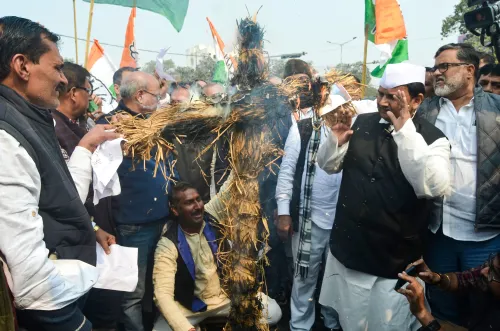
The groups questioned Congress leaders' participation in an India Gate protest, asking whether social justice is a consistent principle or a partisan instrument for the party.
The signatories invoked Dr B.R.
Ambedkar's legacy, demanding 'intellectual honesty, principled conduct and equal standards of accountability.' The letters called for 'a politics guided by consistent principles' rather than 'selective outrage dictated by political expediency.'
Four Dalit organisations across Hyderabad and New Delhi have accused the Indian National Congress of practising political opportunism and invoking social justice selectively in the Ankita Bhandari case, through open letters addressed to the party's leadership on Thursday, 15 October 2026. The letters question whether Congress treats constitutional morality as a consistent principle or a partisan instrument.
The Core Allegation
The four organisations — SC Hakkula Porata Sangham (Hyderabad), Dr B.R. Ambedkar Volleyball Club (Hyderabad), NBCC SC/ST Employees Welfare Association (New Delhi), and SAIL SC & ST Employees Federation (New Delhi) — released separate but thematically aligned open letters. They pointed specifically to the participation of senior Congress leaders in a protest at India Gate, arguing it thrust the Ankita Bhandari case into the national political arena while raising deeper questions about the party's motivations.
'The participation of senior Congress leaders in the India Gate protest has brought the issue into the national political arena. Yet, the larger question remains: Is social justice a consistent principle for Congress, or a political instrument invoked when it serves partisan interests?' the letters stated.
What the Letters Demand
The organisations clarified their objection is not to democratic protest, public scrutiny, or institutional accountability as such. Rather, they challenged what they described as the selective application of principles that ought to be universal. 'A party that routinely lectures the nation on constitutional morality must demonstrate consistency in its own political conduct,' the letters read.
The signatories invoked Dr B.R. Ambedkar's legacy explicitly, arguing that generations of Ambedkarite movements had fought for equality before the law and substantive social justice — ideals they said cannot be 'reduced to convenient political vocabulary.' They called on Congress to demonstrate 'intellectual honesty, principled conduct and equal standards of accountability.'
Who Signed the Letters
The letters were signed by Maredu Mohan, Founder President of SC Hakkula Porata Sangham; Kranthi Kiran, President, and other office-bearers of Dr B.R. Ambedkar Volleyball Club; S.K. Soni and Manoj Kumar, President and General Secretary respectively of NBCC SC/ST Employees Welfare Association; and office-bearers of SAIL SC & ST Employees Federation. The breadth of signatories — spanning civil society, public sector employee groups, and academic communities — signals coordinated concern across Dalit institutional networks.
Broader Context and Political Significance
The Ankita Bhandari case has drawn sustained national attention, with multiple political parties staking out positions around it. This comes amid a broader pattern in which Dalit groups across the political spectrum have grown increasingly critical of what they term 'outrage tourism' by mainstream parties around caste-related cases. Notably, criticism of this kind targeting Congress from within Dalit civil society carries particular weight ahead of state electoral cycles in which Dalit voter consolidation is a pivotal variable.
'Social justice cannot be selective. Constitutional morality cannot be convenient. And Babasaheb Ambedkar's legacy cannot be reduced to a partisan instrument,' the letters concluded, calling for 'a politics guided by consistent principles, institutional responsibility and genuine commitment to equality.'
Whether Congress responds formally to the open letters — and how it does so — is likely to shape how Dalit voters and civil society organisations assess the party's credibility on social justice going forward.
Point of View
The criticism lands differently. The open letters are notable not for their anger but for their precision: they do not oppose protest, they oppose inconsistency. This pattern of Dalit groups calling out mainstream parties across the spectrum for 'outrage tourism' has grown more visible, suggesting that Ambedkarite constituencies are increasingly unwilling to be mobilised by parties that fail to demonstrate a principled track record. For Congress, which has positioned social justice at the core of its electoral identity, failing to respond credibly to this challenge — especially in a state like Telangana — carries a real political cost.
NationPress
15 Oct 2026
Frequently Asked Questions
Which Dalit organisations accused Congress in the Ankita Bhandari case?
Four organisations released open letters: SC Hakkula Porata Sangham (Hyderabad), Dr B.R. Ambedkar Volleyball Club (Hyderabad), NBCC SC/ST Employees Welfare Association (New Delhi), and SAIL SC & ST Employees Federation (New Delhi). Together they represent Dalit civil society groups from both Telangana and the national capital.
What is the core accusation against Congress in these open letters?
The organisations accuse Congress of invoking social justice selectively — specifically, of intervening in the Ankita Bhandari case primarily because it offered an opportunity to challenge political opponents, rather than out of a consistent commitment to constitutional morality. They argue the party applies principles of equality only when it is politically convenient.
What prompted the open letters — what did Congress do in the Ankita Bhandari case?
Senior Congress leaders participated in a protest at India Gate over the Ankita Bhandari case, which the organisations acknowledge brought the issue into the national political arena. However, the groups argue this intervention raises questions about consistency, given what they describe as Congress's uneven record on social justice.
How do the letters invoke Dr B.R. Ambedkar?
The letters argue that generations of Ambedkarite movements have fought for equality before the law and substantive social justice, and that these ideals cannot be reduced to political vocabulary. The organisations state that Dr Ambedkar's legacy demands intellectual honesty and equal standards of accountability — not rhetorical references to the Constitution deployed for partisan purposes.
What do the Dalit organisations want Congress to do?
They call on Congress leadership to reflect on the perception that its commitment to social justice becomes most visible only when controversies offer opportunities to challenge political opponents. The groups demand a politics of consistent principles, institutional responsibility, and genuine commitment to equality — rather than selective outrage.