Giriraj Singh: DBT Saved Centre Rs 5.14 Lakh Crore in a Decade
Synopsis
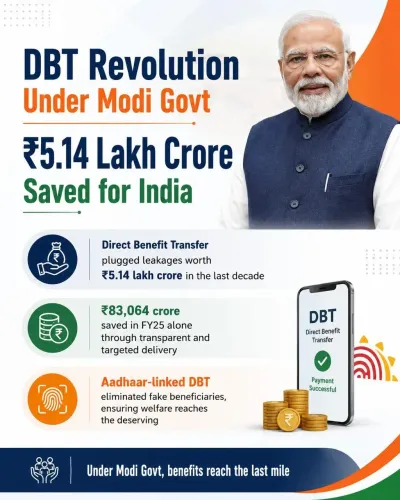
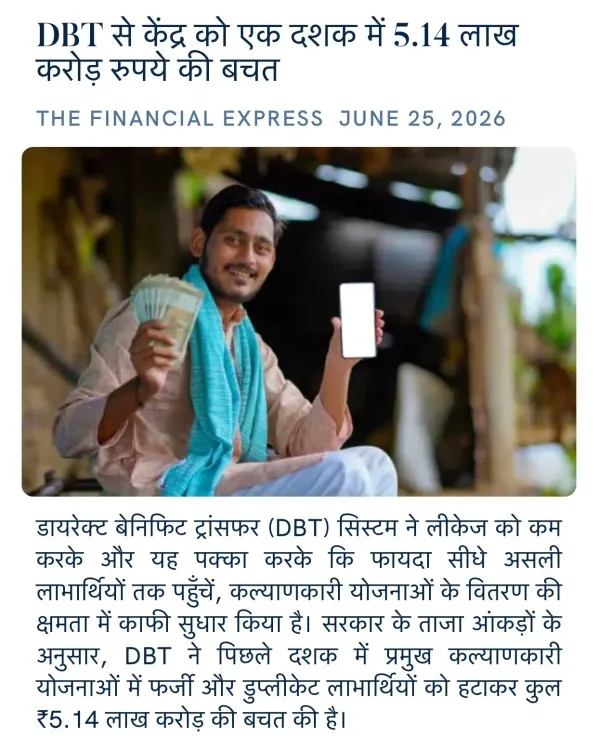
Union Textiles Minister Giriraj Singh has amplified a report claiming the Direct Benefit Transfer scheme saved the central government Rs 5.14 lakh crore over a decade. The figure underscores the government's decade-long push to use the JAM Trinity to eliminate subsidy leakages and rationalise welfare delivery.
Key Takeaways
Rs 5.14 lakh crore in cumulative savings attributed to the Direct Benefit Transfer (DBT) scheme over a decade, as cited by Union Textiles Minister Giriraj Singh .
DBT was formally launched in January 2013 , initially covering 34 schemes across 43 districts before nationwide rollout.
The JAM Trinity — Jan Dhan accounts, Aadhaar, and mobile numbers — was the infrastructure backbone that enabled DBT to scale after 2014 .
Key schemes contributing to savings include PAHAL (LPG subsidy), MGNREGA wage payments, and fertiliser subsidies .
Singh shared the claim via the NaMo App , the official platform used to amplify government policy milestones.
Cumulative DBT savings figures are typically updated in the annual Economic Survey or parliamentary budget-session replies.
Union Textiles Minister Giriraj Singh on Thursday, June 25, 2026, shared a report highlighting that the Direct Benefit Transfer (DBT) scheme has saved the central government Rs 5.14 lakh crore over a decade, amplifying the claim via the NaMo App.
Context
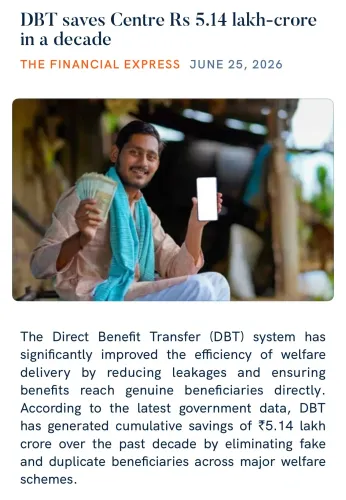
Singh's post, shared in Hindi, cited the headline 'DBT se kendra ko ek dashak mein 5.14 lakh crore rupaye ki bachat' — meaning 'DBT saves the Centre Rs 5.14 lakh crore in a decade.' The minister shared the figure through the NaMo App, the official mobile platform used to amplify government policy achievements, underscoring the ruling party's intent to spotlight the programme's fiscal impact.
The Direct Benefit Transfer mechanism was formally launched in January 2013, initially covering 34 schemes across 43 districts before being expanded nationwide. It routes subsidies and welfare payments directly into Aadhaar-linked bank accounts, cutting out intermediaries and reducing leakages through duplicate or ghost beneficiaries.
Policy Backdrop
DBT's scale-up was driven by the JAM Trinity — Jan Dhan bank accounts, Aadhaar biometric IDs, and mobile numbers — which the government prioritised from 2014 onwards to build the digital infrastructure required for direct transfers at scale. Schemes such as PAHAL (LPG subsidy), MGNREGA wage payments, and fertiliser subsidies have been among the largest contributors to documented savings by eliminating ineligible claimants.
The programme represents a policy thread that began under the previous UPA government and was substantially accelerated post-2014 through aggressive Aadhaar seeding and bank-account linkage drives. Successive government reports and parliamentary replies have cited cumulative savings as evidence that technology-driven delivery reduces fiscal leakage across multiple ministries.
Stakeholders and Impact
The primary beneficiaries of DBT's efficiency gains are the central government exchequer and, indirectly, the hundreds of millions of genuine subsidy recipients whose entitlements are no longer diluted by leakages. For the government, the savings free up fiscal space that can be redirected toward capital expenditure or expanded welfare coverage.
Critics of the framework have, over the years, pointed to exclusion errors — instances where eligible beneficiaries were left out due to Aadhaar-seeding failures or biometric mismatches. The net fiscal saving figure, however, has been consistently cited by the government as a headline indicator of DBT's success in rationalising subsidy delivery.
What's Next
Updated cumulative DBT savings figures are typically released alongside the annual Economic Survey or in parliamentary replies during the budget session. With the ten-year milestone now being publicly highlighted by senior ministers like Giriraj Singh, the figure is likely to feature prominently in the government's broader narrative around digital governance and fiscal consolidation in the run-up to the next budget cycle. The emphasis also signals that DBT expansion — potentially into new scheme categories — remains a live policy priority.
Point of View
The BJP is ensuring the DBT savings narrative reaches its core supporter base as a testament to Prime Minister Modi's reform agenda. The ten-year framing is significant: it allows the party to claim ownership of a programme that technically began under the UPA, by emphasising the post-2014 scale-up as the decisive intervention. For opposition parties, the challenge will be to contest the headline number without appearing to oppose the principle of direct welfare transfers, which enjoy broad popular support.
NationPress
24 Sept 2026
Frequently Asked Questions
What is DBT and how does it save government money?
Direct Benefit Transfer (DBT) routes subsidies and welfare payments directly into Aadhaar-linked bank accounts, eliminating duplicate and ghost beneficiaries. By removing intermediaries, the government avoids payments to ineligible claimants, generating cumulative fiscal savings across schemes like LPG subsidies, MGNREGA wages, and fertiliser support.
How much has DBT saved the Indian government?
According to the report shared by Union Textiles Minister Giriraj Singh on June 25, 2026, DBT has saved the central government Rs 5.14 lakh crore over a decade since its launch in 2013.
When was DBT launched in India?
DBT was formally launched in January 2013, initially covering 34 schemes across 43 districts. It was subsequently expanded nationwide, with significant acceleration after 2014 through the JAM Trinity of Jan Dhan accounts, Aadhaar, and mobile numbers.
What is the JAM Trinity and its role in DBT?
The JAM Trinity refers to Jan Dhan bank accounts, Aadhaar biometric IDs, and mobile numbers. The government prioritised this infrastructure from 2014 to enable DBT to function at scale by ensuring every beneficiary had a bank account linked to a verified identity.
Which schemes contribute most to DBT savings?
Key contributors to DBT savings include the PAHAL scheme for LPG subsidies, MGNREGA wage payments, and fertiliser subsidies — all areas where elimination of duplicate or ghost beneficiaries has generated significant fiscal gains for the central government.