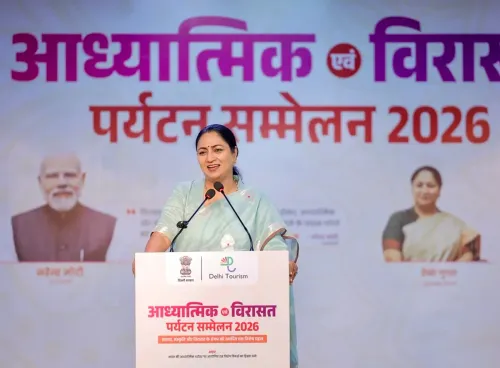
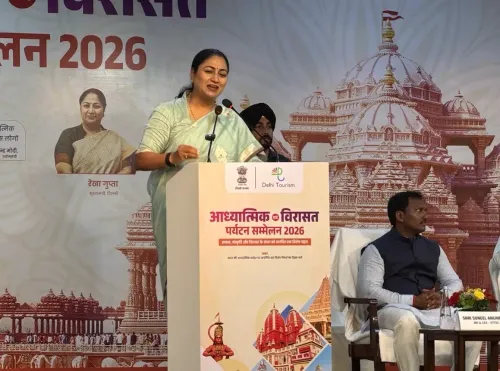
CM Rekha Gupta Launches Four Heritage Tourism Circuits at Akshardham Conclave
Synopsis
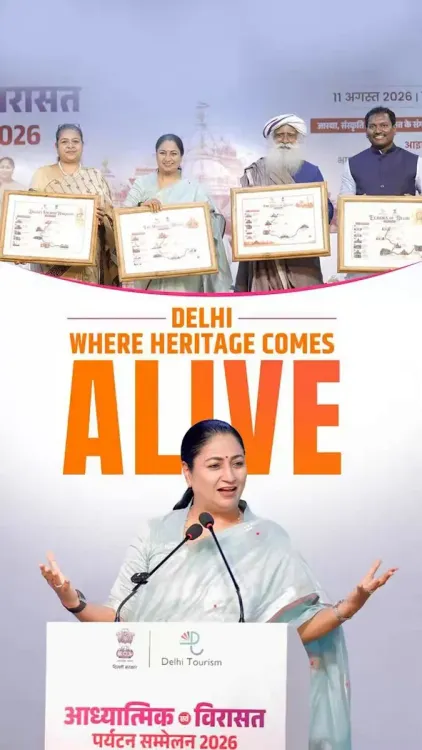
Delhi Chief Minister Rekha Gupta launched four branded tourism circuits — Soul of Delhi, Heritage of Delhi, Sacred Harmony, and Echoes of Delhi — covering 21 destinations at the Spiritual and Heritage Tourism Conclave 2026 held at Akshardham Temple, with Sadhguru Jaggi Vasudev in attendance.
Key Takeaways
Delhi CM Rekha Gupta announced four new tourism circuits at the Spiritual and Heritage Tourism Conclave 2026 on 11 August 2026 .
The circuits — Soul of Delhi , Heritage of Delhi , Sacred Harmony , and Echoes of Delhi — collectively link 21 spiritual, cultural, and heritage destinations .
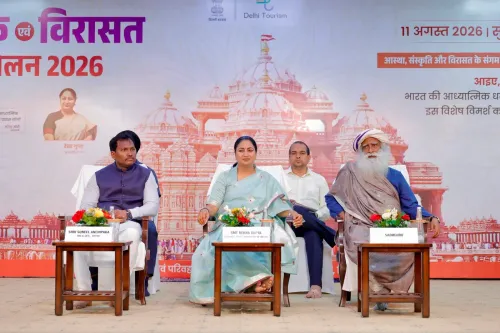
The conclave was held at Akshardham Temple , with Sadhguru Jaggi Vasudev of the Isha Foundation participating.
Highlighted sites include Jantar Mantar (a UNESCO World Heritage Site), Yogmaya Temple , Agrasen ki Baoli , and Mehrauli .
The circuits build on national frameworks including the Swadesh Darshan scheme (2014) and the HRIDAY scheme (2015) , adding a state-level branded identity.
Delhi's pitch positions the capital as a multi-era, multi-faith spiritual and heritage destination to rival established pilgrimage cities.
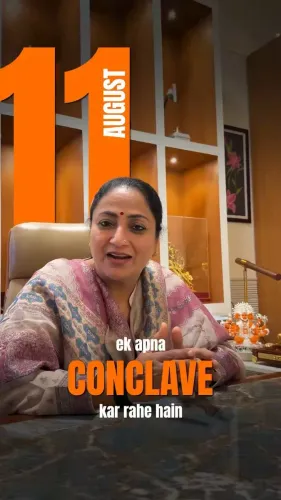
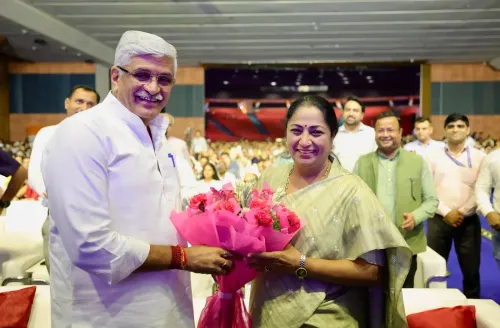
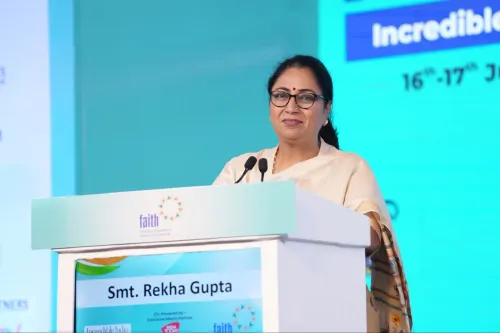
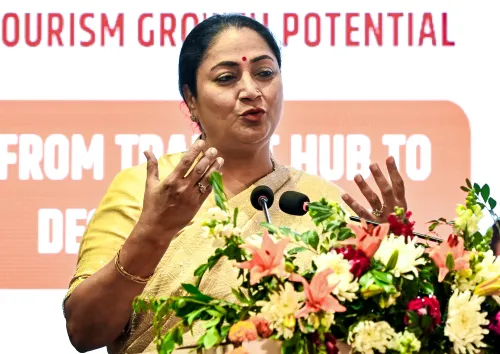
Delhi's story did not begin with the Red Fort or India Gate — it began with Indraprastha, the ancient city of the Mahabharata, and it runs through every mosque, temple, step-well, and observatory that has outlasted empires. On Tuesday, 11 August 2026, Delhi Chief Minister Rekha Gupta used the Spiritual and Heritage Tourism Conclave 2026 at Akshardham Temple to announce a structured push to take that deeper Delhi to the world — unveiling four new tourism circuits designed to stitch together 21 spiritual, cultural, and heritage destinations across the capital.
Four Circuits, One City's Layered Soul
The four circuits — Soul of Delhi, Heritage of Delhi, Sacred Harmony, and Echoes of Delhi — are Delhi Tourism's attempt to move visitors beyond the postcard landmarks and into the city's quieter, older corners. Sites named in the Chief Minister's post include Yogmaya Temple in Mehrauli, the Agrasen ki Baoli step-well, and the Jantar Mantar astronomical observatory — an 18th-century marvel and a UNESCO World Heritage Site — alongside the grand Akshardham Temple complex itself and the layered cultural geography of Mehrauli, one of Delhi's oldest inhabited zones.
The conclave brought Sadhguru Jaggi Vasudev, founder of the Isha Foundation, into the conversation — a deliberate signal that spiritual tourism is being positioned not merely as a government scheme but as a cultural movement with cross-sector credibility. The choice of Akshardham as the venue was itself a statement: the BAPS Swaminarayan complex already draws millions of domestic and international visitors and represents exactly the scale of spiritual-tourism infrastructure Delhi is hoping to replicate across its lesser-known sites.
A National Playbook, a Delhi-Specific Pitch
The circuits fit neatly into a longer policy arc. The central government's Swadesh Darshan scheme, launched in 2014, pioneered the concept of thematic tourism circuits — heritage, spiritual, tribal, eco — across Indian states. The HRIDAY scheme, introduced in 2015, specifically targeted heritage city preservation, with Delhi among its first cohort. What the Gupta government is now doing is building a state-level layer on top of that national scaffolding: branded, named circuits with a marketing identity designed to compete for the global spiritual-tourism traveller.
India's spiritual tourism market has grown steadily as a share of overall inbound and domestic travel, and Delhi — sitting at the confluence of Mughal, Rajput, British colonial, and ancient Hindu and Buddhist histories — has long been under-sold relative to destinations like Varanasi or Tirupati. The four circuits are a direct bid to change that arithmetic.
From Lord Krishna to Jantar Mantar: What the Circuits Cover
Chief Minister Gupta's framing — 'from Indraprastha aur Bhagwan Shri Krishna [Indraprastha and Lord Krishna]' to the precision instruments of Jantar Mantar — is not incidental. It draws a line across roughly 3,000 years of continuous civilisation in one city, from mythological antiquity through medieval step-wells and Mughal-era observatories to the modern spiritual architecture of Akshardham. The Sacred Harmony circuit name in particular suggests an attempt to present Delhi's multi-faith heritage — Hindu temples, Sufi shrines, mosques, and colonial-era churches — as a unified draw rather than separate silos.
The proof, as always, will be in the rollout: whether the circuits get adequate signage, guided-tour infrastructure, multilingual support, and the kind of sustained marketing that converts a government announcement into an actual visitor itinerary. Those metrics — footfall numbers, international tourist share, site-level revenue — are the ones to watch as Delhi Tourism moves from launch to execution.
Delhi has been telling its own story for millennia. The question now is whether the world is finally ready to listen — and whether the infrastructure is ready to receive them.
Point of View
The BJP-led administration is deliberately blending spiritual credibility with state tourism policy, a formula that has proven effective in states like Uttar Pradesh. The circuits also serve a political purpose: demonstrating governance momentum on a soft-power issue that cuts across voter segments and invites comparison with rival parties' heritage records in Delhi. Whether the announcement translates into sustained infrastructure investment — or remains a launch-day headline — will determine its real legacy.
NationPress
25 Sept 2026
Frequently Asked Questions
What are the four new Delhi tourism circuits announced in 2026?
Delhi Tourism announced four circuits: Soul of Delhi , Heritage of Delhi , Sacred Harmony , and Echoes of Delhi , collectively covering 21 spiritual, cultural, and heritage destinations across the capital.
What is the Spiritual and Heritage Tourism Conclave 2026?
The Spiritual and Heritage Tourism Conclave 2026 was an event held at Akshardham Temple in Delhi on 11 August 2026 , convened by Delhi CM Rekha Gupta to promote the capital's spiritual and heritage tourism potential, with Sadhguru Jaggi Vasudev among the participants.
Which heritage sites are included in Delhi's new tourism circuits?
Sites highlighted include Akshardham Temple , Jantar Mantar (a UNESCO World Heritage Site), Yogmaya Temple in Mehrauli, Agrasen ki Baoli , and locations associated with the ancient city of Indraprastha , among 21 destinations in total.
What is the Swadesh Darshan scheme and how does it relate to Delhi's circuits?
The Swadesh Darshan scheme , launched by the central government in 2014 , funds thematic tourism circuits — including heritage and spiritual routes — across India. Delhi's four new circuits build on this national framework with a state-level branded identity.
Why is Sadhguru Jaggi Vasudev involved in Delhi's heritage tourism push?
Sadhguru Jaggi Vasudev , founder of the Isha Foundation and a prominent spiritual leader, participated in the conclave to lend cross-sector credibility to Delhi's spiritual tourism initiative, signalling that the effort extends beyond routine government promotion.