DGCA probes Cessna runway excursion at Baramati airfield in Maharashtra
Synopsis
A Cessna C-172 trainer overshot the runway at Baramati airfield in Maharashtra during a rejected take-off drill on Sunday, triggering a DGCA Air Safety investigation. The aircraft sustained damage to its propeller, engine cowling, and nose landing gear — but crucially, both the instructor and trainee on board walked away unharmed.
Key Takeaways
The DGCA has launched an investigation into a runway excursion at Baramati airfield, Maharashtra on 9 August .
A Cessna C-172 (registration VT-SEX ), operated by Academy of Carver Aviation , veered off Runway 29 during a rejected take-off training exercise.
The aircraft sustained damage to the propeller , engine cowling , and nose landing gear ; no injuries or fatalities were reported.
The flight was under the command of instructor Captain Chirag Shashikant Doifode , with trainee Abhijeet Jundre on board.
The DGCA Air Safety team has proceeded to the site to conduct a preliminary investigation into contributing factors.
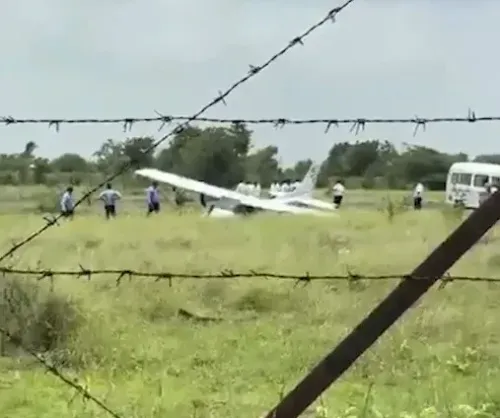
The Directorate General of Civil Aviation (DGCA) has launched an investigation into a runway excursion incident involving a Cessna C-172 training aircraft at the Baramati airfield in Maharashtra on Sunday, 9 August, according to a statement issued by the Civil Aviation Ministry. The aircraft sustained damage to its propeller, engine cowling, and nose landing gear, though no injuries or fatalities were reported.
What Happened on the Runway
The Cessna C-172, registered VT-SEX and belonging to Academy of Carver Aviation — a DGCA-approved Flying Training Organisation — taxied out at approximately 12:09 pm for a scheduled Circuit and Landing Emergencies (CL Emergencies) training exercise. The aircraft was under the command of Captain Chirag Shashikant Doifode, a flight instructor, with trainee Abhijeet Jundre on board.
During the exercise, the aircraft entered the runway through Link Bravo and lined up at the threshold of Runway 29, where a rejected take-off practice was carried out. A second rejected take-off exercise was subsequently performed from the threshold of Runway 11.
How the Excursion Unfolded
'During the course of the exercise, the aircraft was unable to stop within the paved runway surface and subsequently veered off the extended paved surface beyond the threshold of Runway 29 towards the right side, resulting in a runway excursion,' the ministry statement said. The plane overran the designated stopping zone during what is a standard emergency-response training drill.
A runway excursion, in aviation terms, refers to a safety incident in which an aircraft departs the paved runway surface — either by running off the side or overshooting the end — during take-off or landing operations.
Damage Assessment Under Way
'The aircraft has sustained prima facie damage to the propeller, engine cowling and nose landing gear. A detailed assessment of the damage will be carried out by the competent authorities,' the statement noted. No passengers were on board; the flight was purely a training operation.
DGCA Response and Next Steps
The DGCA Air Safety team has been dispatched to the Baramati airfield to conduct a preliminary investigation and determine the circumstances and contributing factors behind the incident. 'Further information will be shared as and when it is verified and becomes available,' the ministry said. The inquiry is expected to examine aircraft performance data, instructor decisions, and runway surface conditions at the time of the exercise.
This incident underscores the inherent risks in rejected take-off drills, which simulate high-stress abort scenarios and demand precise braking judgment. Regulatory scrutiny of Flying Training Organisations has intensified in recent years as India expands its pilot training capacity to meet growing aviation demand.
Point of View
But they demand the same regulatory rigour as commercial incidents — and the DGCA's swift dispatch of its Air Safety team is the right call. What the investigation must establish is whether the excursion reflects a procedural lapse, an aircraft maintenance issue, or an instructor-assessment failure. India's rapid expansion of Flying Training Organisations to meet pilot demand has outpaced oversight capacity in the past; this incident is a reminder that safety frameworks must scale alongside ambition. The absence of injuries is fortunate, but the damaged airframe at a training school is a cost that the system should not normalise.
NationPress
24 Sept 2026
Frequently Asked Questions
What happened at Baramati airfield on 9 August?
A Cessna C-172 training aircraft operated by Academy of Carver Aviation veered off Runway 29 at Baramati airfield in Maharashtra during a rejected take-off training exercise. The plane was unable to stop within the paved runway surface, resulting in a runway excursion that damaged the propeller, engine cowling, and nose landing gear. No injuries were reported.
What is a runway excursion?
A runway excursion is an aviation safety incident in which an aircraft departs the paved runway surface during take-off or landing — either by running off the side or overshooting the end. It is classified as a serious incident requiring mandatory regulatory investigation.
Who was on board the aircraft during the incident?
The aircraft carried two people: flight instructor Captain Chirag Shashikant Doifode, who was in command, and trainee Abhijeet Jundre. There were no passengers; the flight was a scheduled Circuit and Landing Emergencies training exercise.
What action has the DGCA taken following the incident?
The DGCA has launched a formal investigation and dispatched its Air Safety team to Baramati airfield to conduct a preliminary inquiry. The team will examine the circumstances and contributing factors behind the excursion, with further findings to be shared as they are verified.
Which organisation owned the aircraft involved?
The Cessna C-172 (registration VT-SEX) belongs to Academy of Carver Aviation, a DGCA-approved Flying Training Organisation. The aircraft was being used for a standard Circuit and Landing Emergencies training drill at the time of the incident.