CM Dhami Defends Operation Kalanemi Against Religious Fraud
Synopsis
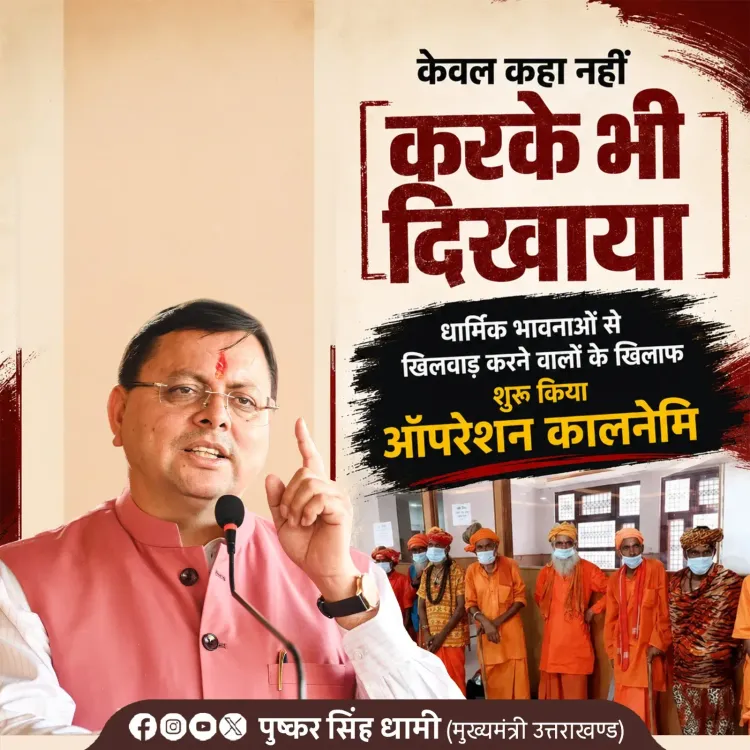
Uttarakhand Chief Minister Pushkar Singh Dhami defended Operation Kalanemi, his government's drive against those accused of defrauding devotees in the name of religion. In a post on X, he said no deceit with pilgrims' faith would be tolerated and that strict action was underway to protect the dignity and religious environment of Devbhoomi.
Key Takeaways
CM Pushkar Singh Dhami publicly defended Operation Kalanemi on X.
The drive targets individuals accused of religious fraud and impersonation of holy men.
Dhami invoked Uttarakhand's Devbhoomi identity and the protection of pilgrim faith.
The operation's name draws from the Ramayana demon Kalanemi, who disguised himself as a sage.
It extends a policy arc that includes the 2018 Uttarakhand Freedom of Religion Act.
Outcomes will be measured by arrests, charges and any follow-up legislation.
Uttarakhand Chief Minister Pushkar Singh Dhami on Wednesday defended his government's enforcement drive, Operation Kalanemi, declaring that no deception of devotees in the name of religion will be tolerated in the Himalayan state. In a post on X, the BJP leader said the operation was launched specifically against those who tamper with the faith, culture and religious traditions of Devbhoomi (the Land of the Gods).
'Our government has launched Operation Kalanemi to send a clear message that any kind of fraud or deceit with the faith of devotees will not be tolerated,' Dhami wrote in Hindi. He added that strict action against 'elements spreading fraud and hypocrisy in the name of religion' was being taken to safeguard the 'dignity and religious environment' of Uttarakhand.
Context
Uttarakhand is officially promoted as Devbhoomi, a designation tied to its status as the seat of the Char Dham pilgrimage circuit comprising Yamunotri, Gangotri, Kedarnath and Badrinath. The yatra season draws lakhs of pilgrims each summer, with adjoining towns such as Haridwar and Rishikesh functioning as year-round spiritual hubs.
The name of the operation itself carries scriptural weight. Kalanemi, in the Ramayana, is a demon who disguises himself as a sage to deceive Hanuman — a reference Dhami's administration has invoked to frame the drive as one targeting impostors masquerading as holy men.
Policy backdrop
The latest enforcement push builds on a broader regulatory arc in Uttarakhand around faith and public order. The state enacted the Uttarakhand Freedom of Religion Act in 2018 to penalise conversions secured through misrepresentation, force or allurement, and has since tightened provisions in line with similar laws in other BJP-ruled states.
Dhami's government has also moved on parallel fronts including anti-cheating legislation for public examinations and a Uniform Civil Code framework. Operation Kalanemi extends this enforcement-heavy template into the religious-tourism economy, where complaints of fake godmen, fraudulent astrologers and exploitative ritual practitioners have surfaced periodically around pilgrimage routes.
Stakeholders and impact
The primary constituency cited by the Chief Minister is the pilgrim — domestic devotees who travel to Uttarakhand's shrines, often after long savings and elaborate planning. Local traders, registered priests and tour operators stand to benefit if confidence in the pilgrimage ecosystem strengthens, while individuals operating outside formal religious institutions face heightened scrutiny.
Civil-liberties observers tend to watch such drives closely for due-process safeguards, particularly where identity, attire or itinerant lifestyles intersect with policing. The state administration has framed the operation as a consumer-protection measure for the faithful rather than a curb on religious expression.
What's next
Attention now turns to the operational metrics — the number of persons booked, the nature of charges, and whether arrests translate into convictions under existing provisions of the Bharatiya Nyaya Sanhita dealing with cheating and impersonation. Any move to codify the drive through fresh legislation in the Uttarakhand Vidhan Sabha would mark a significant escalation.
For Dhami, the campaign dovetails with his pitch of Uttarakhand as a disciplined, devotee-friendly destination ahead of the next Char Dham Yatra cycle. How the operation balances enforcement with the state's open-door spiritual ethos will shape its political and pilgrimage footprint in the months ahead.
Point of View
The messaging pre-empts criticism by locating the action within scriptural tradition rather than political contest. The real test, however, lies in execution — whether the operation produces verifiable cases of fraud or drifts into broader profiling of itinerant ascetics. Either outcome will shape how Uttarakhand's pilgrimage-led economy is regulated in coming yatra seasons.
NationPress
18 Oct 2026
Frequently Asked Questions
What is Operation Kalanemi in Uttarakhand?
Operation Kalanemi is a state-led enforcement drive in Uttarakhand targeting individuals accused of defrauding devotees in the name of religion, including fake sadhus and impostors posing as spiritual figures. CM Pushkar Singh Dhami says it aims to protect pilgrim faith and the dignity of Devbhoomi.
Why is it called Operation Kalanemi?
The name refers to Kalanemi, a demon in the Ramayana who disguised himself as a sage to deceive Hanuman. The Uttarakhand government uses the reference to symbolise action against impostors masquerading as holy men.
Who launched Operation Kalanemi?
The operation was launched by the Uttarakhand state government under Chief Minister Pushkar Singh Dhami of the BJP, as part of broader measures to regulate religious tourism and protect pilgrims.
What did CM Dhami say about religious fraud?
Dhami said his government will not tolerate any deceit with the faith of devotees and will take strict action against those spreading fraud and hypocrisy in the name of religion to safeguard Uttarakhand's religious environment.
How does this affect Char Dham pilgrims?
The drive is intended to make the pilgrimage ecosystem safer for devotees visiting shrines such as Kedarnath, Badrinath, Gangotri and Yamunotri by acting against fraudulent religious practitioners operating along yatra routes.