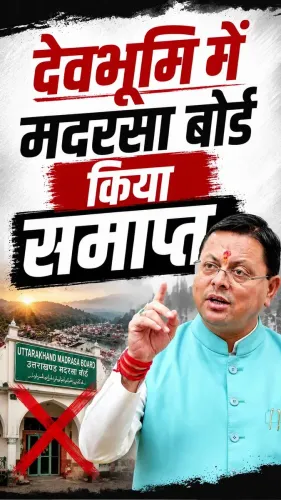
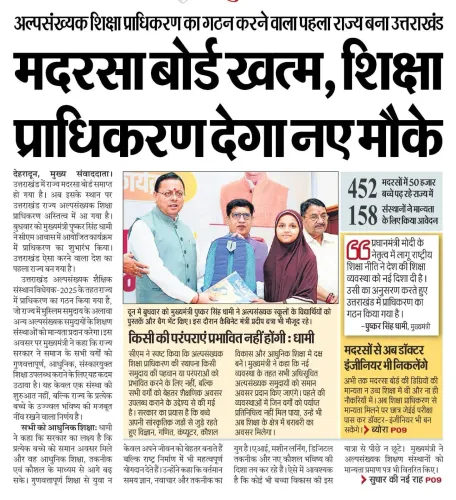
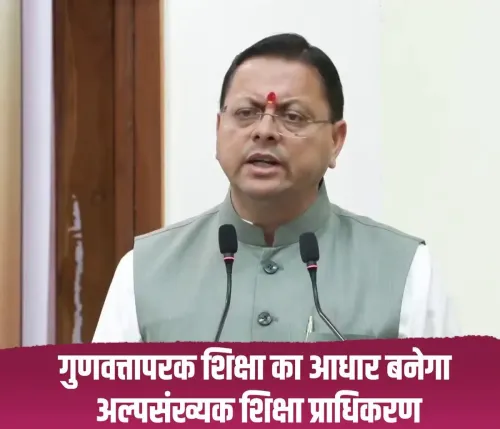
CM Dhami: Only State-Curriculum Madrasas to Run in Uttarakhand from July 2026
Synopsis
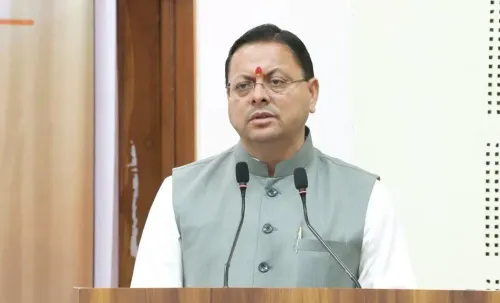
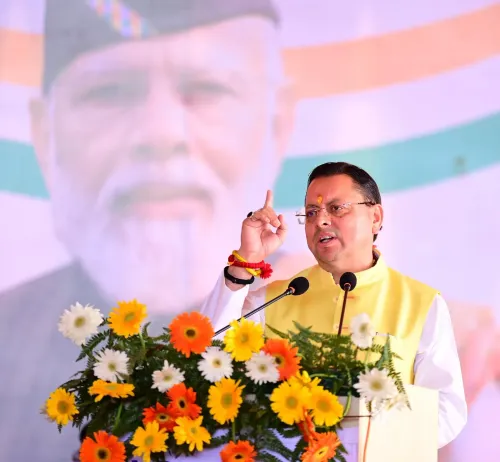
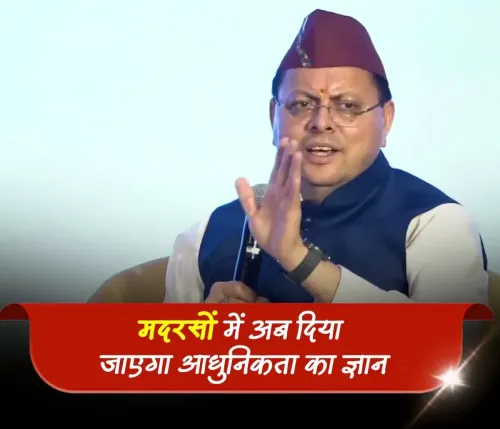
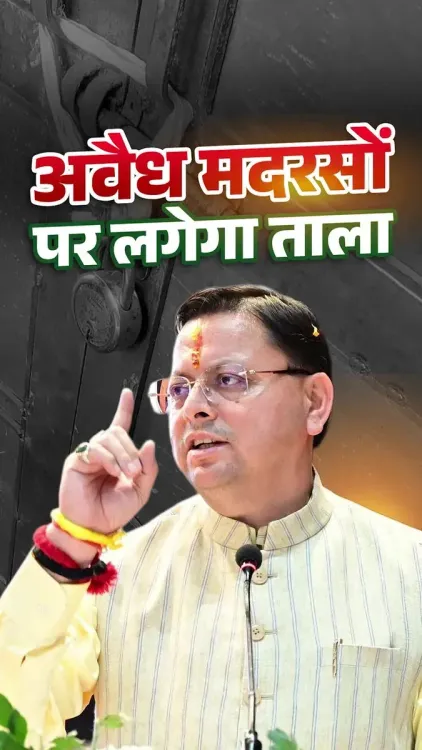
Uttarakhand CM Pushkar Singh Dhami has announced that from 1 July 2026, only madrasas complying with the state government's prescribed curriculum will be permitted to operate, framing the move as a stand against extremism and in favour of modern, nationalist education.
Key Takeaways
CM Pushkar Singh Dhami announced on 10 June 2026 that madrasas in Uttarakhand must follow the state government's curriculum to continue operating.
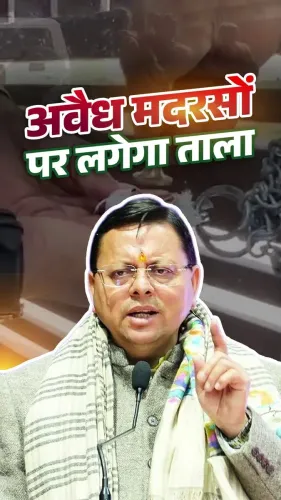
The deadline for compliance is 1 July 2026 ; non-compliant madrasas will not be permitted to run.
Dhami framed the move as a stand against 'tribal and extremist mindset,' calling for 'nationalism and modern education' on Uttarakhand's soil.
The policy follows Uttarakhand's Uniform Civil Code notification in January 2025 , extending state oversight over religiously governed institutions.
Similar curriculum-compliance mandates have been implemented in Uttar Pradesh and Assam under BJP governments since 2017 .
A formal gazette notification detailing the prescribed curriculum and enforcement mechanism is awaited; legal challenges remain a possibility.
Uttarakhand Chief Minister Pushkar Singh Dhami announced on Wednesday, 10 June 2026 that from 1 July 2026, only madrasas following the state government's prescribed curriculum will be permitted to operate in Uttarakhand, signalling a sweeping regulatory overhaul of minority religious education in the state.
Context
Posting in Hindi on X, CM Dhami declared: 'देवभूमि उत्तराखंड में कबीलाई और कट्टरपंथी मानसिकता को किसी भी कीमत पर पनपने नहीं दिया जाएगा' ['A tribal and extremist mindset will not be allowed to flourish in Devbhoomi Uttarakhand at any cost']. He added that the land of Uttarakhand would run on 'nationalism and modern education, not fanaticism in the name of education.' The post was tagged to Prime Minister Narendra Modi, Home Minister Amit Shah, and the BJP's official handle, signalling the announcement was framed as part of the party's broader governance agenda.
Policy Backdrop
Uttarakhand has been among the most active BJP-governed states in extending state oversight over institutions previously regulated by religious norms. The state notified its Uniform Civil Code in January 2025, a first among Indian states, extending regulatory reach into personal and educational practices. The National Education Policy 2020, the central framework mandating standardised curricula and modern vocational subjects across all schools, has served as the policy foundation for similar madrasa-modernisation drives in Uttar Pradesh and Assam since 2017, requiring NCERT-aligned syllabi and bilingual instruction.
Dhami's announcement follows this established pattern: madrasas that do not affiliate with the state curriculum framework by the deadline will effectively be barred from operating. The move places Uttarakhand alongside states that have used curriculum-compliance mandates as the primary instrument of madrasa reform rather than direct closure orders.
Stakeholders and Impact
Madrasa managements, Muslim students, and parents across Uttarakhand are the most directly affected. Institutions that currently teach a purely religious syllabus will need to integrate state-mandated subjects — including modern sciences, mathematics, and civic education — or cease operations by 1 July 2026. The timeline gives institutions roughly three weeks from the date of the announcement to prepare, though the precise curriculum specifications and transitional support, if any, have not yet been made public.
Broader civil-society and legal stakeholders are also watching closely. Madrasa boards in other states have previously challenged similar mandates in the courts, and legal petitions before the 2026 deadline remain a possibility. Student enrolment and continuity of education for children currently in non-compliant institutions is a concern flagged by education-rights advocates.
What's Next
The immediate next step is a formal gazette notification from the Uttarakhand government detailing the prescribed curriculum, the compliance process for existing madrasas, and any funding or support for institutions that choose to align. The 1 July 2026 deadline is the hard legislative marker, but enforcement mechanisms and inspection frameworks have not yet been publicly outlined. Legal challenges from madrasa boards or civil-liberties groups could test the policy in court before it takes effect. How the state balances the constitutional right to establish and administer minority educational institutions against its curriculum-uniformity mandate will define the policy's durability and its influence on similar moves in other BJP-governed states.
Point of View
And it arrives less than 18 months after Uttarakhand became the first state to notify a Uniform Civil Code. Together, these moves construct a coherent governance identity for the BJP in the state: regulatory uniformity across religious and educational domains. The tagging of the Prime Minister and Home Minister in the post is a deliberate signal that this is not a state-level improvisation but is positioned within the party's national integration narrative. The compressed timeline — roughly three weeks from announcement to deadline — raises practical questions about implementation and will likely face legal scrutiny, but the political messaging is unmistakably aimed at a national audience ahead of future electoral cycles.
NationPress
26 Oct 2026
Frequently Asked Questions
What did CM Dhami announce about madrasas in Uttarakhand?
CM Pushkar Singh Dhami announced on 10 June 2026 that from 1 July 2026, only madrasas that follow the Uttarakhand state government's prescribed curriculum will be allowed to operate in the state.
From when will the new madrasa rules apply in Uttarakhand?
The new rules will apply from 1 July 2026, giving existing madrasas a short window to comply with the state-mandated curriculum or cease operations.
What curriculum will Uttarakhand madrasas need to follow?
Madrasas will need to follow a curriculum prescribed by the Uttarakhand state government. The detailed specifications are expected in a formal gazette notification; the announcement aligns with the broader NEP 2020 framework of NCERT-aligned, modern-subjects syllabi.
Has any other state done something similar to Uttarakhand's madrasa reform?
Yes. Uttar Pradesh and Assam have implemented similar madrasa-modernisation drives since 2017, requiring NCERT-aligned syllabi and bilingual instruction in institutions that wish to continue operating.
Can madrasas challenge the Uttarakhand government's curriculum mandate in court?
Legal challenges are possible. Madrasa boards in other states have previously petitioned courts against similar curriculum-compliance mandates, and constitutional provisions protecting minority educational institutions could form the basis of legal petitions before the July 2026 deadline.