CM Dhami Vows Inclusive Growth for Uttarakhand's Villages and Border Areas
Synopsis
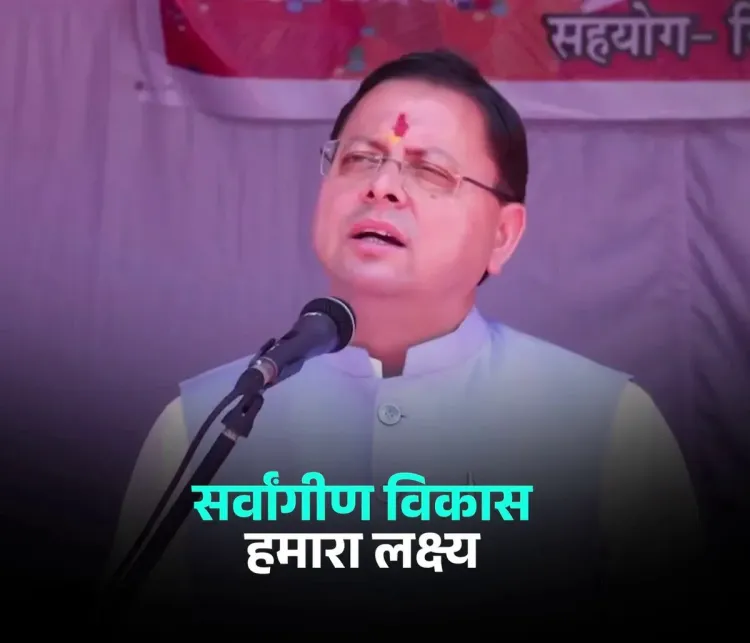
Uttarakhand Chief Minister Pushkar Singh Dhami on 15 June 2026 pledged integrated and all-encompassing development across the state, from urban centres to remote border villages, reinforcing a long-standing mandate to bridge the plains-hill divide.
Key Takeaways
CM Pushkar Singh Dhami on 15 June 2026 reaffirmed his government's goal of delivering balanced development statewide.
The commitment explicitly covers cities, villages, plains and border areas — the full geographic spectrum of Uttarakhand .
Uttarakhand was formed in 2000 with a mandate to address development gaps between plains districts and neglected hill regions.
The Char Dham Highway project (launched 2016 ) remains a key infrastructure instrument linking plains to high-altitude and border zones.
Development in border villages carries strategic significance beyond welfare, helping counter out-migration and reinforcing civilian presence near the China and Nepal frontiers.
State budget allocations for rural and border infrastructure in the next fiscal cycle will be the practical measure of this commitment.
Uttarakhand Chief Minister Pushkar Singh Dhami on Monday, 15 June 2026, reaffirmed his government's commitment to delivering balanced development across the state — from urban centres to remote villages and from the plains to the frontier border regions.
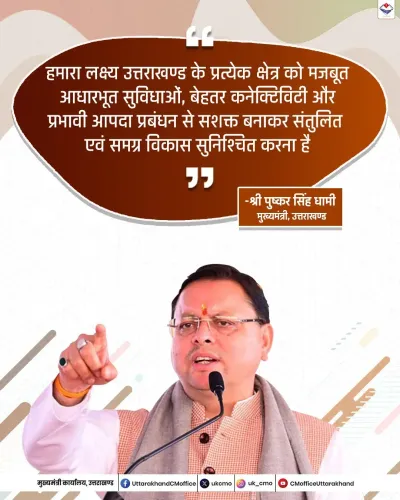
In a post on X, CM Dhami wrote in Hindi: 'हमारा प्रयास प्रदेश के शहरों से लेकर गांवों तक तथा मैदानों से लेकर सीमांत क्षेत्रों तक विकास की रोशनी पहुंचाते हुए समेकित, संतुलित और सर्वस्पर्शी विकास सुनिश्चित करना है।' — translated: 'Our endeavour is to ensure integrated, balanced and all-encompassing development by taking the light of progress from the cities to the villages and from the plains to the border areas.'
Context
Uttarakhand, carved out of Uttar Pradesh in 2000, was created with an explicit mandate to address the chronic neglect of its hill districts and border communities. The state spans sharply contrasting geographies — the relatively accessible Haridwar and Udham Singh Nagar plains on one end, and high-altitude districts bordering China and Nepal on the other. Bridging this divide has remained the central challenge for every government since statehood.
CM Dhami, who assumed office in 2021 and retained power after the 2022 assembly elections, has repeatedly framed inclusive regional development as a cornerstone of his administration's agenda. Monday's statement reinforces that positioning ahead of the next state budget cycle.
Policy Backdrop
The phrase 'सर्वस्पर्शी विकास' — 'all-encompassing development' — echoes a broader policy vocabulary used by the BJP at both the state and national level to describe schemes targeting the last mile. At the infrastructure level, the Char Dham Highway project, launched in 2016, remains the most visible instrument for connecting the plains to high-altitude pilgrimage sites and strategic border zones in Uttarakhand.
India's Himalayan border states have also received focused attention under central connectivity and village-electrification programmes, driven partly by the dual imperative of economic inclusion and strategic access to frontier areas. Development in border villages is increasingly viewed not merely as a welfare measure but as a tool to check out-migration and reinforce civilian presence along sensitive frontiers.
Stakeholders and Impact
The communities most directly referenced in CM Dhami's statement are the rural and semi-urban populations of Uttarakhand's hill districts — including the Pithoragarh, Chamoli, Uttarkashi, and Champawat border belts — where access to roads, healthcare, and economic opportunity has historically lagged behind the plains. Seasonal migration from these areas remains a persistent demographic pressure on the state.
Urban residents and plains-based communities stand to benefit from parallel infrastructure and services investment, while the emphasis on 'integrated' development signals an intent to avoid siloed, region-specific spending in favour of a networked approach across the state's diverse terrain.
What's Next
The statement is likely to be read as a signal of the state government's priorities heading into the next fiscal planning cycle. Analysts and local representatives in hill constituencies will watch closely for concrete budget allocations for rural connectivity, border-area infrastructure, and social services in the months ahead. Whether the rhetorical commitment translates into measurable spending increases for Uttarakhand's most remote districts will be the key test of the administration's inclusive development agenda.
Point of View
Balanced and all-encompassing' growth in a single post, he is simultaneously speaking to rural constituents in hill seats and signalling strategic intent on border-area development, a theme that resonates with the central government's broader Himalayan frontier policy. The timing, ahead of a new budget cycle, suggests the statement may be laying political groundwork for forthcoming spending announcements. Whether it marks a rhetorical baseline or a genuine policy inflection will depend on the specifics that follow.
NationPress
14 Sept 2026
Frequently Asked Questions
What did Uttarakhand CM Pushkar Singh Dhami say about development on 15 June 2026?
CM Dhami pledged to ensure integrated, balanced and all-encompassing development across Uttarakhand, reaching from cities to villages and from the plains to border areas, in a post on X on 15 June 2026.
Why is development in Uttarakhand's border areas significant?
Uttarakhand shares international borders with China and Nepal, and developing remote frontier villages is seen as both an economic necessity and a strategic priority to reduce out-migration and strengthen civilian presence near the borders.
What is the Char Dham Highway project and how does it relate to Uttarakhand development?
The Char Dham Highway project, launched in 2016, upgrades road connectivity from the plains to high-altitude pilgrimage sites and border zones in Uttarakhand, and is one of the most significant infrastructure efforts to bridge the state's geographic divide.
What is the history behind Uttarakhand's focus on balanced regional development?
Uttarakhand was carved out of Uttar Pradesh in 2000 partly because its hill districts had long been neglected. The state's formation came with an explicit mandate to deliver equitable development between the plains and the hills.
What should we watch for after CM Dhami's inclusive development statement?
The key indicator will be state budget allocations for rural connectivity, border-area infrastructure and social services in the next fiscal cycle, which will reveal whether the commitment translates into concrete spending.