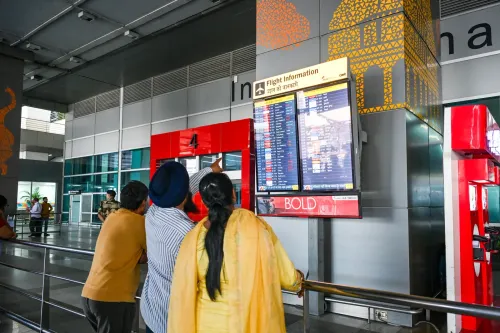
Giriraj Singh Hails Digi Yatra Crossing 10 Crore Journeys

Synopsis
Union Textiles Minister Giriraj Singh has highlighted Digi Yatra crossing 10 crore journeys, calling it a landmark in India's aviation revolution under PM Modi. The biometric paperless boarding system, piloted in 2022, is part of the broader Digital India push to make air travel faster and more accessible.
Key Takeaways
Digi Yatra has crossed 10 crore journeys , according to a post shared by Union Textiles Minister Giriraj Singh on June 1, 2026 .
The system uses facial recognition to allow paperless airport entry and boarding without physical document checks.
Digi Yatra was piloted at Delhi and Hyderabad airports in 2022 and has since expanded to multiple major airports.
The DigiYatra Foundation was set up in 2019 under the Ministry of Civil Aviation to govern the biometric travel framework.
The milestone is being cited as evidence of the Digital India programme's integration of biometric technology into public services.
Data-privacy frameworks for biometric systems and full rollout to all operational airports remain key policy areas to watch.
Union Textiles Minister Giriraj Singh on Monday, June 1, 2026, shared a post on X celebrating the Digi Yatra biometric travel system crossing the landmark of 10 crore journeys, crediting the milestone to what he described as an aviation revolution under Prime Minister Narendra Modi.
Context
In his post, Singh wrote in Hindi: 'DigiYatra ne 10 crore yatraon ka aankda paar kiya' — translating to 'Digi Yatra has crossed the figure of 10 crore journeys' — and described the development as evidence of how air travel has become faster and easier under PM Modi's leadership. The post was shared via the NaMo App, the BJP-linked platform used by party leaders to amplify government messaging. Singh included a link to a detailed report on the milestone.
Digi Yatra is a facial-recognition-based system that allows air passengers to enter airports and board flights without physical documents, using a one-time biometric registration. The initiative was piloted at Delhi and Hyderabad airports in 2022 before being progressively extended across the country.
Policy Backdrop
The DigiYatra Foundation was established in 2019 under the Ministry of Civil Aviation to develop and govern the biometric travel framework. The system sits within the broader Digital India programme, which has sought to integrate technology across public services — from payments to identity verification — since 2014.
The aviation sector has seen parallel expansion under the same period, including airport modernisation drives and regional connectivity initiatives aimed at bringing air travel within reach of smaller cities and first-time flyers. The 10-crore-journey figure, if confirmed, would represent a significant adoption curve for a system that is entirely opt-in and requires passengers to voluntarily enrol their biometric data.
Stakeholders and Impact
For everyday air travellers, Digi Yatra's proposition is a reduction in queue times and the elimination of repeated document checks at multiple checkpoints within an airport. Airport operators benefit from smoother passenger flow, particularly at high-traffic hubs such as Delhi, Mumbai, Bengaluru, and Hyderabad.
Civil liberties and data-privacy advocates have previously raised questions about the storage and use of biometric data collected through the system. The government has maintained that biometric data is stored on passengers' own devices and is not retained centrally beyond the journey, though independent audits of this architecture remain a point of ongoing public interest.
What's Next
The immediate policy watch is the rollout of Digi Yatra to all operational airports across India, a target the Civil Aviation Ministry has flagged in earlier communications. A formal data-privacy framework governing biometric systems used in public infrastructure is also anticipated as the scale of adoption grows. The 10-crore milestone, now cited by a senior Union Cabinet minister, is likely to accelerate political pressure to expand the system further and to announce the next numerical target.
Point of View
Framed as an aviation revolution, plugs directly into the Modi government's long-running Digital India story — one that connects infrastructure, technology, and aspirational mobility in a single message. The choice of the NaMo App as the sharing platform reinforces the party-government communications loop, ensuring the milestone lands as both a policy achievement and a political signal. The unresolved data-privacy question around biometric storage, however, means the milestone will continue to attract scrutiny from civil society alongside the applause from the government bench.
NationPress
21 Oct 2026
Frequently Asked Questions
What is Digi Yatra and how does it work?
Digi Yatra is a biometric facial recognition system that allows air passengers in India to enter airports and board flights without showing physical documents. Travellers register once with their Aadhaar-linked details and biometric data, which is then used for automated verification at airport checkpoints.
Has Digi Yatra really crossed 10 crore journeys?
Union Textiles Minister Giriraj Singh shared a post on June 1, 2026 citing the 10-crore-journey figure. NationPress notes this figure has not been independently verified from official Civil Aviation Ministry data at the time of publication.
When was Digi Yatra launched in India?
Digi Yatra was formally piloted at Delhi and Hyderabad airports in 2022 . The DigiYatra Foundation that underpins the initiative was established in 2019 under the Ministry of Civil Aviation.
Is Digi Yatra safe? What happens to my biometric data?
The government has stated that biometric data enrolled in Digi Yatra is stored on the passenger's own device and is not retained centrally after the journey. Independent verification of this data architecture remains a matter of ongoing public and civil-society interest.
Which airports support Digi Yatra in India?
Digi Yatra began at Delhi and Hyderabad airports and has since expanded to several major airports including those in Mumbai, Bengaluru, and other cities. A full rollout to all operational airports across India is a stated policy target of the Civil Aviation Ministry.