CM Samrat Choudhary Hails DigiYatra Crossing 10 Crore Trips

Synopsis
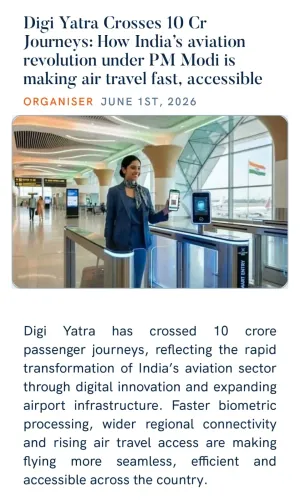
Bihar Chief Minister Samrat Choudhary on June 2, 2026 hailed DigiYatra for crossing 10 crore journeys, calling it a landmark in PM Modi's Digital India vision. The facial recognition boarding system, launched in 2022, has expanded to major Indian airports and forms a key pillar of India's digital public infrastructure stack.
Key Takeaways
Bihar CM Samrat Choudhary posted on June 2, 2026 praising DigiYatra for crossing 10 crore journeys .
DigiYatra is a facial recognition-based, paperless boarding system approved by the Ministry of Civil Aviation in 2018 .
The first pilot was launched at Kempegowda International Airport, Bengaluru in December 2022 , later expanding to Delhi , Mumbai , and Hyderabad .
The system is voluntary and uses biometric verification linked to Aadhaar , with facial data processed locally at airport gates.
DigiYatra is part of India's broader digital public infrastructure alongside Aadhaar and UPI , under the Digital India programme launched in 2015 .
Potential future expansion includes linkage with international e-gates and immigration systems.
Bihar Chief Minister Samrat Choudhary on Tuesday, June 2, 2026, lauded the DigiYatra facial recognition boarding system for surpassing 10 crore journeys, calling it a landmark achievement in India's digital transformation under Prime Minister Narendra Modi. Posting on X, the senior BJP leader credited the milestone to the Prime Minister's 'visionary leadership' in building a Digital India.
Context
In his post, Choudhary wrote that under PM Modi's leadership, the country is 'continuously setting new records in the direction of building Digital India.' He described the crossing of 10 crore-plus journeys via DigiYatra as a 'historic figure' and a 'great achievement of a technology-driven, secure and seamless travel system.' He added that the milestone is a 'powerful example of India's digital transformation and the expansion of citizen conveniences.'
The post, written in Hindi, reflects a pattern among BJP leaders of amplifying central government digital programme milestones on social media. The Bihar Chief Minister has previously highlighted Digital India achievements as part of broader political communication on governance delivery.
Policy Backdrop
DigiYatra is a facial recognition-based, paperless boarding system developed by the Ministry of Civil Aviation, enabling passengers to check in and board flights using biometric verification linked to their Aadhaar identity and boarding passes — eliminating the need for physical documents at airport checkpoints. The policy framework was approved in 2018, with the first pilot launched at Kempegowda International Airport, Bengaluru, in December 2022.
The rollout subsequently expanded to major airports including Delhi, Mumbai, and Hyderabad through 2023. DigiYatra sits within India's broader digital public infrastructure stack — alongside Aadhaar and UPI — which successive policy cycles have layered across sectors to reduce friction in citizen-facing services. The programme emphasises voluntary participation and data minimisation, with facial data processed locally at airport entry gates rather than stored centrally.
The parent initiative, Digital India, was launched in July 2015 with the stated goal of creating a digitally empowered society and knowledge economy, spanning e-governance, digital infrastructure, and citizen services across sectors.
Stakeholders and Impact
Air passengers are the primary beneficiaries, gaining a faster, document-free boarding experience at participating airports. Airport operators benefit from reduced congestion at check-in and boarding gates, as biometric verification can process travellers more efficiently than manual document checks.
The 10 crore journey figure, as cited in the post, signals substantial adoption among India's air-travelling population, though participation remains opt-in. Privacy advocates have previously flagged questions around biometric data governance, and the programme's voluntary design is positioned as a response to those concerns.
What's Next
The Ministry of Civil Aviation has signalled intent to expand DigiYatra to additional domestic airports beyond the current network. Analysts tracking India's digital infrastructure point to a potential future linkage between the DigiYatra biometric framework and international e-gate or immigration systems, which could extend contactless travel beyond domestic terminals. The pace of that expansion and any regulatory framework around cross-border biometric interoperability will be closely watched by both the aviation industry and civil liberties groups.
Point of View
If the 10 crore figure holds, would represent a meaningful inflection point for biometric adoption in Indian civil aviation, validating the Ministry of Civil Aviation's phased rollout model. More broadly, the post reinforces the ruling party's 'New India' narrative, which frames digital infrastructure as a proxy for modernisation and administrative efficiency. The political salience of such milestones is likely to grow as India's 2026-27 budget cycle debates further digital public infrastructure investment.
NationPress
15 Oct 2026
Frequently Asked Questions
What is DigiYatra and how does it work?
DigiYatra is a facial recognition-based paperless boarding system developed by India's Ministry of Civil Aviation. Passengers register once using their Aadhaar-linked biometrics, and at participating airports they can check in and board flights without showing physical documents — the system verifies identity at entry gates using facial recognition.
How many journeys has DigiYatra completed?
According to Bihar Chief Minister Samrat Choudhary's post on June 2, 2026, DigiYatra has surpassed 10 crore (100 million) journeys, which he described as a historic milestone for India's digital travel infrastructure.
Which airports support DigiYatra in India?
DigiYatra was first piloted at Kempegowda International Airport in Bengaluru in December 2022, and subsequently expanded to major airports including Delhi, Mumbai, and Hyderabad. The Ministry of Civil Aviation has indicated plans for further expansion to additional domestic airports.
Is DigiYatra mandatory for air travel in India?
No, DigiYatra is entirely voluntary. Passengers choose whether to enrol and use the biometric boarding system. Those who do not enrol can continue to use conventional document-based check-in and boarding processes.
What is the connection between DigiYatra and Digital India?
DigiYatra is part of the broader Digital India programme launched in July 2015, which aims to expand digital infrastructure and e-governance across sectors. It applies the same digital public infrastructure logic — combining Aadhaar biometrics with sector-specific services — that underpins UPI in payments and other citizen-facing digital systems.