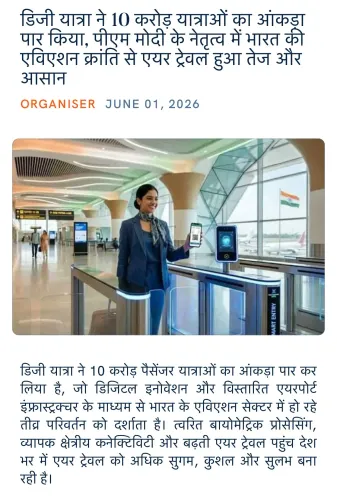
CM Himanta Highlights Digi Yatra Crossing 10 Cr Journeys
Synopsis
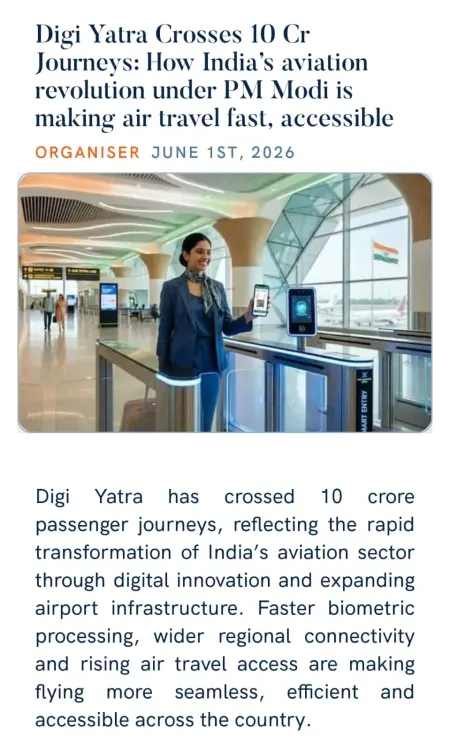
Assam Chief Minister Himanta Biswa Sarma flagged Digi Yatra crossing 10 crore journeys on June 2, 2026, framing India's biometric airport boarding system as a centrepiece of PM Modi's aviation revolution that is making air travel faster and more accessible.
Key Takeaways
Digi Yatra has crossed 10 crore journeys , according to a report shared by Assam CM Himanta Biswa Sarma on June 2, 2026 .
The system uses facial recognition to enable paperless, contactless boarding at Indian airports.
Digi Yatra was piloted in 2018 and officially launched in December 2022 at five major airports.
The initiative is part of a broader digital infrastructure push under the Ministry of Civil Aviation that complements the UDAN regional connectivity scheme launched in 2016 .
Expansion to remaining Category A and B airports and possible integration with immigration systems are the next steps being watched.
Assam Chief Minister Himanta Biswa Sarma on Tuesday, June 2, 2026, shared a report highlighting that Digi Yatra, India's biometric facial-recognition boarding system, has crossed 10 crore journeys, calling it part of an aviation revolution driven by Prime Minister Narendra Modi.
Context
Digi Yatra is a paperless, facial-recognition-based boarding system developed by the Ministry of Civil Aviation to eliminate physical document checks at airports. The system allows registered passengers to move through security and boarding gates using only their face as identity proof, reducing queues and wait times significantly.
The programme was piloted at Kempegowda International Airport, Bengaluru in 2018 and formally launched at scale in December 2022 across airports in Delhi, Bengaluru, Hyderabad, Kolkata and Pune. It has since expanded to additional airports across the country.
Policy Backdrop
Digi Yatra sits within a broader digital infrastructure push that successive central government programmes have advanced since 2014. The initiative draws on the same Aadhaar-anchored digital public goods architecture that underpins payments, welfare delivery and identity verification across sectors.
On the physical side, the UDAN regional connectivity scheme, launched in 2016, expanded domestic airport traffic by bringing smaller cities into the aviation network. Digi Yatra represents the technology layer laid on top of this physical expansion, designed to handle rising passenger volumes without proportional increases in ground staff or infrastructure costs.
The Ministry of Civil Aviation has positioned digital facilitation alongside airport construction as twin pillars of its modernisation agenda, mirroring comparable digitalisation drives in Indian Railways and national highways under the same administration.
Stakeholders and Impact
The primary beneficiaries are air passengers, who gain faster, contactless movement through airports. Airport operators benefit from reduced congestion at check-in and boarding counters, while airlines gain operational efficiency through smoother boarding flows.
CM Sarma, as convenor of the North-East Democratic Alliance (NEDA) and a prominent BJP leader, regularly amplifies central government schemes on social media. His post frames the 10-crore milestone as evidence of accessible and fast air travel becoming a reality for ordinary Indians under the current administration.
For Assam and the broader North-East, where connectivity has historically lagged, the intersection of UDAN routes and Digi Yatra-enabled airports carries particular significance, as more regional airports come under the digital boarding framework.
What's Next
The Ministry of Civil Aviation is expected to extend Digi Yatra to remaining Category A and B airports as the next phase of rollout. Analysts tracking civil aviation policy are also watching for possible integration of the biometric system with immigration databases, which could streamline international departure processes.
As cumulative journey numbers grow, the government is likely to use the milestone data to build the case for deeper digital integration across transport modes, positioning Digi Yatra as a replicable model for technology-led public service delivery.
Point of View
If verified, would mark a significant inflection point for Digi Yatra, shifting it from a niche early-adopter product to a mass-use public service. Framing the milestone as an 'aviation revolution' connects the scheme to the broader Modi-era narrative of technology as the great equaliser in public infrastructure. For the North-East specifically, where Sarma has political capital to protect, linking aviation accessibility to central policy serves a dual purpose: national loyalty signalling and regional development optics.
NationPress
16 Oct 2026
Frequently Asked Questions
What is Digi Yatra and how does it work?
Digi Yatra is a facial-recognition-based boarding system at Indian airports that allows passengers to check in and board without showing physical documents. Passengers register once using their Aadhaar or passport details, and their face acts as their boarding pass at enrolled airports.
How many journeys has Digi Yatra completed?
According to a report shared by Assam Chief Minister Himanta Biswa Sarma on June 2, 2026, Digi Yatra has crossed 10 crore journeys, marking a major milestone for the programme.
At which airports is Digi Yatra available?
Digi Yatra was launched in December 2022 at airports in Delhi, Bengaluru, Hyderabad, Kolkata and Pune, and has since expanded to additional airports. The Ministry of Civil Aviation is working to extend it to remaining Category A and B airports.
When was Digi Yatra launched in India?
Digi Yatra was piloted at Kempegowda International Airport, Bengaluru in 2018. Its full operational launch took place in December 2022 across five major Indian airports.
Why did Assam CM Himanta Biswa Sarma post about Digi Yatra?
CM Sarma shared the Digi Yatra milestone as part of his regular social media practice of highlighting central government schemes, framing the achievement as evidence of PM Modi's aviation and digital governance agenda delivering results for ordinary travellers.